14.461 is an advanced course in macroeconomics that seeks to bring students …
14.461 is an advanced course in macroeconomics that seeks to bring students to the research frontier. The course is divided into two sections. The first half is taught by Prof. Iván Werning and covers topics such as how to formulate and solve optimal problems. Students will study fiscal and monetary policy, among other issues. The second half, taught by Prof. George-Marios Angeletos, covers recent work on multiple equilibria, global games, and informational fictions.
15.012 Applied Macro- and International Economics uses case studies to investigate the …
15.012 Applied Macro- and International Economics uses case studies to investigate the macroeconomic environment in which firms operate. The first half of the course develops the basic tools of macroeconomic management: monetary, fiscal, and exchange rate policy. The class discusses recent emerging market and financial crises by examining their causes and considering how best to address them and prevent them from recurring in the future. The second half evaluates different strategies of economic development. Topics covered in the second half of this course include growth, the role of debt and foreign aid, and the reliance on natural resources.
This course seeks to establish understanding of the development processes of societies …
This course seeks to establish understanding of the development processes of societies and economies by studying several dimensions of sustainability (environmental, social, political, institutional, economy, organizational, relational, and personal) and the balance among them. It explores the basics of governmental intervention, focusing on areas such as the judicial system, environment, social security, and health, and builds skills to determine what type of policy is most appropriate. We also consider implications of new technologies on the financial sector: Internationalization of currencies, mobile payment systems, and cryptocurrencies, and discuss the institutional framework to ensure choices are sustainable across all dimensions and applications.
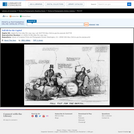
The cartoon pertains to some instance of corruption in the Van Buren …
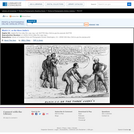
The cartoon pertains to some instance of corruption in the Van Buren administration. Van Buren shovels coins from a great pile into a bag held by a man (probably a federal judge), who urges him, "Matty fill up the shovel, you are not the first man, I have helped out of a dirty scrape what is a little bribery and corruption to us limbs of the law, I have been the means of clearing hundreds." At left wait two other men, called "Black" and "Cooper," holding bags. Black to Cooper: "I mean to take my mint drops to Hansells the broker and get depreciated paper for it. that will do to pay my landlady her bill and all my other expenses too." Cooper: "Black dont you think the judge will preach a good sermon for this. when he gets in Georgia. I say Matty dont you mean to count it. I wish I had brought a larger bag." Van Buren: "No Mr. Cooper I'm above numbers a shovel full or two more or less is of no consequence I will charge it all to the account of the Florida War [i.e., the expensive conflict with the Seminole Indians which dragged on throughout Van Buren's presidency]." "Black.C.C." is probably the work of Napoleon Sarony, given its affinity in draftsmanship and lithographic technique to his "The New Era or Effects of a Standing Army" (no. 1840-3).|Printed & published by H.R. Robinson, 52 Cortlandt St. N.Y. & Pennsa. Avenue Washington D.C.|Probably drawn by Napoleon Sarony.|Title appears as it is written on the item.|Weitenkampf, p. 62.|Forms part of: American cartoon print filing series (Library of Congress)|Published in: American political prints, 1766-1876 / Bernard F. Reilly. Boston : G.K. Hall, 1991, entry 1840-4.
Many people love a roller coaster’s thrilling ups and downs. When it …
Many people love a roller coaster’s thrilling ups and downs. When it comes to the economy, however, most people would prefer to avoid a wild ride. In fact, most like a smooth ride with very few dips. This episode of The Economic Lowdown podcast series describes how the economy moves through phases of the business cycle, and the role the Federal Reserve System plays in smoothing some of the ride's bumps.
Since the Crash of 2008, the Federal Reserve has been "printing money" …
Since the Crash of 2008, the Federal Reserve has been "printing money" to stimulate the economy. But won't that just lead to inflation? Speeding tickets are always caused by flooring the gas pedal, but flooring the gas doesn't always result in a speeding ticket - like when you're driving up a steep hill. Likewise, inflation is always caused by printing money - but monetary expansion does not always lead to inflation.
This video provides a basic overview of unemployment and how it is …
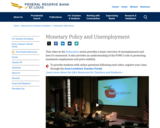
This video provides a basic overview of unemployment and how it is measured. It also provides an understanding of the FOMC's role in promoting maximum employment and price stability.
The fourth episode of Feducation dissects an FOMC (Federal Open Market Commission) …
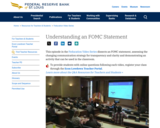
The fourth episode of Feducation dissects an FOMC (Federal Open Market Commission) statement, assessing the changing communication strategy for transparency and clarity and demonstrating an activity that can be used in the classroom.
How are the money supply and inflation related? And what does the …
How are the money supply and inflation related? And what does the Federal Reserve have to do with this relationship? Episode 1 of the Feducation video series reviews the functions of money, features an interactive auction that demonstrates the relationship between the money supply and inflation, then utilizes a simple equation to show how changes in the money supply affect the economy. The video also describes how the Fed uses monetary policy to achieve its dual mandate of maximum employment and price stability.
Financial institutions are a pillar of civilized society, supporting people in their …
Financial institutions are a pillar of civilized society, supporting people in their productive ventures and managing the economic risks they take on. The workings of these institutions are important to comprehend if we are to predict their actions today and their evolution in the coming information age. The course strives to offer understanding of the theory of finance and its relation to the history, strengths and imperfections of such institutions as banking, insurance, securities, futures, and other derivatives markets, and the future of these institutions over the next century.
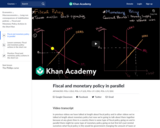
In previous lessons we've learned how expansionary monetary policy and expansionary fiscal …
In previous lessons we've learned how expansionary monetary policy and expansionary fiscal policy can be used to mitigate a recession, but they don't have to be used in isolation from each other. Often there is simultaneous use of fiscal and monetary policy. Learn what happens when they are used at the same time in this video.
The artist envisions public repudiation of Democratic hard-money policies, and the triumph …
The artist envisions public repudiation of Democratic hard-money policies, and the triumph of administration opponent Nathaniel P. Tallmadge, a conservative Democrat. Tallmadge, on horseback and armed with a lance "public opinion," rides over a fallen Van Buren, saying, "Roll off that ball, tis the voice of the People, they tolerate no more of your hard money humbugs." Van Buren protests, ". . . take your horse's hoofs from off my shoulder; I've no room for SĚ_Ąober second thoughts' now." He leans against a large ball marked "Solitary and Alone," which rolls over Missouri Senator Thomas Hart Benton and Treasury Secretary Levi Woodbury. Benton, who wields a quill "Expunger" and holds "Mint Drops," exclaims, "Woodbury get out of my way, or the ball will overwhelm us both." "Mint drops" was a colloquialism for gold coins, and refers to Benton's advocacy of a higher ratio of gold to silver in circulation. (For an earlier use of the giant ball metaphor see "N. Tom O' Logical Studies," no. 1837-14.) Editor Francis Preston Blair (seated on a bench at right) says, "Benton out with your old pistols that you shot Jackson with, & pop down Talmadge & his horse, or he'll reach the Capitol." Behind him appear the faint outlines of the Capitol. At left former postmaster general Amos Kendall and former New York governor William L. Marcy sit on the ground. Kendall asks, "By the powers tis the Bronze Horse, he carries all before him. Marcy what shall we do?" Marcy complains, "Confound it I'm down, quite down, with my britches torn again." Marcy's trousers are mended with a "50 cents" patch. (On Marcy's trousers' patch see &2Executive Mercy/Marcy and the Bambers, &1no. 1838-5.) The print probably appeared during the 1840 presidential campaign, when Tallmadge used his formidable influence in New York State in support of Harrison. It is also possible that it appeared during one of his own bids for reelection in 1838 or 1840. Comparison with other 1840 prints by "HD" supports the later date.|Lith. & pub. by H.R. Robinson, no. 52 Cortlandt St., no. 2 Wall St. N.Y. & Pennsylvania Ave: Washington Dist: Cola.|Signed with monogram: HD (Henry Dacre?).|Title appears as it is written on the item.|Weitenkampf, p. 66-67.|Forms part of: American cartoon print filing series (Library of Congress)|Published in: American political prints, 1766-1876 / Bernard F. Reilly. Boston : G.K. Hall, 1991, entry 1840-38.
This video is only one and half minutes long but discusses the …
This video is only one and half minutes long but discusses the importance of a central banking system separate, but answerable to the US Federal government. It is part of a series (Part 5) on The Gold Standard and will help to ensure standard EPF. 6 is met.
All inflation isn't bad—a moderate amount can signal a healthy economy. But …
All inflation isn't bad—a moderate amount can signal a healthy economy. But high inflation, such as that during the Great Inflation, can lead to a vicious cycle where expectations of higher inflation lead to further increases in the price level. Read the October 2012 issue to find out what caused the Great Inflation, how tough (and painful) policy brought it to an end, and two key lessons learned.
In this course, superhero Jack of All Trades and his sidekick Andy …
In this course, superhero Jack of All Trades and his sidekick Andy are confronted by a villain that threatens to disrupt society and rob the world of the certainty people have come to expect. And this dastardly villain is...Inflation. Jack and Andy time travel to the period known as The Great Inflation to discover the truth about inflation. With the help of Dr. Equilibrium, professor of economics, they learn that inflation is the result of too much money chasing too few goods and that the Federal Reserve System plays a key role in maintaining stable prices.
Lesson seeds are ideas for the standards that can be used to …
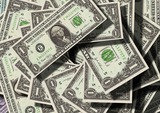
Lesson seeds are ideas for the standards that can be used to build a lesson. Lesson seeds are not meant to be all-inclusive, nor are they substitutes for instruction. This lesson seed provides a compelling question and a bank of sources to use to drive an inquiry based lesson or a potential Evidence Based Argument Set (EBAS). When developing lessons from these seeds, teachers must consider the needs of all learners. Once you have built your lesson from the lesson seed, teachers are encouraged to post the lesson that has emerged from this lesson seed and share with others. Compelling question:Is monetary policy effective in stimulating the US economy? EL Modification: highlight important vocabulary, add images to improve text comprenesion; consider adapting content, process and/or product based on Can Do WIDA DescriptorsImage source: "Dollar" by geralt on Pixabay.com
The Federal Reserve has a congressional mandate to promote maximum employment and …
The Federal Reserve has a congressional mandate to promote maximum employment and price stability. The May issue of Page One Economics explains how the Federal Open Market Committee (FOMC) conducts monetary policy by setting the target range for the federal funds rate and how the Fed uses its policy tools to steer the federal funds rate into the FOMC’s target range.
The Federal Reserve’s Federal Open Market Committee conducts monetary policy to promote …
The Federal Reserve’s Federal Open Market Committee conducts monetary policy to promote maximum employment and price stability in the U.S. economy. Monetary policy is made at the national level, but it’s important that policy reflects the economic voices beyond Washington, D.C., and Wall Street. The November issue of Page One Economics explains how Federal Reserve Bank presidents ensure the voices of “Main Street” are reflected in monetary policy decisions.
This video is 6 minutes long and will explain how the FED …
This video is 6 minutes long and will explain how the FED operated after the 2008 Great Recession to help aid the economy in recovery. This video will enforce students understanding of EPF. 6 and 7
Want to learn about the Federal Reserve? Have no fear! In Plain …
Want to learn about the Federal Reserve? Have no fear! In Plain English describes the structure and functions of the Federal Reserve System in an easy-to-understand interactive format.
No restrictions on your remixing, redistributing, or making derivative works. Give credit to the author, as required.
Your remixing, redistributing, or making derivatives works comes with some restrictions, including how it is shared.
Your redistributing comes with some restrictions. Do not remix or make derivative works.
Most restrictive license type. Prohibits most uses, sharing, and any changes.
Copyrighted materials, available under Fair Use and the TEACH Act for US-based educators, or other custom arrangements. Go to the resource provider to see their individual restrictions.