You must be logged in to perform this action.
Read the Fine Print

-
(Complete Item Description)
- Abstract:
In this video segment, the ZOOM cast demonstrates how to use cabbage juice to find out if a solution is an acid or a base.
- Subject:
- Science and Technology
- Grade Level:
- Primary, Secondary
- Collection:
-
Teachers' Domain
Read the Fine Print

-
(Complete Item Description)
- Abstract:
A car propelled by the reaction between lemon juice and baking soda has more in common with rockets and jet aircraft than one might think. In this video segment adapted from ZOOM, two cast members demonstrate the power of rocket-propelled vehicles and how to exploit the force produced by the carbon dioxide gas. Grades 3-8.
- Subject:
- Science and Technology
- Grade Level:
- Primary, Secondary
- Collection:
-
Teachers' Domain
Remix and Share

-
(Complete Item Description)
- Abstract:
This is a series of activities demonstrating that air has mass, takes up space, and can exert a force on objects enough to lift them.
- Subject:
- Science and Technology
- Grade Level:
- Primary
- Collection:
-
Pedagogy in Action (SERC)
Read the Fine Print

-
(Complete Item Description)
- Abstract:
This collection of still images presents different ways to visualize air, from billowing sails to windblown hair to tornadoes.
- Subject:
- Science and Technology
- Grade Level:
- Primary, Secondary
- Collection:
-
Teachers' Domain
Remix and Share

-
(Complete Item Description)
- Abstract:
Fundamentals of nuclear physics for engineering students. Basic properties of the nucleus and nuclear radiations. Elementary quantum mechanical calculations of bound-state energies and barrier transmission probability. Binding energy and nuclear stability. Interactions of charged particles, neutrons, and gamma rays with matter. Radioactive decays. Energetics and general cross-section behavior in nuclear reactions.
- Subject:
- Science and Technology
- Grade Level:
- Post-secondary
- Collection:
-
MIT OpenCourseWare
Read the Fine Print

-
(Complete Item Description)
- Abstract:
In this hands-on OLogy activity, kids learn about matter by building their own models of carbon out of pipe cleaners, wire, and clay. The activity begins with a kid-friendly introduction to matter, elements, and atoms. The illustrated, step-by-step directions show kids how to use the information about carbon on the Periodic Table to create a mobile that shows the element's basic structure. A PDF version of the Periodic Table, along with a kid-friendly overview of how to read it, is also included.
- Subject:
- Science and Technology
- Grade Level:
- Primary, Secondary
- Collection:
-
American Museum of Natural History
Read the Fine Print

-
(Complete Item Description)
- Abstract:
Students are introduced to chemical engineering and learn about its many different applications. They are provided with a basic introduction to matter and its different properties and states. An associated hands-on activity gives students a chance to test their knowledge of the states of matter and how to make observations using their five senses: touch, smell, sound, sight and taste.
- Subject:
- Mathematics and Statistics, Science and Technology
- Grade Level:
- Primary
- Collection:
-
TeachEngineering
Remix and Share

-
(Complete Item Description)
- Abstract:
Students are introduced to the concept of different kinds of matter. Students create models of different substances to learn to identify the differences between elements, compounds, and mixtures. This lesson is developed so that teachers can use it with English as a Second Language students.
- Subject:
- Science and Technology
- Grade Level:
- Secondary
- Collection:
-
LEARN NC Lesson Plans
No Strings Attached

-
(Complete Item Description)
- Abstract:
This unit explores issues related to size and scale, specifically the effect of the size of nanopowders on the interactions of energy and matter (e.g., the absorption of light, addressing the electromagnetic spectrum and associated wavelengths). For example, old sunscreens use "large" zinc oxide particles, which block ultraviolet light but scatter visible light, giving the cream a white color. If nanopowders of zinc oxide are used instead, the cream is transparent, because the diameter of each nanoparticle is smaller than the wavelength of visible light. Upon completing this unit, students will understand: How the energies of different wavelengths of light interact differently with different kinds of matter; Why particle size can affect the optical properties of a material; That there may be health issues for nanosized particles that are undetermined at this time; That it is possible to engineer useful materials with an incomplete understanding of their properties; There are often multiple valid theoretical explanations for experimental data; to find out which one works best, additional experiments are required; How to apply their scientific knowledge to be an informed consumer of chemical products. Length: 5 lessons, up to 11 50-minute classroom periods if all lessons are used. Not all lessons are required. Use the lessons most appropriate for your students.
- Subject:
- Science and Technology
- Grade Level:
- Secondary
- Collection:
-
National Center for Learning and Teaching
Read the Fine Print

-
(Complete Item Description)
- Abstract:
This module focuses on the launch and propulsion of the Genesis spacecraft. Students will become familiar with how rockets are launched, learn how and why specific rockets are chosen for varying payloads, learn about the history of rocketry, and work with variables that might affect the performance of a launch vehicle. They will work in teams to test a single variable involved in launching a rocket and learn the variables involved with constructing and launching a water rocket. Each activity includes a teacher's guide and students handouts. Video and audio clips are provided.
- Subject:
- Science and Technology
- Grade Level:
- Primary, Secondary
- Collection:
-
NASA
Read the Fine Print

-
(Complete Item Description)
- Abstract:
This module engages students in the use of a clean room and in the planning of assembly of solar collector wafers for the Genesis space mission. They will work in production design teams to explore how the Genesis spacecraft will collect bulk solar wind with the collector arrays and learn to work as a team in a restrictive environment. The module includes several activities with accompanying video clips. Downloadable, printable teachers' guides and students pages are provided for each one.
- Subject:
- Science and Technology
- Grade Level:
- Secondary
- Collection:
-
NASA
No Strings Attached

-
(Complete Item Description)
- Abstract:
The students will be able to identify concepts that guide scientific investigations, recognize and analyze alternative explanations and models by the end of this activity.
- Subject:
- Science and Technology
- Grade Level:
- Secondary
- Collection:
-
NASA
Read the Fine Print

-
(Complete Item Description)
- Abstract:
Students use a Although atoms contain both negatively and positively charged particles, they do so in equal amounts and carry no net charge. This balance can be temporarily disrupted by rubbing one material against another. One device, known as a Van de Graaff generator, uses a fast moving rubber belt to charge a metallic dome to nearly 200,000 Volts. This activity uses a Van de Graaff generator to study the behavior of electrical charges.
- Subject:
- Science and Technology
- Grade Level:
- Primary
- Collection:
-
Jefferson Lab
Read the Fine Print

-
(Complete Item Description)
- Abstract:
In this video from Evolution, an exploration of multi-drug resistant tuberculosis in the Russian prison system highlights one reason it is important to understand evolution.
- Subject:
- Science and Technology
- Grade Level:
- Primary, Secondary
- Collection:
-
Teachers' Domain
Read the Fine Print

-
(Complete Item Description)
- Abstract:
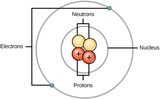
This lesson plan explores the fundamentals of atoms and their structure. The building blocks of matter (protons, electrons, neutrons) are covered in detail. Students think about how atoms and molecules can influence new technologies developed by engineers.
- Subject:
- Mathematics and Statistics, Science and Technology
- Grade Level:
- Primary, Secondary
- Collection:
-
TeachEngineering
Remix and Share

-
(Complete Item Description)
- Abstract:
This course focuses on the fundamentals of structure, energetics, and bonding that underpin materials science. It is the introductory lecture class for sophomore students in Materials Science and Engineering, taken with 3.014 and 3.016 to create a unified introduction to the subject. Topics include: an introduction to thermodynamic functions and laws governing equilibrium properties, relating macroscopic behavior to atomistic and molecular models of materials; the role of electronic bonding in determining the energy, structure, and stability of materials; quantum mechanical descriptions of interacting electrons and atoms; materials phenomena, such as heat capacities, phase transformations, and multiphase equilibria to chemical reactions and magnetism; symmetry properties of molecules and solids; structure of complex, disordered, and amorphous materials; tensors and constraints on physical properties imposed by symmetry; and determination of structure through diffraction. Real-world applications include engineered alloys, electronic and magnetic materials, ionic and network solids, polymers, and biomaterials.
- Subject:
- Science and Technology
- Grade Level:
- Post-secondary
- Collection:
-
MIT OpenCourseWare
Remix and Share

-
(Complete Item Description)
- Abstract:
This course explores the fundamentals of optical and optoelectronic phenomena and devices based on classical and quantum properties of radiation and matter culminating in lasers and applications. Fundamentals include: Maxwell's electromagnetic waves, resonators and beams, classical ray optics and optical systems, quantum theory of light, matter and its interaction, classical and quantum noise, lasers and laser dynamics, continuous wave and short pulse generation, light modulation; examples from integrated optics and semiconductor optoelectronics and nonlinear optics.
- Subject:
- Science and Technology
- Grade Level:
- Post-secondary
- Collection:
-
MIT OpenCourseWare
Read the Fine Print

-
(Complete Item Description)
- Abstract:
We are constantly being exposed to the behavior of gases. Each time we pump up a tire, blow up a balloon, use a spray can, or experience the cooling of gases as they escape from a gas storage container, we are reminded of how gases behave with changes in temperature, volume, pressure, or number of particles. In an astronomical scale, we know that star formation involves contraction of gas clouds to produce dense, high-pressure cores capable of fusion reactions. These labs will help your students investigate the behavior of gases due to changes in variables like volume, temperature, and number of particles. This experience with molecular motion in gases can be extended to help students understand perpetual motion in all states of matter. Students can transfer this relationship to the change in temperature and the corresponding change in vibration of molecules in a solid.
- Subject:
- Science and Technology
- Grade Level:
- Secondary
- Collection:
-
ASPIRE
Read the Fine Print

-
(Complete Item Description)
- Abstract:
This survey chemistry course is designed to introduce students to the world of chemistry. In this course, we will study chemistry from the ground up, learning the basics of the atom and its behavior. We will apply this knowledge to understand the chemical properties of matter and the changes and reactions that take place in all types of matter. Upon successful completion of this course, students will be able to: Define the general term 'chemistry.' Distinguish between the physical and chemical properties of matter. Distinguish between mixtures and pure substances. Describe the arrangement of the periodic table. Perform mathematical operations involving significant figures. Convert measurements into scientific notation. Explain the law of conservation of mass, the law of definite composition, and the law of multiple proportions. Summarize the essential points of Dalton's atomic theory. Define the term 'atom.' Describe electron configurations. Draw Lewis structures for molecules. Name ionic and covalent compounds using the rules for nomenclature of inorganic compounds. Explain the relationship between enthalpy change and a reaction's tendency to occur. (Chemistry 101; See also: Biology 105. Mechanical Engineering 004)
- Subject:
- Science and Technology
- Grade Level:
- Post-secondary
- Collection:
-
Saylor Foundation
Read the Fine Print

-
(Complete Item Description)
- Abstract:
In this activity, students make a model of a lithium atom using gumdrops and toothpicks. Using this model, they investigate the makeup of an atom, including its relative size. Students also practice adding and subtracting electrons from an atom and determining the overall charges on atoms.
- Subject:
- Mathematics and Statistics, Science and Technology
- Grade Level:
- Primary, Secondary
- Collection:
-
TeachEngineering