This textbook, or really a “coursebook” for a college freshman-level class, has …
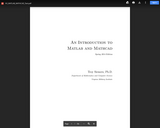
This textbook, or really a “coursebook” for a college freshman-level class, has been updated for Spring 2014 and provides an introduction to programming and problem solving using both Matlab and Mathcad. We provide a balanced selection of introductory exercises and real-world problems (i.e. no “contrived” problems). We include many examples and screenshots to guide the reader. We assume no prior knowledge of Matlab or Mathcad.
This course offers an advanced introduction to numerical analysis, with a focus …
This course offers an advanced introduction to numerical analysis, with a focus on accuracy and efficiency of numerical algorithms. Topics include sparse-matrix/iterative and dense-matrix algorithms in numerical linear algebra (for linear systems and eigenproblems), floating-point arithmetic, backwards error analysis, conditioning, and stability. Other computational topics (e.g., numerical integration or nonlinear optimization) are also surveyed.
9.63 teaches principles of experimental methods in human perception and cognition, including …
9.63 teaches principles of experimental methods in human perception and cognition, including design and statistical analysis. The course combines lectures and hands-on experimental exercises and requires an independent experimental project. Some experience in programming is desirable. To foster improved writing and presentation skills in conducting and critiquing research in cognitive science, students are required to provide reports and give oral presentations of three team experiments. A fourth individually conducted experiment includes a proposal with revision, and concluding written and oral reports.
Learn Differential Equations: Up Close with _Gilbert Strang and_ Cleve Moler is …
Learn Differential Equations: Up Close with _Gilbert Strang and_ Cleve Moler is an in-depth series of videos about differential equations and the MATLAB® ODE suite. These videos are suitable for students and life-long learners to enjoy. About the Instructors Gilbert Strang is the MathWorks Professor of Mathematics at MIT. His research focuses on mathematical analysis, linear algebra and PDEs. He has written textbooks on linear algebra, computational science, finite elements, wavelets, GPS, and calculus. Cleve Moler is chief mathematician, chairman, and cofounder of MathWorks. He was a professor of math and computer science for almost 20 years at the University of Michigan, Stanford University, and the University of New Mexico. These videos were produced by The MathWorks and are also available on The MathWorks website.
Students groups act as aerospace engineering teams competing to create linear equations …
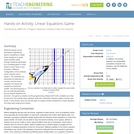
Students groups act as aerospace engineering teams competing to create linear equations to guide space shuttles safely through obstacles generated by a modeling game in level-based rounds. Each round provides a different configuration of the obstacle, which consists of two "gates." The obstacles are presented as asteroids or comets, and the linear equations as inputs into autopilot on board the shuttle. The winning group is the one that first generates the successful equations for all levels. The game is created via the programming software MATLAB, available as a free 30-day trial. The activity helps students make the connection between graphs and the real world. In this activity, they can see the path of a space shuttle modeled by a linear equation, as if they were looking from above.
This is an introductory course to MATLAB, the high-performance interactive software. Topics …
This is an introductory course to MATLAB, the high-performance interactive software. Topics include MATLAB Basics, Plotting, Scripts & Functions and Programming. Additional resources are also provided.
This textbook attempts to provide you with an overview of the commonly …
This textbook attempts to provide you with an overview of the commonly used basic mathematical models, as well as a wide range of applications. It offers a perspective that brings you back to the modeling process and the assumptions that go into it.
This course introduces the fundamentals of machine tool and computer tool use. …
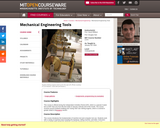
This course introduces the fundamentals of machine tool and computer tool use. Students work with a variety of machine tools including the bandsaw, milling machine, and lathe. Instruction given on MATLAB®, MAPLE®, XESS™, and CAD. Emphasis is on problem solving, not programming or algorithmic development.
This course introduces the fundamentals of machine tool and computer tool use. …
This course introduces the fundamentals of machine tool and computer tool use. Students work with a variety of machine tools including the bandsaw, milling machine, and lathe. Instruction given on MATLAB®, MAPLE®, XESS™, and CAD. Emphasis is on problem solving, not programming or algorithmic development. Assignments are project-oriented relating to mechanical engineering topics. It is recommended that students take this subject in the first IAP after declaring the major in Mechanical Engineering. This course was co-created by Prof. Douglas Hart and Dr. Kevin Otto.
This course helps students develop computational programming skills and gain experience with …
This course helps students develop computational programming skills and gain experience with computational tools to be used in the solution of engineering problems. Topics include: Introduction to Computing, Basic Matlab commands, Arrays: one-dimensional and multi-dimensional, Flow control, Selective execution, Repetitive execution and iterations, Input and Output, Modular Programming: Functions, Plotting, and Advanced data types.
In this activity students build a hydrologic model of Mono Lake in …
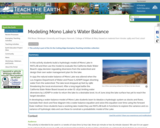
In this activity students build a hydrologic model of Mono Lake in MATLAB and then use the model to evaluate the California State Water Board's 1994 decision regulating diversions from the watershed and design their own water management plan for the lake. In 1941 the natural water balance of Mono Lake was altered when the Los Angeles Department of Water and Power (LADWP) began diverting water from the watershed. The lake level dropped 45 feet by 1982 threatening the local environment. After a long legal battle the California State Water Board issued an order (D. 1631) limiting water diversions by LADWP in order to return the lake to a desirable level. As of June 2019 the lake surface has yet to reach the target elevation. In developing a water-balance model of Mono Lake students learn to idealize a hydrologic system as stocks and flows, translate their stock and flow diagram into a water balance equation and solve this equation over time using the forward Euler method. Once students have a working lake model they use MATLAB built-in functions to explore the variance and co-variance of hydrologic data and use these to constrain a probabilistic model of the Lake.
This course uses computer-aided design methodologies for synthesis of multivariable feedback control …
This course uses computer-aided design methodologies for synthesis of multivariable feedback control systems. Topics covered include: performance and robustness trade-offs; model-based compensators; Q-parameterization; ill-posed optimization problems; dynamic augmentation; linear-quadratic optimization of controllers; H-infinity controller design; Mu-synthesis; model and compensator simplification; and nonlinear effects. The assignments for the course comprise of computer-aided (MATLAB®) design problems.
This class introduces elementary programming concepts including variable types, data structures, and …
This class introduces elementary programming concepts including variable types, data structures, and flow control. After an introduction to linear algebra and probability, it covers numerical methods relevant to mechanical engineering, including approximation (interpolation, least squares and statistical regression), integration, solution of linear and nonlinear equations, ordinary differential equations, and deterministic and probabilistic approaches. Examples are drawn from mechanical engineering disciplines, in particular from robotics, dynamics, and structural analysis.
This class introduces elementary programming concepts including variable types, data structures, and …
This class introduces elementary programming concepts including variable types, data structures, and flow control. After an introduction to linear algebra and probability, it covers numerical methods relevant to mechanical engineering, including approximation (interpolation, least squares and statistical regression), integration, solution of linear and nonlinear equations, ordinary differential equations, and deterministic and probabilistic approaches. Examples are drawn from mechanical engineering disciplines, in particular from robotics, dynamics, and structural analysis. Assignments require MATLAB® programming.
This class introduces elementary programming concepts including variable types, data structures, and …
This class introduces elementary programming concepts including variable types, data structures, and flow control. After an introduction to linear algebra and probability, it covers numerical methods relevant to mechanical engineering, including approximation (interpolation, least squares and statistical regression), integration, solution of linear and nonlinear equations, ordinary differential equations, and deterministic and probabilistic approaches. Examples are drawn from mechanical engineering disciplines, in particular from robotics, dynamics, and structural analysis. Assignments require MATLAB® programming.
This course focuses on the use of modern computational and mathematical techniques …
This course focuses on the use of modern computational and mathematical techniques in chemical engineering. Starting from a discussion of linear systems as the basic computational unit in scientific computing, methods for solving sets of nonlinear algebraic equations, ordinary differential equations, and differential-algebraic (DAE) systems are presented. Probability theory and its use in physical modeling is covered, as is the statistical analysis of data and parameter estimation. The finite difference and finite element techniques are presented for converting the partial differential equations obtained from transport phenomena to DAE systems. The use of these techniques will be demonstrated throughout the course in the MATLAB® computing environment.
Commercial simulation software for solar plants is readily available, but source codes …
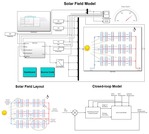
Commercial simulation software for solar plants is readily available, but source codes are not. Many articles in the open literature give governing equations and algorithms for solar plant simulations, but adopters must program them themselves. This paper presents an open-source, ready-to-run, model of a parabolic trough solar field with a user-friendly interface in the Simulink® environment. The intention is to provide a foundational tool for the solar thermal research community, similar to the Tennessee Eastman Challenge Problem employed for chemical processes. The flow rate of the heat transfer fluid (HTF) and the angle of incidence are the manipulated variables of the model. The size of the solar field may be altered. Both open- and closed-loop responses to disturbances may be investigated. The source code of the model is freely available at the Open Educational Resource Commons, which investigators can utilize and extend.
Most books that use MATLAB are aimed at readers who know how …
Most books that use MATLAB are aimed at readers who know how to program. This book is for people who have never programmed before. As a result, the order of presentation is unusual. The book starts with scalar values and works up to vectors and matrices very gradually. This approach is good for beginning programmers, because it is hard to understand composite objects until you understand basic programming semantics.
The best way to learn how to program is to do something …
The best way to learn how to program is to do something useful, so this introduction to MATLAB is built around a common scientific task: data analysis. Our real goal isn’t to teach you MATLAB, but to teach you the basic concepts that all programming depends on. We use MATLAB in our lessons because: we have to use something for examples; it’s well-documented; it has a large (and growing) user base among scientists in academia and industry; and it has a large library of packages available for performing diverse tasks. But the two most important things are to use whatever language your colleagues are using, so that you can share your work with them easily, and to use that language well.
No restrictions on your remixing, redistributing, or making derivative works. Give credit to the author, as required.
Your remixing, redistributing, or making derivatives works comes with some restrictions, including how it is shared.
Your redistributing comes with some restrictions. Do not remix or make derivative works.
Most restrictive license type. Prohibits most uses, sharing, and any changes.
Copyrighted materials, available under Fair Use and the TEACH Act for US-based educators, or other custom arrangements. Go to the resource provider to see their individual restrictions.