(Complete Item Description)
- Abstract:
-
In this course, we will study important movements and some influential artists in Western art history. It begins with the Proto-Renaissance in Italy in the 13th century and continues through to the late 20th century, providing a framework for considering how and why certain artistic movements emerged in certain places at certain times. Upon successful completion of this course, student will be able to: identify the major styles of works of art in the West from the Italian proto-Renaissance through contemporary art; explain how political, social, and religious ideas inform art styles and images; explain prevalent artistic and architectural techniques developed through the period covered; eiscuss formal aspects of works of art in terminology basic to the field; recognize important artworks and describe them in terms of their form, content, and general history of their creation. (Art HIstory 111)
- Subject:
-
Arts
- Grade Level:
-
Post-secondary
- Collection:
-
Saylor Foundation
Rate this resource by using the left and right arrow keys and pressing Enter.
Read the Fine Print
(Complete Item Description)
- Abstract:
-
The student will focus on becoming literate in the art of the Italian Renaissance, on identifying the effects that the Renaissance had on the arts of Italy, and discovering the ways in which specific historical developments impacted those arts from the end of the thirteenth century to the end of the sixteenth century. The Renaissance, a European phenomenon that began to develop in the late thirteenth century, refers to a marked shift in the ways in which individuals perceived their world. A new outlook was emerging that was characterized by, among other things, increased humanism and a renewed interest in the cultures of Classical Antiquity (and all within a Christian framework). There is no specific date that marks the beginning of the Renaissance, but its burgeoning effects on art can be detected earlier in Italy than in other areas. Upon successful completion of this course, the student will be able to: Define the term Renaissance and identify its modes of expression in the art of Italy; Place the major artistic developments of Italian Renaissance art along a timeline and characterize the art of different periods within the Renaissance; Situate different artists, artworks, and artistic practices within their respective regions or cities; Explain how specific historical contexts, events, and figures affected Italian Renaissance art; Describe specificities in interests and style as they apply to the work of important artists of the Renaissance; Recognize important artworks and describe them in terms of their form, content, and general history of their creation; Explain the role of art and artists during the Renaissance in Italy; Discuss specific artistic techniques used during the Renaissance in Italy. (Art History 206)
- Subject:
-
Arts,
Humanities
- Grade Level:
-
Post-secondary
- Collection:
-
Saylor Foundation
Rate this resource by using the left and right arrow keys and pressing Enter.
Read the Fine Print
(Complete Item Description)
- Abstract:
-
This art history video discussion examines Michelangelo's "Laurentian Library" (vestibule and reading room), begun 1524, opened 1571, San Lorenzo, Florence.
- Subject:
-
Arts,
Humanities
- Grade Level:
-
Secondary,
Post-secondary
- Collection:
-
Smarthistory
Rate this resource by using the left and right arrow keys and pressing Enter.
Remix and Share
(Complete Item Description)
- Abstract:
-
This art history video discussion examines Michelangelo's "The Slaves" (commonly referred to as the Dying Slave and the Rebellious Slave), marble, 2.09 m high, 1513-15 (Musee du Louvre, Paris).
- Subject:
-
Arts,
Humanities
- Grade Level:
-
Secondary,
Post-secondary
- Collection:
-
Smarthistory
Rate this resource by using the left and right arrow keys and pressing Enter.
Remix and Share
(Complete Item Description)
- Abstract:
-
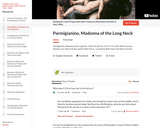
This art history video discussion looks at Parmigianino's "Madonna of the Long Neck" (Uffizi, Florence).
- Subject:
-
Arts,
Humanities
- Grade Level:
-
Secondary,
Post-secondary
- Collection:
-
Smarthistory
Rate this resource by using the left and right arrow keys and pressing Enter.
Remix and Share
(Complete Item Description)
- Abstract:
-
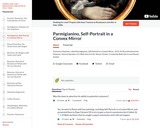
This art history video dicussion examines Parmigianino's "Self-Portrait in a Convex Mirror", oil on panel, 1524 (Kunsthistorisches Museum, Vienna).
- Subject:
-
Arts,
Humanities
- Grade Level:
-
Secondary,
Post-secondary
- Collection:
-
Smarthistory
Rate this resource by using the left and right arrow keys and pressing Enter.
Remix and Share
(Complete Item Description)
- Abstract:
-
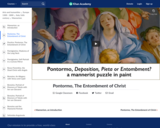
This art history video discussion looks at Pontormo's "Entombment (or Deposition from the Cross)", oil on panel, 1525-28 (Capponi Chapel, Santa Felicita, Florence).
- Subject:
-
Arts,
Humanities
- Grade Level:
-
Secondary,
Post-secondary
- Collection:
-
Smarthistory
Rate this resource by using the left and right arrow keys and pressing Enter.
Remix and Share
(Complete Item Description)
- Abstract:
-
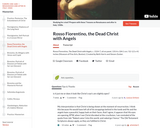
This art history video discussion examines Rosso Fiorentino's "The Dead Christ with Angels", c. 1524-7, oil on panel (Museum of Fine Arts, Boston).
- Subject:
-
Arts,
Humanities
- Grade Level:
-
Secondary,
Post-secondary
- Collection:
-
Smarthistory
Rate this resource by using the left and right arrow keys and pressing Enter.
Remix and Share
(Complete Item Description)
- Abstract:
-
This art history video discussion looks at Jacopo Tintoretto's "The Origin of the Milky Way", c. 1575, oil on canvas (The National Gallery, London).
- Subject:
-
Arts,
Humanities
- Grade Level:
-
Secondary,
Post-secondary
- Collection:
-
Smarthistory
Rate this resource by using the left and right arrow keys and pressing Enter.
Remix and Share
No restrictions on your remixing, redistributing, or making derivative works. Give credit to the author, as required.
Your remixing, redistributing, or making derivatives works comes with some restrictions, including how it is shared.
Your redistributing comes with some restrictions. Do not remix or make derivative works.
Copyrighted materials, available under Fair Use and the TEACH Act for US-based educators, or other custom arrangements. Go to the resource provider to see their individual restrictions.