Only Sharing Permitted
CC BY-NC-ND
Draft of 1.1
- Subject:
- Applied Science
- Material Type:
- Activity/Lab
- Date Added:
- 05/31/2018
Draft of 1.1
6th Grade Regular Science Scope & Sequence
This classroom activity will show students that there is a lot we don't know about science, for example life throughout the universe. It will hopefully encourage students to question what we know and don't know, and exploration and study of the unknown.
8th Grade Regular Science Scope & Sequence
Paul Anderson's video play list of videos that can be used in a AP Biology Science Practices course
For students interested in studying biomechanical engineering, especially in the field of surgery, this lesson serves as an anatomy and physiology primer of the abdominopelvic cavity. Students are introduced to the abdominopelvic cavity—a region of the body that is the focus of laparoscopic surgery—as well as the benefits and drawbacks of laparoscopic surgery. Understanding the abdominopelvic environment and laparoscopic surgery is critical for biomechanical engineers who design laparoscopic surgical tools.
How do strong and weak acids differ? Use lab tools on your computer to find out! Dip the paper or the probe into solution to measure the pH, or put in the electrodes to measure the conductivity. Then see how concentration and strength affect pH. Can a weak acid solution have the same pH as a strong acid solution?
This activity is acid-base titration lab where students determine the percent of calcium carbonate in an eggshell.
This video follows biologist Gretchen Hofmann as she studies the effects of ocean acidification on sea urchin larvae.
Learn about how organisms adapt to their habitats. This video is part of The Virtual School's "Adapting and Living Together" chapter within our Ecology and Environment topic.
Students explore the adaptations that allow beavers to thrive in aquatic environments, then make observations and inferences about the functions of diverse bird beaks.
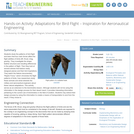
This activity first asks the students to study the patterns of bird flight and understand that four main forces affect the flight abilities of a bird. They will study the shape, feather structure, and resulting differences in the pattern of flight. They will then look at several articles that feature newly designed planes and the birds that they are modeled after. The final component of this activity is to watch the Nature documentary, "Raptor Force" which chronicles the flight patterns of birds, how researchers study these animals, and what interests our military and aeronautical engineers about these natural adaptations. This activity serves as an extension to the biomimetics lesson. Although students will not be using this information in the design process for their desert resort, it provides interesting information pertaining to the current use of biomimetics in the field of aviation. Students may extend their design process by using this information to create a means of transportation to and from the resort if they chose to.
An introduction to the chapter "Adapting and Living Together" within the Ecology and Environment topic of the virtual school GCSE Biology.
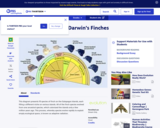
Finches on the Galapagos Islands have evolved to exploit almost every possible niche. This diagram shows the range of food sources available on the island and the different beak shapes adapted to exploit each of them.
Spreadsheets across the Curriculum Module. Students build a spreadsheet to calculate proper medicine dosages using the metric system.
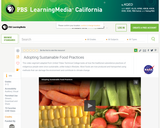
Hear about how respect for Earth can help us attain a more sustainable lifestyle in the face of climate change in this video segment adapted from United Tribes Technical College.
A short video that discusses how changing climate is affecting the population of AdÃlie penguins.

This comprehensive guide to the Paleontology section of OLogy, the Museum's science Web site for kids, explains how after-school educators can make the most of the site. It focuses on dinosaurs because that's what kids are most familiar with. An introduction to the Big Ideas in Paleontology brings educators up to speed on how scientists study early life on Earth, what kind of information the fossil record contains, and why dinosaurs are not extinct. A Site Map shows where to locate all Paleontology resources, from stories to quizzes to hands-on-activities. Paleontology units offer ways to combine different types of resources around a topic. Follow-up questions encourage inquiry-based learning. Wrap-Up Paleo Projects suggests fun ways to wrap up any of these units. A Links and Resources section lists recommended paleontology-related books and Web sites for educators and for kids. A glossary of paleontological terms wraps up the guide.
This is a learning module that uses data to investigate trends in attitudes regarding the rights of homosexuals in the United States from the early 1990s through 2007.
The goal of this exercise is to explore the characteristics and well-being of middle-aged caregivers.