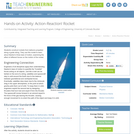
Students construct rockets from balloons propelled along a guide string. They use …
Students construct rockets from balloons propelled along a guide string. They use this model to learn about Newton's three laws of motion, examining the effect of different forces on the motion of the rocket.
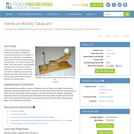
Students observe the relationship between the angle of a catapult (a force …
Students observe the relationship between the angle of a catapult (a force measurement) and the flight of a cotton ball. They learn how Newton's second law of motion works by seeing directly that F = ma. When they pull the metal "arm" back further, thus applying a greater force to the cotton ball, it causes the cotton ball to travel faster and farther. Students also learn that objects of greater mass require more force to result in the same distance traveled by a lighter object.
Secondary educators across Lebanon County, Pennsylvania developed lesson plans to integrate the …
Secondary educators across Lebanon County, Pennsylvania developed lesson plans to integrate the Pennsylvania Career Education and Work Standards with the content they teach. This work was made possible through a partnership between the South Central PA Workforce Investment Board (SCPa Works) and Lancaster-Lebanon Intermediate Unit 13 (IU13) and was funded by a Teacher in the Workplace Grant Award from the Pennsylvania Department of Labor and Industry. This lesson plan was developed by one of the talented educators who participated in this project during the 2018-2019 school year.
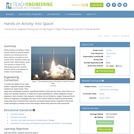
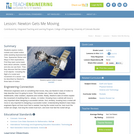
The purpose of this lesson is to teach the students about how …
The purpose of this lesson is to teach the students about how a spacecraft gets from the surface of the Earth to Mars. The lesson first investigates rockets and how they are able to get us into space. Finally, the nature of an orbit is discussed as well as how orbits enable us to get from planet to planet specifically from Earth to Mars.
Students use water balloons and a length of string to understand how …
Students use water balloons and a length of string to understand how the force of gravity between two objects and the velocity of a spacecraft can balance to form an orbit. They see that when the velocity becomes too great for gravity to hold the spacecraft in orbit, the object escapes the orbit and travels further away from the planet.
This course focuses on an in-depth reading of Principia Mathematica Philosophiae Naturalis …
This course focuses on an in-depth reading of Principia Mathematica Philosophiae Naturalis by Isaac Newton, as well as several related commentaries and historical philosophical texts.
While building and testing model rockets fueled by antacid tablets, students are …
While building and testing model rockets fueled by antacid tablets, students are introduced to the basic physics concepts on how rockets work. Students revise and improve their initial designs. Note: This activity is similar to the elementary-level film canister rockets activity, but adapted for middle school students.
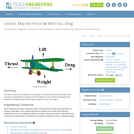
This lesson explores the drag force on airplanes. The students will be …
This lesson explores the drag force on airplanes. The students will be introduced to the concept of conservation of energy and how it relates to drag. Students will explore the relationship between drag and the shape, speed and size of an object.
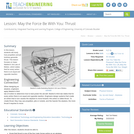
In this lesson, students will study how propellers and jet turbines generate …
In this lesson, students will study how propellers and jet turbines generate thrust. This lesson focuses on Isaac Newton's 3rd Law of Motion, which states that for every action there is an equal and opposite reaction.
Student pairs experience the iterative engineering design process as they design, build, …
Student pairs experience the iterative engineering design process as they design, build, test and improve catching devices to prevent a "naked" egg from breaking when dropped from increasing heights. To support their design work, they learn about materials properties, energy types and conservation of energy. Acting as engineering teams, during the activity and competition they are responsible for design and construction planning within project constraints, including making engineering modifications for improvement. They carefully consider material choices to balance potentially competing requirements (such as impact-absorbing and low-cost) in the design of their prototypes. They also experience a real-world transfer of energy as the elevated egg's gravitational potential energy turns into kinetic energy as it falls and further dissipates into other forms upon impact. Pre- and post-activity assessments and a scoring rubric are provided. The activity scales up to district or regional egg drop competition scale. As an alternative to a ladder, detailed instructions are provided for creating a 10-foot-tall egg dropper rig.
In this lesson, students will explore motion, rockets and rocket motion while …
In this lesson, students will explore motion, rockets and rocket motion while assisting Spacewoman Tess, Spaceman Rohan and Maya in their explorations. They will first learn some basic facts about vehicles, rockets and why we use them. Then, the students will discover that the motion of all objects including the flight of a rocket and movement of a canoe is governed by Newton's three laws of motion.
In this lab students will investigate Newton's first law of motion or …
In this lab students will investigate Newton's first law of motion or the Law of Inertia. The first lab investigates an object at rest, and the effects of friction on motion. The second lab investigates an object in motion. Students will experiment with this law by varying their speed, while trying to drop a tennis ball in a given target zone. Although intended for seventh grade students this lab can be adjusted to fit the educational needs of each student. Definitions adapted from cK-12 Newton's First Law of Motion
Students design and build paper rockets around film canisters, which serve as …
Students design and build paper rockets around film canisters, which serve as engines. An antacid tablet and water are put into each canister, reacting to form carbon dioxide gas, and acting as the pop rocket's propellant. With the lid snapped on, the continuous creation of gas causes pressure to build up until the lid pops off, sending the rocket into the air. The pop rockets demonstrate Newton's third law of motion: for every action, there is an equal and opposite reaction.
Building upon their understanding of forces and Newton's laws of motion, students …
Building upon their understanding of forces and Newton's laws of motion, students learn about the force of friction, specifically with respect to cars. They explore the friction between tires and the road to learn how it affects the movement of cars while driving. In an associated literacy activity, students explore the theme of conflict in literature, and the difference between internal and external conflict, and various types of conflicts. Stories are used to discuss methods of managing and resolving conflict and interpersonal friction.
Students learn how and why engineers design satellites to benefit life on …
Students learn how and why engineers design satellites to benefit life on Earth, as well as explore motion, rockets and rocket motion. Through six lessons and 10 associated hands-on activities, students discover that the motion of all objects everything from the flight of a rocket to the movement of a canoe is governed by Newton's three laws of motion. This unit introduces students to the challenges of getting into space for the purpose of exploration. The ideas of thrust, weight and control are explored, helping students to fully understand what goes into the design of rockets and the value of understanding these scientific concepts. After learning how and why the experts make specific engineering choices, students also learn about the iterative engineering design process as they design and construct their own model rockets. Then students explore triangulation, a concept that is fundamental to the navigation of satellites and global positioning systems designed by engineers; by investigating these technologies, they learn how people can determine their positions and the locations of others.
In the culminating activity of the unit, students explore and apply their …
In the culminating activity of the unit, students explore and apply their knowledge of forces, friction, acceleration and gravity in a two-part experiment. First, student groups measure the average acceleration of a textbook pulled along a table by varying weights (with optional extensions, such as with the addition of a pulley or an inclined plane). Then, with a simple modification to the same experimental setup, teams test different surfaces for the effects of friction, graphing and analyzing their results. Students also consider the real-world applications for high- and low-friction surfaces for different situations and purposes, seeing how forces play a role in engineering design and material choices.
Working as if they were engineers, students design and construct model solar …
Working as if they were engineers, students design and construct model solar sails made of aluminum foil to move cardboard tube satellites through “space” on a string. Working in teams, they follow the engineering design thinking steps—empathize, define, ideate, prototype, test, redesign—to design and test small-scale solar sails for satellites and space probes. During the process, learn about Newton’s laws of motion and the transfer of energy from wave energy to mechanical energy. A student activity worksheet is provided.
The airplanes unit begins with a lesson on how airplanes create lift, …
The airplanes unit begins with a lesson on how airplanes create lift, which involves a discussion of air pressure and how wings use Bernoulli's principle to change air pressure. Next, students explore the other three forces acting on airplanes thrust, weight and drag. Following these lessons, students learn how airplanes are controlled and use paper airplanes to demonstrate these principles. The final lessons addresses societal and technological impacts that airplanes have had on our world. Students learn about different kinds of airplanes and then design and build their own balsa wood airplanes based on what they have learned.
What makes rockets fly straight? What makes rockets fly far? Why use …
What makes rockets fly straight? What makes rockets fly far? Why use water to make the rocket fly? Students are challenged to design and build rockets from two-liter plastic soda bottles that travel as far and straight as possible or stay aloft as long as possible. Guided by the steps of the engineering design process, students first watch a video that shows rocket launch failures and then participate in three teacher-led mini-activities with demos to explore key rocket design concepts: center of drag, center of mass, and momentum and impulse. Then the class tests four combinations of propellants (air, water) and center of mass (weight added fore or aft) to see how these variables affect rocket distance and hang time. From what they learn, student pairs create their own rockets from plastic bottles with cardboard fins and their choices of propellant and center of mass placement, which they test and refine before a culminating engineering field day competition. Teams design for maximum distance or hang time; adding a parachute is optional. Students learn that engineering failures during design and testing are just steps along the way to success.
Through a series of three lessons and one activity, students are introduced …
Through a series of three lessons and one activity, students are introduced to inertia, forces and Newton's three laws of motion. For each lesson, a combination of class demonstrations and PowerPoint® presentations are used to explain, show and relate the concepts to engineering. Lesson 1 starts with inertia, forces and Newton's first law of motion. Lesson 2 builds on lesson 1 with s review and then introduces Newton's second law of motion. Lesson 3 builds on the previous two lessons with a review and then introduces Newton's third law of motion. In a culminating activity, students apply their knowledge of forces, friction, acceleration and gravity in an experiment to measure the average acceleration of a textbook pulled along a table by varying weights, and then test the effects of friction on different surfaces.
No restrictions on your remixing, redistributing, or making derivative works. Give credit to the author, as required.
Your remixing, redistributing, or making derivatives works comes with some restrictions, including how it is shared.
Your redistributing comes with some restrictions. Do not remix or make derivative works.
Most restrictive license type. Prohibits most uses, sharing, and any changes.
Copyrighted materials, available under Fair Use and the TEACH Act for US-based educators, or other custom arrangements. Go to the resource provider to see their individual restrictions.