This course discusses the fundamental material science behind amorphous solids, or non-crystalline …
This course discusses the fundamental material science behind amorphous solids, or non-crystalline materials. It covers formation of amorphous solids; amorphous structures and their electrical and optical properties; and characterization methods and technical applications.
In this interactive activity, learners explore factors that cause atoms to form …
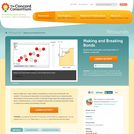
In this interactive activity, learners explore factors that cause atoms to form (or break) bonds with each other. The first simulation depicts a box containing 12 identical atoms. Using a slider to add heat, students can see the influence of temperature on formation of diatomic bonds. Simulations #2 and #3 introduce learners to reactions involving two types of atoms. Which atom forms a diatomic molecule more easily, and why? The activity concludes as students explore paired atoms (molecules). In this simulation they compare the amount of energy needed to break the molecular bonds to the energy needed to form the bonds. This item is part of the Concord Consortium, a nonprofit research and development organization dedicated to transforming education through technology.
In this course, students will learn about plasmas, the fourth state of …
In this course, students will learn about plasmas, the fourth state of matter. The plasma state dominates the visible universe, and is of increasing economic importance. Plasmas behave in lots of interesting and sometimes unexpected ways. The course is intended only as a first plasma physics course, but includes critical concepts needed for a foundation for further study. A solid undergraduate background in classical physics, electromagnetic theory including Maxwell's equations, and mathematical familiarity with partial differential equations and complex analysis are prerequisites. The course introduces plasma phenomena relevant to energy generation by controlled thermonuclear fusion and to astrophysics, coulomb collisions and transport processes, motion of charged particles in magnetic fields, plasma confinement schemes, MHD models, simple equilibrium and stability analysis. It also covers two-fluid hydrodynamic plasma models, wave propagation in a magnetic field, kinetic theory, Vlasov plasma model, electron plasma waves and Landau damping, ion-acoustic waves, and streaming instabilities. A subject description tailored to fit the background and interests of the attending students is distributed shortly before and at the beginning of the subject.
The plasma state dominates the visible universe, and is important in fields …
The plasma state dominates the visible universe, and is important in fields as diverse as Astrophysics and Controlled Fusion. Plasma is often referred to as "the fourth state of matter." This course introduces the study of the nature and behavior of plasma. A variety of models to describe plasma behavior are presented.
This course highlights the properties and behavior of low-temperature plasmas in relation …
This course highlights the properties and behavior of low-temperature plasmas in relation to energy conversion, plasma propulsion, and gas lasers. The course includes material on the equilibrium (energy states, statistical mechanics, and relationship to thermodynamics) and kinetic theory of ionized gases (motion of charged particles, distribution function, collisions, characteristic lengths and times, cross sections, and transport properties). In addition, the course discusses gas surface interactions (thermionic emission, sheaths, and probe theory) and radiation in plasmas and diagnostics.
This course covers elementary statistical mechanics, transport properties, kinetic theory, solid state, …
This course covers elementary statistical mechanics, transport properties, kinetic theory, solid state, reaction rate theory, and chemical reaction dynamics. Acknowledgements The staff for this course would like to acknowledge that these course materials include contributions from past instructors, textbooks, and other members of the MIT Chemistry Department affiliated with course #5.62. Since the following works have evolved over a period of many years, no single source can be attributed.
Physics I is a first-year physics course which introduces students to classical …
Physics I is a first-year physics course which introduces students to classical mechanics. This course has a hands-on focus, and approaches mechanics through take-home experiments. Topics include: kinematics, Newton's laws of motion, universal gravitation, statics, conservation laws, energy, work, momentum, and special relativity.
Explore what makes a reaction happen by colliding atoms and molecules. Design …
Explore what makes a reaction happen by colliding atoms and molecules. Design experiments with different reactions, concentrations, and temperatures. When are reactions reversible? What affects the rate of a reaction?
Watch different types of molecules form a solid, liquid, or gas. Add …
Watch different types of molecules form a solid, liquid, or gas. Add or remove heat and watch the phase change. Change the temperature or volume of a container and see a pressure-temperature diagram respond in real time. Relate the interaction potential to the forces between molecules.
No restrictions on your remixing, redistributing, or making derivative works. Give credit to the author, as required.
Your remixing, redistributing, or making derivatives works comes with some restrictions, including how it is shared.
Your redistributing comes with some restrictions. Do not remix or make derivative works.
Most restrictive license type. Prohibits most uses, sharing, and any changes.
Copyrighted materials, available under Fair Use and the TEACH Act for US-based educators, or other custom arrangements. Go to the resource provider to see their individual restrictions.