Students will learn about the jazz singer Billie Holiday and the sociohistorical …
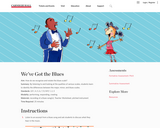
Students will learn about the jazz singer Billie Holiday and the sociohistorical context in which she performed. They will learn how discriminatory statutes (called Jim Crow laws) affected daily life. They will also analyze how movement is created in photographs and the effect of a photographer's point of view on composition. Finally, students will photograph a musician, paying attention to what can be communicated through point of view.
This video segment from Weston Woods presents the story of Duke by …
This video segment from Weston Woods presents the story of Duke by Andrea Davis Pinkney, illustrated by Brian Pinkney, and is about Duke Ellington, one of the founding fathers of jazz. When Duke Ellington was young, his parents wanted him to learn to play the piano. Although he began lessons, he was soon lured away by his love of baseball. Later, as a teenager he heard the new musical style called "ragtime" and he was inspired once again to learn to play piano. Soon, he created his own style of music using "hops" and "slides" on the piano. He became a popular entertainer with a flair that attracted many fans.
This collection uses primary sources to explore F. Scott Fitzgerald's novel, The …
This collection uses primary sources to explore F. Scott Fitzgerald's novel, The Great Gatsby. Digital Public Library of America Primary Source Sets are designed to help students develop their critical thinking skills and draw diverse material from libraries, archives, and museums across the United States. Each set includes an overview, ten to fifteen primary sources, links to related resources, and a teaching guide. These sets were created and reviewed by the teachers on the DPLA's Education Advisory Committee.
In addition to piano players galore, Memphis Tennessee is also home to …
In addition to piano players galore, Memphis Tennessee is also home to some of the greatest horn players in the world. They have recorded with countless bands and groups and also traveled the world extensively. Regardless of style, horns players both as soloists and in ensembles have definitely made their mark.
Syllabus with listening links for Introduction to Jazz History course that uses …
Syllabus with listening links for Introduction to Jazz History course that uses a library ebook as primary textbook: Ted Gioia, The History of Jazz, 2nd ed. (New York: Oxford, 2011). Covers the 90-year history of jazz, a truly American art form. Examines and analyzes eras, styles, and significant artists.
Upon successful completion students should be able to:
Understand that the study of jazz involves an analysis of what motivates humans to create and how their creations reflect their values and world views Experience jazz music “dynamically,” that is, to appreciate simultaneously the uniqueness of a work, its origins and precedent, its potential as an inspiration and influence on later music and its relationship to a particular cultural moment Critically examine the impact of jazz on social interaction so as to encourage sensitivity and empathy toward people with different values or beliefs.
This course gives a broad overview of Western music from the Middle …
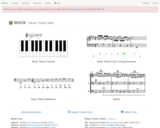
This course gives a broad overview of Western music from the Middle Ages to the 20th century, with emphasis on late baroque, classical, romantic, and modernist styles (1700-1910). It is also meant to enhance students' musical experience by developing listening skills and an understanding of diverse forms and genres. Major composers and their works will be placed in social and cultural contexts. Weekly lectures feature demonstrations by professional performers, and introduce topics to be discussed in sections. The focus of the course is on the weekly listening and reading assignments.
This lesson is aimed at adults who interrupted their education due to …
This lesson is aimed at adults who interrupted their education due to multiple problems. The purpose is to develop reading and writing skills while learning essential information about the musical genre of jazz.
This is a look at some of the more successful jazz pianists …
This is a look at some of the more successful jazz pianists from Memphis Tennessee. Each artist has experienced national and international acclaim as both a pianist and composer. What's more, they are all comtemporaries having attended the University of Memphis (then Memphis State University)at the same time.
These materials, created by Dr. Adam Gaines in Summer 2023, feature a …
These materials, created by Dr. Adam Gaines in Summer 2023, feature a syllabus, video lectures, bibliographic references, assignment prompts, discussion questions, and links to library resources, like Ken Burns' film, Jazz. The topics covered in this course include: Background through 1910s: Jazz Heritage and Early Styles; 1920s Through 1940s: The Jazz Age and The Swing Era; 1950s Through 1980s: Breakthroughs, Fusions and Reexaminations; 1990s Through Today: An Evolving Artform.
Welcome to Music 1300, Music: Its Language History, and Culture. The course …
Welcome to Music 1300, Music: Its Language History, and Culture. The course has a number of interrelated objectives: 1. To introduce you to works representative of a variety of music traditions.These include the repertoires of Western Europe from the Middle Agesthrough the present; of the United States, including art music, jazz, folk, rock, musical theater; and from at least two non-Western world areas (Africa, Asia, Latin America, the Caribbean, the Middle East, Indian subcontinent). 2. To enable you to speak and write about the features of the music you study,employing vocabulary and concepts of melody, rhythm, harmony, texture, timbre,and form used by musicians. 3. To explore with you the historic, social, and cultural contexts and the role of class, ethnicity, and gender in the creation and performance of music,including practices of improvisation and the implications of oral andnotated transmission. 4. To acquaint you with the sources of musical sounds—instruments and voices fromdifferent cultures, found sounds, electronically generated sounds; basic principlesthat determine pitch and timbre. 5. To examine the influence of technology, mass media, globalization, and transnationalcurrents on the music of today. The chapters in this reader contain definitions and explanations of musical terms and concepts,short essays on subjects related to music as a creative performing art, biographical sketchesof major figures in music, and historical and cultural background information on music fromdifferent periods and places.
This course begins with the premise that the 1960s mark a great …
This course begins with the premise that the 1960s mark a great dividing point in the history of 20th century Western musical culture, and explores the ways in which various social and artistic concerns of composers, performers, and listeners have evolved since that decade. It focuses on works by classical composers from around the world. Topics include the impact of rock, as it developed during the 1960s - 70s; the concurrent emergence of post serial, neotonal, minimalist, and new age styles; the globalization of Western musical traditions; the impact of new technologies; and the significance of music video, video games, and other versions of multimedia. The course interweaves discussion of these topics with close study of seminal musical works, evenly distributed across the four decades since 1960; works by MIT composers are included.
In this course, students study concepts and practice techniques of improvisation in …
In this course, students study concepts and practice techniques of improvisation in solo and ensemble contexts. The course examines relationships between improvisation, composition, and performance based in traditional and experimental approaches. Hands-on music making will be complemented by discussion of the aesthetics of improvisation. Weekly lab sessions support work on musical technique. Guest artist / lecturers will engage students through mini-residencies in jazz with film, Indian music, electronic music, and blending improvisation with classic music; and an accompanying concert series will feature these artists in performance. Open by audition to instrumental or vocal performers.
This pass/fail seminar should be a fun setting where we can all …
This pass/fail seminar should be a fun setting where we can all enjoy a love of good books together. Students will read approximately one novel every two weeks, and the class will discuss each novel in a relaxed and interactive setting, with attention to whatever themes and issues interest them most about each book. We will read a wide mixture of classic and contemporary novels written by women, including: Edith Wharton, The House of Mirth; Toni Morrison, Jazz; Virginia Woolf, Mrs. Dalloway; Alice Walker, The Color Purple; Charlotte Brontë, Jane Eyre; Sheri Reynolds, The Rapture of Canaan; Jane Austen, Pride and Prejudice; and Sylvia Plath, The Bell Jar. Recurrent issues likely to be discussed include: gender, race, and class; romance, love, and marriage; depression and suicide; and conception, childbirth, and parenthood.
No restrictions on your remixing, redistributing, or making derivative works. Give credit to the author, as required.
Your remixing, redistributing, or making derivatives works comes with some restrictions, including how it is shared.
Your redistributing comes with some restrictions. Do not remix or make derivative works.
Most restrictive license type. Prohibits most uses, sharing, and any changes.
Copyrighted materials, available under Fair Use and the TEACH Act for US-based educators, or other custom arrangements. Go to the resource provider to see their individual restrictions.