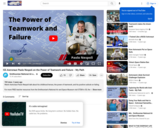
Tune in as we talk to NASA astronauts who launched to the …
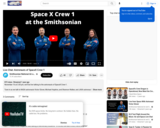
Tune in as we talk to NASA astronauts who launched to the International Space Station on the first operational crewed flight of a SpaceX Crew Dragon spacecraft (Crew-1).
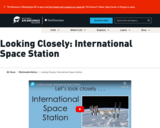
Learn about the history and importance of the International Space Station from …
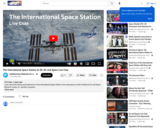
Learn about the history and importance of the International Space Station from astronauts as well as National Air and Space Museum curator, Dr. Jennifer Levasseur.
This resource is a video abstract of a research paper created by …
This resource is a video abstract of a research paper created by Research Square on behalf of its authors. It provides a synopsis that's easy to understand, and can be used to introduce the topics it covers to students, researchers, and the general public. The video's transcript is also provided in full, with a portion provided below for preview:
"Antibiotic resistance is a growing problem worldwide—and in outer space. Spaceflight can promote biofilm formation and antimicrobial resistance development, and astronauts are especially vulnerable to infection due to the unique demands of spaceflight. To support future space travel, it is critical to understand exactly how spaceflight affects microbial diversity and virulence. To learn more, researchers recently used a machine learning algorithm to analyze sequencing data from the Microbial Tracking (MT)-1 mission, which sampled microbes at eight locations on the International Space Station during three flights. The model predicted the presence of hundreds of antibiotic resistance genes (ARGs) in the 226 bacterial strains isolated from the flights, including strains of the potentially very pathogenic bacterium Enterobacter bugandensis and the food poisoning-related bacterium Bacillus cereus..."
The rest of the transcript, along with a link to the research itself, is available on the resource itself.
This resource is a video abstract of a research paper created by …
This resource is a video abstract of a research paper created by Research Square on behalf of its authors. It provides a synopsis that's easy to understand, and can be used to introduce the topics it covers to students, researchers, and the general public. The video's transcript is also provided in full, with a portion provided below for preview:
"A new addition to the International Space Station marks the beginning of exciting new explorations of exotic matter. This is BECCAL, the Bose-Einstein Condensate and Cold Atom Laboratory. A joint venture between NASA and the German Aerospace Center, BECCAL will enable scientists across the globe to eliminate one pesky force that plagues earthbound experiments: gravity. A Bose-Einstein condensate is a state of matter formed by cooling a gas of extremely low density to just above absolute zero. Systems like this enable scientists to study aspects of quantum mechanics on a relatively big scale, and could hold the key to bridging quantum mechanics to general relativity. Methods for generating Bose-Einstein condensates vary according to how they trap atoms, using either optics or magnets to do the trick. But typical experiments are hampered by the force of gravity. In a standard setup, gravity deforms optical and magnetic traps..."
The rest of the transcript, along with a link to the research itself, is available on the resource itself.
Using photographs and models, students are taken on a virtual journey to …
Using photographs and models, students are taken on a virtual journey to outer space. They can look back at the Earth as they travel further away and see it growing increasingly smaller, giving the experience that we live on a tiny planet that floats in a vast and empty space.
This resource is a video abstract of a research paper created by …
This resource is a video abstract of a research paper created by Research Square on behalf of its authors. It provides a synopsis that's easy to understand, and can be used to introduce the topics it covers to students, researchers, and the general public. The video's transcript is also provided in full, with a portion provided below for preview:
"Built environment microbiomes are shaped by their occupants and the outside environment. These microbiomes can have a profound impact on the health of its occupants. The International Space Station (ISS) is a uniquely sealed environment, with only the arrival of crewmembers and supplies introducing new microbes. Monitoring the ISS microbiome is important to ensure astronaut health and spacecraft integrity. So, a recent study used samples from two long-term projects, Microbial Tracking 1 and 2, which sampled the same surfaces over two 14-month-long periods. The ISS surface microbiome was dominated by microbes associated with human skin. The most represented groups were Staphylococcus and Malassezia among bacteria and fungi, respectively. Community abundances shifted over time, but did not differ between surfaces. Overall, the metabolism genes tended towards amino acid utilization rather than carbohydrate metabolism..."
The rest of the transcript, along with a link to the research itself, is available on the resource itself.
This November, we celebrate 20 years of continuous human presence on the …
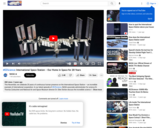
This November, we celebrate 20 years of continuous human presence on the International Space Station--an incredible example of international cooperation.
This lesson presents several images taken from the International Space Station and …
This lesson presents several images taken from the International Space Station and challenges students to identify the land forms and their locations on Earth.
This presentaton show multiple landforms from the ISS. It supports the Identifying …
This presentaton show multiple landforms from the ISS. It supports the Identifying Landforms from the International Space Station Lesson and Learning Lab
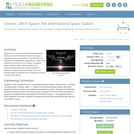
Students are introduced to the International Space Station (ISS) with information about …
Students are introduced to the International Space Station (ISS) with information about its structure, operation and key experiments. The ISS itself is an experiment in international cooperation to explore the potential for humans to live in space. The space station features state-of-the-art science and engineering laboratories to conduct research in medicine, materials and fundamental science to benefit people on Earth as well as people who will live in space in the future.
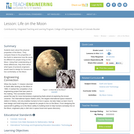
In this lesson, students learn about the physical properties of the Moon. …
In this lesson, students learn about the physical properties of the Moon. They compare these to the properties of the Earth to determine how life would be different for astronauts living on the Moon. Using their understanding of these differences, they are asked to think about what types of products engineers would need to design for us to live comfortably on the Moon.
This resource is a video abstract of a research paper created by …
This resource is a video abstract of a research paper created by Research Square on behalf of its authors. It provides a synopsis that's easy to understand, and can be used to introduce the topics it covers to students, researchers, and the general public. The video's transcript is also provided in full, with a portion provided below for preview:
"Microbes colonize and influence nearly every environment on Earth, and when we go to space, like on the International Space Station (ISS), we bring some with us. The ISS microbial community structure has been well described, but the interactions between species have not. To close that gap, researchers utilized computer models to examine the potential metabolic interactions among ISS microbes. _Klebsiella pneumoniae_ has been shown previously to dominate the ISS microbiome, and in this study _K. pneumoniae_ and other members of the Enterobacteriaceae family were predicted to be beneficial to the survival of some microbes. But not all the predicted interactions were beneficial. For the fungal groups _Aspergillus_ and _Penicillium_, the analysis predicted harmful interactions with and without benefit to _K. pneumoniae_, respectively. Culturing _K..."
The rest of the transcript, along with a link to the research itself, is available on the resource itself.
JAXA Astronaut Soichi Noguchi was the first person to make sushi in …
JAXA Astronaut Soichi Noguchi was the first person to make sushi in space. Hear about this and what it is like to be a member of an international crew orbiting 250 miles above the earth.
No restrictions on your remixing, redistributing, or making derivative works. Give credit to the author, as required.
Your remixing, redistributing, or making derivatives works comes with some restrictions, including how it is shared.
Your redistributing comes with some restrictions. Do not remix or make derivative works.
Most restrictive license type. Prohibits most uses, sharing, and any changes.
Copyrighted materials, available under Fair Use and the TEACH Act for US-based educators, or other custom arrangements. Go to the resource provider to see their individual restrictions.