This is a syllabus for the course "The Age of Human Rights" …
This is a syllabus for the course "The Age of Human Rights" (Capstone course – International Relations & International Law) designed for the University College Groningen (UCG), University of Groningen (the Netherlands). The syllabus is designed by taking into consideration the UCG’s focus on project-based education and it is further inspired by the design thinking approach to education.
This course aims to do two things. Firstly, to provide a good knowledge base on what international human rights are and what mechanisms exist to implement, supervise and enforce them. Secondly, to discuss in a critical manner how international human rights thinking has become inextricably linked to almost all areas of international cooperation. Students are asked to critically analyse specific human rights issues from a multi- or interdisciplinary perspective, thereby drawing upon information from the various disciplinary fields that they have covered in their programmes.
The first part of the course (6 sessions) is used to create the relevant knowledge base through interactive lectures. In the second part of the course (12 sessions), students are asked to work in small subgroups on particular issue areas which will be chosen in consultation with the instructors. The course concludes with a half-day conference on human rights in which the participating students act as panel members (this may be subject to change).
This four-lesson curriculum unit will examine the nature of what Winston Churchill …
This four-lesson curriculum unit will examine the nature of what Winston Churchill called the "Grand Alliance" between the United States, Great Britain, and the Soviet Union in opposition to the aggression of Nazi Germany and Imperial Japan.
The Beijing Urban Design Studio is a joint program between the MIT …
The Beijing Urban Design Studio is a joint program between the MIT and Tsinghua University Schools of Architecture and Planning. The goal of the studio is to foster international cooperation through the undertaking of a joint urban design and planning initiative in the city of Beijing involving important, often controversial, sites and projects. Since 1995, almost 250 MIT and Tsinghua University students and faculty have participated in this annual studio, making it one of the most successful and enduring international academic programs between China and the US. It has received the Irwin Sizer Award from MIT for outstanding innovation in education. The studio takes place over five weeks in June and July including several weeks in residence at Tsinghua University and two brief study tours to locations and projects that inform the work. It will include 18-20 MIT and 10-15 Tsinghua Architecture and Planning students. The Beijing City Planning Institute, responsible for strategic planning in the city, participates in the studio as the client.
This is the 20th anniversary of the Beijing Urban Design Studio, which …
This is the 20th anniversary of the Beijing Urban Design Studio, which is a joint program between the MIT and Tsinghua University Schools of Architecture and Planning. The goal of the studio is to foster international cooperation through the undertaking of a joint urban design and planning initiative in the city of Beijing involving important, often controversial, sites and projects. Since 1995, almost 250 MIT and Tsinghua University students and faculty have participated in this annual studio, making it one of the most successful and enduring international academic programs between China and the U.S. It has received the Irwin Sizer Award from MIT for outstanding innovation in education. The studio takes place over five weeks in June and July including several weeks in residence at Tsinghua University and two brief study tours to locations and projects that inform the work. It will include 18-20 MIT and 10-15 Tsinghua Architecture and Planning students. The Beijing City Planning Institute, responsible for strategic planning in the city, participates in the studio as the client.
Why Should Americans Study World Politics? 1. It can kill you. 2. …
Why Should Americans Study World Politics?
1. It can kill you. 2. It costs you money. 3. It affects your job. 4. It affects your shopping. 5. It affects your health. 6. The world is becoming more and more globalized, more and more quickly.
Whether we like it or not, world politics affects us greatly. So it is a good idea for us to know what is going on out there.
The Council on Foreign Relations (CFR) presents a backgrounder on Al-Shabab; an …
The Council on Foreign Relations (CFR) presents a backgrounder on Al-Shabab; an Islamist insurgent group that remains capable of carrying out massive attacks in Somalia and surrounding countries despite a decade-long African Union offensive against the Islamist group. CFR Backgrounders provide an in-depth analysis on current political and economic issues.
The Council on Foreign Relation's (CFR) "Deforestation in the Amazon" InfoGuide provides …
The Council on Foreign Relation's (CFR) "Deforestation in the Amazon" InfoGuide provides a compelling look at the causes and consequences of deforestation in the Brazilian Amazon and is available online in English and Portuguese. CFR InfoGuides are a multimedia series to promote understanding of complex foreign policy issues.
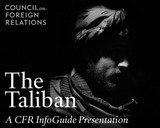
The Council of Foreign Relations (CFR) InfoGuide on The Taliban examines the …
The Council of Foreign Relations (CFR) InfoGuide on The Taliban examines the two Talibans, in Afghanistan and Pakistan, and the consequences for the region. CFR InfoGuides are a multimedia series to promote understanding of complex foreign policy issues.
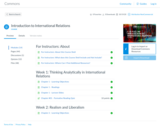
Canvas Course Shell for C-ID POLS 140 Introduction to International Relations: an …
Canvas Course Shell for C-ID POLS 140 Introduction to International Relations: an introduction to international relations theory with an examination of national, international, transnational, and sub-national actors and their institutions, interactions and processes as they relate to global issues.
The content contained within this Open Education Resource (OER) was curated and/or created by Dr. Charlotte Lee at Berkeley City College, Dr. Katherine Michel at Ohlone College, and Dr. Josh Franco at Cuyamaca College. The curation and creation of this content was funded by the Academic Senate for California Community College's Open Educational Resources Initiative.
Question Banks were created by Josh Franco, Ph.D., Elizabeth Nash, M.A., and Jereme Umali, M.A..
This lecture course provides students with a comprehensive introduction to the international …
This lecture course provides students with a comprehensive introduction to the international relations of the People’s Republic of China. China’s foreign relations during the Cold War as well as contemporary diplomatic, security and economic issues will be examined to identify and explain China’s foreign policy goals and their implementation since 1949. Throughout, this course will investigate the sources of conflict and cooperation in China’s behavior, assessing competing explanations for key events and policies. Readings will be drawn from political science, history, and international relations theory.
This course explores the leading theoretical and methodological approaches to studying China's …
This course explores the leading theoretical and methodological approaches to studying China's interaction with the international system since 1949. Readings include books and articles that integrate the study of China's foreign policy with the field of international relations.
China's rise as a great power raises important questions about how that …
China's rise as a great power raises important questions about how that power might be used in its relations with other states. Nowhere are such questions more salient than in the future trajectory of China's conflict behavior, including its approach to deterrence, crisis management and the use of force. To explore these important questions in China's international relations, this seminar examines the evolution of Chinese strategic thought, in primary sources as well as its reflection in the interactions among Chinese states and between China and other states.
This course focuses on the complexities associated with security and sustainability of …
This course focuses on the complexities associated with security and sustainability of states in international relations. Covering aspects of theory, methods and empirical analysis, the course is in three parts, and each consists of seminar sessions focusing on specific topics.
Module on conflict in international relations. Intended for community college students and …
Module on conflict in international relations. Intended for community college students and aligned with the requirements for POLS 140: Introduction to International Relations within the California Community College system. Includes lesson plan, required readings, and ancillary materials (lecture slides and worksheet).
This book is primarily intended for second year and upwards undergraduate students …
This book is primarily intended for second year and upwards undergraduate students in general political theory and international theory, and advanced international relations students. Each chapter is also downloadable on its own for use in courses considering only some of the ten theorists covered.
Written in an accessible way Conflict, War and Revolution will also interest advanced general readers with interests in the historical thought underpinnings of political ideas and today’s international politics.
Introductory module on contemporary China in the world. Intended for community college …
Introductory module on contemporary China in the world. Intended for community college students and lower division students enrolled in relevant courses in global studies, international studies, international relations, Asian studies, and political science. Includes suggested readings, lesson plan, and ancillary materials (lecture slides, notes, and student handout).
In this 1998 interview, Conversations host Harry Kreisler welcomes Faisal Husseini, one …
In this 1998 interview, Conversations host Harry Kreisler welcomes Faisal Husseini, one of the leading figures in the Palestinian national movement and Yossi Beilin, a leading Israeli political figure, for a discussion of how their mutual dialogue set in motion the Oslo Peace Accord. Both Husseini and Beilin talk about their lives and how their perceptions of the other took an important turn toward peace. (50 min)
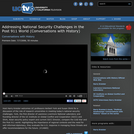
Host Harry Kreisler welcomes UC professors Herbert York and Susan Shirk for …
Host Harry Kreisler welcomes UC professors Herbert York and Susan Shirk for a discussion of the role of research universities in meeting today’s national security challenges. York, the first director of Lawrence Livermore National Laboratory and founding director of the UC Institute on Global Conflict and Cooperation (IGCC) and Shirk, Asian security policy expert and current IGCC Director, compare the Cold War and the Post 911 world. Highlighting the importance of regional contexts and the need for well informed diplomacy, they evaluate the U.S. response in managing these threats and offer recommendations for the future. (55 minutes)
Conversations with History host Harry Kreisler interviews Joseph Joffe, editor/publisher of Die …
Conversations with History host Harry Kreisler interviews Joseph Joffe, editor/publisher of Die Zeit, about the implications of the Bush Doctrine for U.S-European relations. (58 min)
Kishore Mahbubani, author of Beyond the Age of Innocence: Rebuilding Trust between …
Kishore Mahbubani, author of Beyond the Age of Innocence: Rebuilding Trust between America and the World and Can Asians Think? joins Conversations host Harry Kreisler for a discussion about America and the world. (55 min)
No restrictions on your remixing, redistributing, or making derivative works. Give credit to the author, as required.
Your remixing, redistributing, or making derivatives works comes with some restrictions, including how it is shared.
Your redistributing comes with some restrictions. Do not remix or make derivative works.
Most restrictive license type. Prohibits most uses, sharing, and any changes.
Copyrighted materials, available under Fair Use and the TEACH Act for US-based educators, or other custom arrangements. Go to the resource provider to see their individual restrictions.