This is a syllabus for the course "The Age of Human Rights" …
This is a syllabus for the course "The Age of Human Rights" (Capstone course – International Relations & International Law) designed for the University College Groningen (UCG), University of Groningen (the Netherlands). The syllabus is designed by taking into consideration the UCG’s focus on project-based education and it is further inspired by the design thinking approach to education.
This course aims to do two things. Firstly, to provide a good knowledge base on what international human rights are and what mechanisms exist to implement, supervise and enforce them. Secondly, to discuss in a critical manner how international human rights thinking has become inextricably linked to almost all areas of international cooperation. Students are asked to critically analyse specific human rights issues from a multi- or interdisciplinary perspective, thereby drawing upon information from the various disciplinary fields that they have covered in their programmes.
The first part of the course (6 sessions) is used to create the relevant knowledge base through interactive lectures. In the second part of the course (12 sessions), students are asked to work in small subgroups on particular issue areas which will be chosen in consultation with the instructors. The course concludes with a half-day conference on human rights in which the participating students act as panel members (this may be subject to change).
An interview conducted by the ACLU in March of 2005, preceding a …
An interview conducted by the ACLU in March of 2005, preceding a Supreme Court hearing in the case of Castle Rock, Colorado v. Gonzales. This case determined the accountability of local law enforcement for failing to enforce court orders that protect victims of abuse by a spouse or acquaintance.
In the first case brought by a survivor of domestic violence against …
In the first case brought by a survivor of domestic violence against the U.S. before an international human rights tribunal, the Inter-American Commission on Human Rights (IACHR) found that the United States violated the human rights of Jessica Lenahan (formerly Gonzales) and her children.
This course explores the reasons for America's past wars and interventions. It …
This course explores the reasons for America's past wars and interventions. It covers the consequences of American policies, and evaluates these consequences for the U.S. and the world. History covered includes World Wars I and II, the Korean and Indochina wars, the Cuban Missile Crisis and current conflicts, including those in in Iraq and Afghanistan, and against Al Qaeda.
Drawing upon the online archives of the U.S. Holocaust Museum, this lesson …
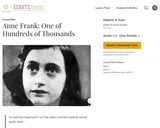
Drawing upon the online archives of the U.S. Holocaust Museum, this lesson helps students to put the events described by Anne Frank into historical perspective, and also serves as a broad overview of the Nazi conquest of Europe during World War II. After surveying the experiences of various countries under Nazi occupation, the lesson ends with activities related specifically to the Netherlands and Anne Frank.
This lesson concentrates on Anne Frank as a writer. After a look …
This lesson concentrates on Anne Frank as a writer. After a look at Anne Frank the adolescent, and a consideration of how the experiences of growing up shaped her composition of the Diary, students explore some of the writing techniques Anne invented for herself and practice those techniques with material drawn from their own lives.
This series looks at the Oxford Martin School's academics and how their …
This series looks at the Oxford Martin School's academics and how their research is making a difference to our global future. The series will be of interest to people who are concerned about the future for the planet, how civilisation will adapt to emerging problems and issues such as climate change, over population, increased urbanisation of populations and the creation of vaccines to fight against future pandemics. The Oxford Martin School academics explain their various research topics in an accessible and thoughtful way and try to find practical solutions to these issues.
Interdisciplinary survey of people of African descent that draws on the overlapping …
Interdisciplinary survey of people of African descent that draws on the overlapping approaches of history, literature, anthropology, legal studies, media studies, performance, linguistics, and creative writing. This course connects the experiences of African-Americans and of other American minorities, focusing on social, political, and cultural histories, and on linguistic patterns.
This textbook provides a much-needed legal examination of the criticisms often levelled …
This textbook provides a much-needed legal examination of the criticisms often levelled at the human rights record of the WTO, and Assesses whether developed States have an obligation towards developing nations to create a fairer trading system in the light of the failure of the Doha Round.
Short Description: This text, The Cause and Consequence of Human Trafficking: Human …
Short Description: This text, The Cause and Consequence of Human Trafficking: Human Rights Violations, is intended to convey the importance of understanding how the violation of human rights is a cause and consequence of human trafficking.
Long Description: This text, The Cause and Consequence of Human Trafficking: Human Rights Violations, is intended to convey the importance of understanding how the violation of human rights is a cause and consequence of human trafficking. In other words, human rights violations are egregious and they compound destitution. They deprive the man, woman and child of their basic humanity. Whenever any dimension of one’s humanity is deprived, it puts the person in a compromised state. Compromised states lead to some degree of impairment, distress or suffering. Impairment, distress or suffering leads to a disequilibrium in a person’s life. In an effort to quiet that compromised state, the individual may unknowingly make decisions that further compromises his or her state of being or result in human trafficking.
Word Count: 63892
(Note: This resource's metadata has been created automatically by reformatting and/or combining the information that the author initially provided as part of a bulk import process.)
Excerpts of Landmark Cases Short Description: This volume focuses on the constitutional …
Excerpts of Landmark Cases
Short Description: This volume focuses on the constitutional doctrine and law in the areas of civil rights and liberties. It contains excerpts of landmark cases covering the first amendment, second amendment, fourteenth amendment and the right to privacy. The excerpts include the constitutional issues in these cases that are related to civil rights and liberties with other questions of law and dicta omitted. Data dashboard
Long Description: This volume focuses on the constitutional doctrine and law in the areas of civil rights and liberties. It contains excerpts of landmark cases covering the first amendment, second amendment, fourteenth amendment and the right to privacy. The excerpts include the constitutional issues in these cases that are related to civil rights and liberties with other questions of law and dicta omitted.
Word Count: 473587
ISBN: 978-1-955101-35-6
(Note: This resource's metadata has been created automatically by reformatting and/or combining the information that the author initially provided as part of a bulk import process.)
This is a collection of downloadable video clips on the theme of …
This is a collection of downloadable video clips on the theme of Conflict, with guiding questions for students. Clips are drawn from the following PBS WIDE ANGLE documentaries: "Greetings from Grozny" (2002), "Ladies First" (2004), "Suicide Bombers" (2004).
Central to our era is the gradual movement of all the world's …
Central to our era is the gradual movement of all the world's regions toward a uniform standard of economic and political development. In this class we will read a variety of recent narratives that partake of, dissent from, or contribute to this story, ranging from novels and poems to World Bank and IMF statements and National Geographic reports. We will seek to understand the many motives and voices – sometimes congruent, sometimes clashing – that are currently engaged in producing accounts of people in the developing world: their hardships, laughter, and courage, and how they help themselves and are helped by outsiders who may or may not have philanthropic motives. Readings will include literature by J. G. Ballard, Jamaica Kincaid, Rohinton Mistry, and John le Carré, as well as policy documents, newspaper and magazine articles, and the Web sites of a variety of trade and development commissions and organizations.
Host Harry Kreisler welcomes Ambassador Princeton N. Lyman, former U.S. Ambassador to …
Host Harry Kreisler welcomes Ambassador Princeton N. Lyman, former U.S. Ambassador to South Africa and Nigeria for a discussion of U.S. Africa Relations. He talks about AfricaŐs strategic importance to the United States focusing on issues such as energy, health, terrorism, and human rights. He describes the role of China in African affairs and analyzes the U.S. capacity to engage Africa in the new strategic environment of the post 911 world. (52 min)
Conversations host Harry Kreisler welcomes Harvard Professor Samantha Power for a discussion …
Conversations host Harry Kreisler welcomes Harvard Professor Samantha Power for a discussion of her new book, "Chasing the Flame: Sergio Vieira de Mello and the Fight to Save the World." The conversation focuses on the lessons of De Mello's life for understanding the challenges confronting world order in the 21st century. (56 minutes)
UC Berkeley's Harry Kreisler and Juan Guzman, Chief judge, Court of Appeals, …
UC Berkeley's Harry Kreisler and Juan Guzman, Chief judge, Court of Appeals, Santiago, Chile, discuss human rights and the Chilean justice system. (59 min))
UC Berkeley's Harry Kreisler welcomes John Shattuck, Chief Executive Officer, Kennedy Library …
UC Berkeley's Harry Kreisler welcomes John Shattuck, Chief Executive Officer, Kennedy Library Foundation, for a discussion of his career and work in the area of civil liberties and human rights. (54 min)
Conversations host Harry Kreisler welcomes Harvard philosophy professor T.M. Scanlon for a …
Conversations host Harry Kreisler welcomes Harvard philosophy professor T.M. Scanlon for a discussion of freedom of expression, tolerance, and human rights. (53 minutes)
No restrictions on your remixing, redistributing, or making derivative works. Give credit to the author, as required.
Your remixing, redistributing, or making derivatives works comes with some restrictions, including how it is shared.
Your redistributing comes with some restrictions. Do not remix or make derivative works.
Most restrictive license type. Prohibits most uses, sharing, and any changes.
Copyrighted materials, available under Fair Use and the TEACH Act for US-based educators, or other custom arrangements. Go to the resource provider to see their individual restrictions.