This is an activity that can be done after the reading of …
This is an activity that can be done after the reading of Number the Stars. It's a lesson plan that will allow them to research what actually happened during the Holocaust to the Jews that were caught, luckily, unlike Annemarie's friend.I have also included the website to the LiveBinders binder that I made to go alongside with the lesson plan. It has websites about the Holocaust if you want to have the students all visiting the same sites. There are also a varying amount of questions that go along with each website in the binder.
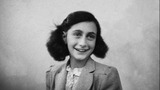
Jewish Anne Frank hid in 1942 from the Nazis during the occupation …
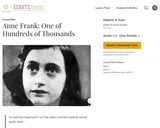
Jewish Anne Frank hid in 1942 from the Nazis during the occupation of the Netherlands. Two years later she was discovered. In 1945 she died in the Bergen-Belsen concentration camp.
These lessons explain more about Anne Frank's life and the historical context around Anne Frank's diary.
Drawing upon the online archives of the U.S. Holocaust Museum, this lesson …
Drawing upon the online archives of the U.S. Holocaust Museum, this lesson helps students to put the events described by Anne Frank into historical perspective, and also serves as a broad overview of the Nazi conquest of Europe during World War II. After surveying the experiences of various countries under Nazi occupation, the lesson ends with activities related specifically to the Netherlands and Anne Frank.
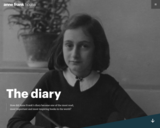
How did Anne Frank's diary become one of the most read, most …
How did Anne Frank's diary become one of the most read, most important and most inspiring books in the world? Learn more by exploring the lessons in this unit.
This lesson concentrates on Anne Frank as a writer. After a look …
This lesson concentrates on Anne Frank as a writer. After a look at Anne Frank the adolescent, and a consideration of how the experiences of growing up shaped her composition of the Diary, students explore some of the writing techniques Anne invented for herself and practice those techniques with material drawn from their own lives.
Bill Rice recalls how German soldiers began surrendering towards the end of …
Bill Rice recalls how German soldiers began surrendering towards the end of the war in Europe. He also discusses how his platoon was involved in liberating prison camps in Germany in this video teaching module from the KACV's local perspective on "The War."
This resource was created by Kate Chrisman, in collaboration with Lynn Bowder, …
This resource was created by Kate Chrisman, in collaboration with Lynn Bowder, as part of ESU2's Mastering the Arts project. This project is a four year initiative focused on integrating arts into the core curriculum through teacher education and experiential learning.
Host Harry Kreisler welcomes distinguished public servant Stuart E. Eizenstat for a …
Host Harry Kreisler welcomes distinguished public servant Stuart E. Eizenstat for a discussion of his career in politics and law and his new book, "Imperfect Justice," an account of his work as the President's envoy to solve the conundrum of reparations for Holocaust survivors. (56 min)
These lessons are provided by Echoes and Reflections. The lessons come from a …
These lessons are provided by Echoes and Reflections. The lessons come from a new book, "Teaching the Holocaust By Inquiry" by Beth Krasemann. The book is scheduled for release at the end of May 2022.
These four lessons are provided by Echoes and Reflections. The lessons come …
These four lessons are provided by Echoes and Reflections. The lessons come from a new book, "Teaching the Holocaust By Inquiry" by Beth Krasemann. The book is scheduled for release at the end of May 2022.
This assignment ties thematically into texts concerning Mob Mentality, Cliques, and Groupthink. …
This assignment ties thematically into texts concerning Mob Mentality, Cliques, and Groupthink. Students are asked to evaluate the psychology behind groupthink and relate it to written and world texts they have encountered.
Social injustice occurs every day all over the world. In this lesson, …
Social injustice occurs every day all over the world. In this lesson, students research a few historical examples of social injustice, including the Holocaust, the Trail of Tears, and Japanese internment.
This Lesson Plan was created by Joanna Pruitt as part of the …
This Lesson Plan was created by Joanna Pruitt as part of the 2020 ESU-NDE Remote Learning Plan Project. This original lesson is for classroom use; however, there is a virtual option as well. Educators worked with coaches to create Remote Learning Plans as a result of the COVID-19 pandemic. The attached Lesson Plan is designed for Grades 9-12 English Language Arts students; however, this could also be used as a Social Studies project as well. Students will evaluate credible sources through research on genocides post World War II after completing a novel unit covering the Holocaust. Students will also create scrapbooks using summarizing, citation, informative writing, textual evidence, caption writing, and persuasive writing. Students will also be expected to demonstrate oral communication skills as they have to present their projects to the class. Students will use background knowledge to clarify text and also gain a deeper understanding by using relevant evidence from a variety of sources to assist in analysis and reflection of informative text.
Holocaust education is history, literature, social studies, psychology, art, and so much …
Holocaust education is history, literature, social studies, psychology, art, and so much more. By studying the Holocaust we learn the importance of speaking out against bigotry and indifference, promoting equity, and taking action. Studies show that Holocaust education both improves students' critical thinking skills and encourages "upstander" behavior: willingness to act upon civic awareness and confront hatred in all its forms. On this site you're going to find lessons that adhere to the requisite guidelines for teaching about the Holocaust and Genocide, with options for in-person and remote instruction. Each Overview Lesson includes:Historical summarySurvivor video clipsDiscussion questionsCommon Core State Standards addressed in that lesson
The Holocaust: Remembrance, Respect, and Resilience by Michael Polgar and Suki John …
The Holocaust: Remembrance, Respect, and Resilience by Michael Polgar and Suki John is a collection of multi-disciplinary essays and lesson plans by different scholars and Holocaust educators offered as an Open Educational Resource (OER).
This course explores how our views of Jewish history have been formed …
This course explores how our views of Jewish history have been formed and how this history can explain the survival of the Jews as an ethnic/religious group into the present day. Special attention is given to the partial and fragmentary nature of our information about the past, and the difficulties inherent in decoding statements about the past that were written with a religious agenda in mind. It also considers complex events in Jewish history -- from early history as portrayed in the Bible to recent history, including the Holocaust.
No restrictions on your remixing, redistributing, or making derivative works. Give credit to the author, as required.
Your remixing, redistributing, or making derivatives works comes with some restrictions, including how it is shared.
Your redistributing comes with some restrictions. Do not remix or make derivative works.
Most restrictive license type. Prohibits most uses, sharing, and any changes.
Copyrighted materials, available under Fair Use and the TEACH Act for US-based educators, or other custom arrangements. Go to the resource provider to see their individual restrictions.