You will present students with a challenge: build a structure from different …
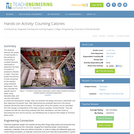
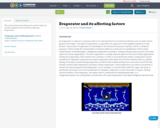
You will present students with a challenge: build a structure from different materials that will protect a model of the Ares launch vehicles (a raw egg) from the heat of a propane torch for as long as possible. Then they design, build, test, and revise their own thermal protection systems. They document their designs with sketches and written descriptions. As a culmination, students compile their results into a poster and present them to the class.
This activity explores the concepts of energy transfer with the following standards: • Energy is a property of many substances and is associated with heat and light. • Heat moves in predictable ways, flowing from warmer objects to cooler ones, until both reach the same temperature.
Have you ever wondered why ventilation helps to cool down your hot …
Have you ever wondered why ventilation helps to cool down your hot chocolate? Do you know why a surfing suit keeps you warm? Why iron feels cold, while wood feels warm at room temperature? Or how air is transferred into aqueous liquids in a water treatment plant? How can we sterilize milk with the least amount of energy? Or how do we design a new cooling tower of a power plant?
Transport Phenomena addresses questions like these and many more, exploring a wide variety of applications ranging from industrial processes to daily life problems and even to bioprocesses in our own body.
In Transport Phenomena, the transport and transfer of momentum, heat and mass are studied. To understand these processes which often take place simultaneously, the underlying concepts will be covered in this course.
Getting Started: This lesson is designed to be used within the heat …
Getting Started:
This lesson is designed to be used within the heat transfer unit as an engineering design project.
My goal is to teach students:
The difference in heat conductivity of different materials. Engage students in thinking about the principles of engineering (designing to meet criteria determined by the desired result).
Total class time:
170 minutes (2 class blocks, 1 period for demo, in-class design, 1 period for student-requested informational experiments).
Getting Started: This lesson is designed to be used within the heat …
Getting Started:
This lesson is designed to be used within the heat transfer unit as an engineering design project.
My goal is to teach students:
The difference in heat conductivity of different materials. Engage students in thinking about the principles of engineering (designing to meet criteria determined by the desired result).
Total class time:
170 minutes (2 class blocks, 1 period for demo, in-class design, 1 period for student-requested informational experiments).
Construct and measure the energy efficiency and solar heat gain of a …
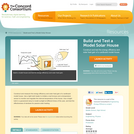
Construct and measure the energy efficiency and solar heat gain of a cardboard model house. Use a light bulb heater to imitate a real furnace and a temperature sensor to monitor and regulate the internal temperature of the house. Use a bright bulb in a gooseneck lamp to model sunlight at different times of the year, and test the effectiveness of windows for passive solar heating.
In this activity, learners burn a peanut, which produces a flame that …
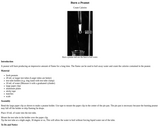
In this activity, learners burn a peanut, which produces a flame that can be used to boil away water and count the calories contained in the peanut. Learners use a formula to calculate the calories in a peanut and then differentiate between food calories and physicist calories as well as calories and joules.
2.26 is a 6-unit Honors-level subject serving as the Mechanical Engineering department's …
2.26 is a 6-unit Honors-level subject serving as the Mechanical Engineering department's sole course in compressible fluid dynamics. The prerequisites for this course are undergraduate courses in thermodynamics, fluid dynamics, and heat transfer. The goal of this course is to lay out the fundamental concepts and results for the compressible flow of gases. Topics to be covered include: appropriate conservation laws; propagation of disturbances; isentropic flows; normal shock wave relations, oblique shock waves, weak and strong shocks, and shock wave structure; compressible flows in ducts with area changes, friction, or heat addition; heat transfer to high speed flows; unsteady compressible flows, Riemann invariants, and piston and shock tube problems; steady 2D supersonic flow, Prandtl-Meyer function; and self-similar compressible flows. The emphasis will be on physical understanding of the phenomena and basic analytical techniques.
Elementary grade students investigate heat transfer in this activity to design and …
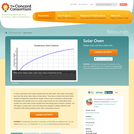
Elementary grade students investigate heat transfer in this activity to design and build a solar oven, then test its effectiveness using a temperature sensor. It blends the hands-on activity with digital graphing tools that allow kids to easily plot and share their data. Included in the package are illustrated procedures and extension activities. Note Requirements: This lesson requires a "VernierGo" temperature sensing device, available for ~ $40. This item is part of the Concord Consortium, a nonprofit research and development organization dedicated to transforming education through technology. The Consortium develops digital learning innovations for science, mathematics, and engineering.
This course focuses on laws, approximations and relations of continuum electromechanics. Topics …
This course focuses on laws, approximations and relations of continuum electromechanics. Topics include mechanical and electromechanical transfer relations, statics and dynamics of electromechanical systems having a static equilibrium, electromechanical flows, and field coupling with thermal and molecular diffusion. Also covered are electrokinetics, streaming interactions, application to materials processing, magnetohydrodynamic and electrohydrodynamic pumps and generators, ferrohydrodynamics, physiochemical systems, heat transfer, continuum feedback control, electron beam devices, and plasma dynamics. Acknowledgements The instructor would like to thank Xuancheng Shao and Anyang Hou for transcribing into LaTeX the problem set solutions and exam solutions, respectively.
Student groups are given a set of materials: cardboard, insulating materials, aluminum …
Student groups are given a set of materials: cardboard, insulating materials, aluminum foil and Plexiglas, and challenged to build solar ovens. The ovens must collect and store as much of the sun's energy as possible. Students experiment with heat transfer through conduction by how well the oven is insulated and radiation by how well it absorbs solar radiation. They test the effectiveness of their designs qualitatively by baking something and quantitatively by taking periodic temperature measurements and plotting temperature vs. time graphs. To conclude, students think like engineers and analyze the solar oven's strengths and weaknesses compared to conventional ovens.
The students discover the basics of heat transfer in this activity by …
The students discover the basics of heat transfer in this activity by constructing a constant pressure calorimeter to determine the heat of solution of potassium chloride in water. They first predict the amount of heat consumed by the reaction using analytical techniques. Then they calculate the specific heat of water using tabulated data, and use this information to predict the temperature change. Next, the students will design and build a calorimeter and then determine its specific heat. After determining the predicted heat lost to the device, students will test the heat of solution. The heat given off by the reaction can be calculated from the change in temperature of the water using an equation of heat transfer. They will compare this with the value they predicted with their calculations, and then finish by discussing the error and its sources, and identifying how to improve their design to minimize these errors.
Students learn how rooftop gardens help the environment and the lives of …
Students learn how rooftop gardens help the environment and the lives of people, especially in urban areas. They gain an understanding of how plants reduce the urban heat island effect, improve air quality, provide agriculture space, reduce energy consumption and increase the aesthetic quality of cities. This draws upon the science of heat transfer (conduction, convection, radiation, materials, color) and ecology (plants, shade, carbon dioxide, photosynthesis), and the engineering requirements for rooftop gardens. In the associated activity, students apply their scientific knowledge to model and measure the effects of green roofs.
This simulation lets learners explore how heating and cooling adds or removes …
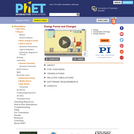
This simulation lets learners explore how heating and cooling adds or removes energy. Use a slider to heat blocks of iron or brick to see the energy flow. Next, build your own system to convert mechanical, light, or chemical energy into electrical or thermal energy. (Learners can choose sunlight, steam, flowing water, or mechanical energy to power their systems.) The simulation allows students to visualize energy transformation and describe how energy flows in various systems. Through examples from everyday life, it also bolsters understanding of conservation of energy. This item is part of a larger collection of simulations developed by the Physics Education Technology project (PhET).
Explore the concept of evaporative cooling through a hands-on experiment. Use a …
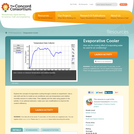
Explore the concept of evaporative cooling through a hands-on experiment. Use a wet cloth and fan to model an air-conditioner and use temperature and relative humidity sensors to collect data. Then digitally plot the data using graphs in the activity. In an optional extension, make your own modifications to improve the cooler's efficiency.
This project will be focused on designing, constructing and evaluating different containers …
This project will be focused on designing, constructing and evaluating different containers to determine the optimal design for heat retention. After students have constructed their designs and collected and shared data, students will evaluate the class data to create an optimal design for our culminating event: warming ooey, gooey chocolate chip cookies to perfection! Through this activity, students will learn about energy transfer, engineering design process, data collection, graphing, rate of change, optimization, surface area and proportions. The students will test the effectiveness of their design using Vernier Probes to gather quantitative data and graphing the rate of temperature change. They will then create a poster presentation to share their data to the class. Students will use their mathematical skills to quantitatively analyze the strength and weaknesses of their designs while enjoying some delicious, toasty, warm cookies.
This course presents finite element theory and methods for general linear and …
This course presents finite element theory and methods for general linear and nonlinear analyses. Reliable and effective finite element procedures are discussed with their applications to the solution of general problems in solid, structural, and fluid mechanics, heat and mass transfer, and fluid-structure interactions. The governing continuum mechanics equations, conservation laws, virtual work, and variational principles are used to establish effective finite element discretizations and the stability, accuracy, and convergence are discussed. The homework and the student-selected term project using the general-purpose finite element analysis program ADINA are important parts of the course.
The course "Fluid Flow, Heat and Mass Transfer," course number ta3220, is …
The course "Fluid Flow, Heat and Mass Transfer," course number ta3220, is third-year BSc course in the program of Applied Earth Sciences at Delft University of Technology. Students in this class have already taken a course in "Transport Phenomena" in the second year, and "Fluid Flow Heat and Mass Transfer" is designed as a follow-up to that class, with an emphasis on topics of importance in applied earth sciences, and in particular to Petroleum Engineering, groundwater flow and mining. In practice, however I start over again with first principles with this class, because the initial concepts of the shell balance are difficult for students to grasp and can always use a second time through. The course covers simple fluid mechanics problems (rectilinear flow) using shell balances, for Newtonian and power-law fluids and Bingham plastics. Turbulence for Newtonian fluids is covered in the context of friction factors for flow in pipes, flow around spheres and flow in packed beds.
This design-based subject provides a first course in energy and thermo-sciences with …
This design-based subject provides a first course in energy and thermo-sciences with applications to sustainable energy-efficient architecture and building technology. No previous experience with subject matter is assumed. After taking this subject, students will understand introductory thermodynamics and heat transfer, know the leading order factors in building energy use, and have creatively employed their understanding of energy fundamentals and knowledge of building energy use in innovative building design projects. This year, the focus will be on design projects that will complement the new NSTAR/MIT campus efficiency program.
Build your own miniature "greenhouse" out of a plastic container and plastic …
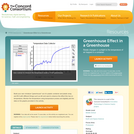
Build your own miniature "greenhouse" out of a plastic container and plastic wrap, and fill it with different things such as dirt and sand to observe the effect this has on temperature. Monitor the temperature using temperature probes and digitally plot the data on the graphs provided in the activity.
No restrictions on your remixing, redistributing, or making derivative works. Give credit to the author, as required.
Your remixing, redistributing, or making derivatives works comes with some restrictions, including how it is shared.
Your redistributing comes with some restrictions. Do not remix or make derivative works.
Most restrictive license type. Prohibits most uses, sharing, and any changes.
Copyrighted materials, available under Fair Use and the TEACH Act for US-based educators, or other custom arrangements. Go to the resource provider to see their individual restrictions.