The students will be exploring the concept of radioactive decay and half-life. …
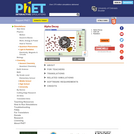
The students will be exploring the concept of radioactive decay and half-life. They will be completing an activity, followed by discussion and and calculations. After discussion, the students will be completing a PHET simulation.
Carbon dating is a real-life example of a first-order reaction. This video …
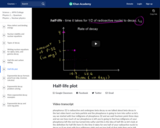
Carbon dating is a real-life example of a first-order reaction. This video explains half-life in the context of radioactive decay. Created by Sal Khan.
This course integrates studies of engineering sciences, reactor physics and safety assessment …
This course integrates studies of engineering sciences, reactor physics and safety assessment into nuclear power plant design. Topics include materials issues in plant design and operations, aspects of thermal design, fuel depletion and fission-product poisoning, and temperature effects on reactivity, safety considerations in regulations and operations, such as the evolution of the regulatory process, the concept of defense in depth, General Design Criteria, accident analysis, probabilistic risk assessment, and risk-informed regulations.
This course provides an introduction to nuclear science and its engineering applications. …
This course provides an introduction to nuclear science and its engineering applications. It describes basic nuclear models, radioactivity, nuclear reactions, and kinematics; covers the interaction of ionizing radiation with matter, with an emphasis on radiation detection, radiation shielding, and radiation effects on human health; and presents energy systems based on fission and fusion nuclear reactions, as well as industrial and medical applications of nuclear science.
This unit delves into the fundamental science and historical contexts to help …
This unit delves into the fundamental science and historical contexts to help students explore the question "How can knowledge gained from the Manhattan Project and the Hanford Site contribute using nuclear technologies to positively impact humanity in the future?."Nuclear Chemistry is a great capstone unit for a standard high school chemistry course in that it is fantastic opportunity for students to explore the crossroads between scientific knowledge and the societal implications of new discoveries. Students will have the opportunity to Delve deep into the science standards while also connecting their learning to what it means for us as a global society.
Learn about different types of radiometric dating, such as carbon dating. Understand …
Learn about different types of radiometric dating, such as carbon dating. Understand how decay and half life work to enable radiometric dating to work. Play a game that tests your ability to match the percentage of the dating element that remains to the age of the object.
Learn about different types of radiometric dating, such as carbon dating. Understand …
Learn about different types of radiometric dating, such as carbon dating. Understand how decay and half life work to enable radiometric dating to work. Play a game that tests your ability to match the percentage of the dating element that remains to the age of the object.
No restrictions on your remixing, redistributing, or making derivative works. Give credit to the author, as required.
Your remixing, redistributing, or making derivatives works comes with some restrictions, including how it is shared.
Your redistributing comes with some restrictions. Do not remix or make derivative works.
Most restrictive license type. Prohibits most uses, sharing, and any changes.
Copyrighted materials, available under Fair Use and the TEACH Act for US-based educators, or other custom arrangements. Go to the resource provider to see their individual restrictions.