The attached lesson plan is designed for 3rd grade English Language Arts …
The attached lesson plan is designed for 3rd grade English Language Arts students. Students will analyze informational text to determine the main ideas for a report, apply the concepts of the writing process, and communicate their research through an oral presentation to their classroom peers. This lesson plan addresses the following NDE Standards: NE LA 3.1.6.e, NE LA 3.2.1.a,c,d,e,j, NE LA 3.3.1.aIt is expected that this lesson plan will take five one-hour sessions to complete.
This assignment is about exploring alternative ways of sharing goods and services …
This assignment is about exploring alternative ways of sharing goods and services and understanding the benefits, drawbacks, and implications of these methods. Students are asked to choose one of seven non-market distribution methods, such as majority rule, contests, force, first-come/first-served, sharing equally, lottery, and personal characteristics, and observe how it is implemented in real-life scenarios. They need to explain the distribution method, who benefits from it, who is excluded, and the advantages and disadvantages of using it. Students also have to find a real-life example of the chosen non-market distribution method, describe how it is used, and assess its fairness and efficiency. Lastly, they are required to include a citation and ensure their submission is no less than 180 words and comprises a list of cited works. The goal of the assignment is to better understand how goods and services are distributed and how these methods affect different groups of people.
This is a collection of interactive Google Forms to complement a series …
This is a collection of interactive Google Forms to complement a series of instructional videos by Shaun Macleod and Mark Roberts of SmrtEnglish. Each exercise includes a short video along with original, self-grading comprehension questions and analysis of contextual grammar examples designed for upper-level writing students of English for Speakers of Other Languages (ESOL). When you click on a link below, you will be prompted to save a copy of the form to your own Google Drive. This allows you to edit the form as you wish and ensures that the data you collect from your students go to your computer. If you have questions or feedback, please feel free to contact me at timothy.krause@pcc.edu.
This course offers analysis and practice of various forms of scientific and …
This course offers analysis and practice of various forms of scientific and technical writing, from memos to journal articles, in addition to strategies for conveying technical information to specialist and non-specialist audiences. Comparable to 21W.780 Communicating in Technical Organizations, but methods in this course are designed to deal with special problems of advanced ELS or bilingual students. The goal of the workshop is to develop effective writing skills for academic and professional contexts. Models, materials, topics and assignments vary from term to term.
This workshop is designed to help you write clearly, accurately and effectively …
This workshop is designed to help you write clearly, accurately and effectively in both an academic and a professional environment. In class, we analyze various forms of writing and address problems common to advanced speakers of English. We will often read one another's work.
This book is intended for those who have already learned to read …
This book is intended for those who have already learned to read Arabic but are still struggling with the basics of Arabic grammar. The book moves from the very simple to the very complex, and includes examples and exercises in each chapter to reinforce learning. The key to the exercises is found in the back of the book. The book is difficult to find, as it was published at the Defense Language Institute. A free non-searchable PDF version is available through this site, and a searchable PDF is also available for purchase.
By analyzing Dear Abby's rant about bad grammar usage, students become aware …
By analyzing Dear Abby's rant about bad grammar usage, students become aware that attitudes about race, social class, moral and ethical character, and "proper" language use are intertwined.
First published in 1910, this book focuses exclusively on the grammar of …
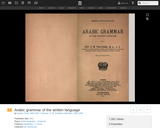
First published in 1910, this book focuses exclusively on the grammar of Modern Standard Arabic as it is used in written Arabic. It contains an introduction that explains the Arabic alphabet and pronunciation and 49 lessons that describe the foundational grammatical elements of MSA, including articles, gender, and the noun and verb systems. The text includes Arabic-English and English-Arabic vocabulary sections as well as a supplement with extract from the Qur'an, classical literature, media, and correspondence. The filesize of the PDF is 32 MB.
In this activity, students will practice using some of the verbs we …
In this activity, students will practice using some of the verbs we use on a daily basis, with the past and imperative tenses more focused on the present tense.Can-Do Statements:I can talk with someone using the three verb tenses.I can read and write words of the Arabic verb tenses.I can recognize the present tense.
In this activity, students will play a game learning how to distinguish …
In this activity, students will play a game learning how to distinguish between singular and plural in Arabic.Can-Do Statements:I can distinguish between singular and plural in Arabic.I can read and write singular and plural words in Arabic.I can form basic singular and plural sentences.
This textbook, first published in 1919, is designed to provide beginning through …
This textbook, first published in 1919, is designed to provide beginning through advanced instruction in the written form of Modern Standard Arabic. The first fifteen lessons introduce the alphabet and the book then moves on to nouns, verbs, and more complex grammatical concepts. The lessons are interspersed with self-tests, and there are review lessons every so often. The textbook contains a reader with selections from newspapers and magazines for each of the last hundred lessons. An answer key and an index are also included. The filesize of the PDF is 34 MB.
This text explores verb time, tense, aspect, and mood through comparison of …
This text explores verb time, tense, aspect, and mood through comparison of Arabic and English sentence patterns. It includes examples of the Arabic patterns from classical and popular sources so Arabic students can learn by explanation and example how to formulate cohesive and grammatically correct sentence structure.
While this guide is intended mainly for English-speaking students studying Arabic, the charts also provide a quick reference of English sentence patterns for Arabic speakers.
Arabic for Life takes an intensive, comprehensive approach to beginning Arabic instruction …
Arabic for Life takes an intensive, comprehensive approach to beginning Arabic instruction and is specifically tailored to the needs of talented and dedicated students. Unlike the other Arabic textbooks on the market, Arabic for Life is not specifically focused on either grammar or proficiency. Instead, it offers a balanced methodology that combines these goals. Frangieh has created a book that is full of energy and excitement about Arabic language and culture, and it effectively transmits that excitement to students. Arabic for Life offers a dynamic and multidimensional view of the Arab world that incorporates language with Arabic culture and intellectual thought.
The book is accompanied by a DVD with some eighty videos of native speakers reciting the vocalized texts in the book and dozens of audio recordings covering vocabulary and expressions, drills on Arabic sounds and letters, and various exercises and activities.
Bassam Frangieh is professor of Arabic at Claremont-McKenna College. He previously taught at Georgetown, Yale, and the Foreign Service Institute. He is the author of Anthology of Arabic Literature, Culture, and Thought from Pre-Islamic Times to the Present, published by Yale University Press.
Consider are the pros and cons of children performing for TV and …
Consider are the pros and cons of children performing for TV and in other competitive performing environments. Learning Objectives:Students will read articles with opposing view points and find main ideas and details from each text.Students will take a stance on an arguementive issue and produce a piece of writing to include evidence from the text.
This Communication and Argumentation seminar is an intensive writing workshop that focuses …
This Communication and Argumentation seminar is an intensive writing workshop that focuses on argumentation and communication. Students learn to write and present their ideas in cogent, persuasive arguments and other analytical frameworks. Reading and writing assignments and other exercises stress the connections between clear thinking, critical reading, and effective writing.
This resource is designed to walk students through the process of completing …
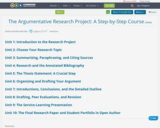
This resource is designed to walk students through the process of completing a research project in any field of study. It covers the earliest stages of brainstorming and discussing, continues through researching and compiling sources; writing, documenting, revising, and polishing a paper; and finally presenting the research topic to a wider audience in a professional manner. The focus is on MLA format, though the course could be modified for other formats.
The first unit is an introduction to the project. It asks students to draw on knowledge of issues affecting their own community and world to help generate discussion that could eventually lead to a research topic.
This PowerPoint Show is a presentation designed to help students use fewer …
This PowerPoint Show is a presentation designed to help students use fewer be verbs. During the presentation, students are introduced to four typical be-verb patterns, and each slide identifies a method to eliminate the pattern by using a verb packed with meaning. At the end of the presentation, there is a brief exercise designed to practice grammar point.
This textbook is designed for beginning learners who want to learn basic …
This textbook is designed for beginning learners who want to learn basic Japanese for the purpose of living and working in Japan. Unlike textbooks written primarily for students, whose content largely centers on student life, this book focuses more on social and professional life beyond school. As a beginning level textbook, this book includes many elementary grammar patterns (Japanese Language Proficiency Test Levels 5 and 4), but the vocabulary and situations are selected specifically for working adults. Explanations are kept concise so as to only cover key points. The main focus is on oral communication and the accompanying audio is to be used extensively. This textbook can be used for self-study, as part of an online course, or as a traditional college course.
This textbook is designed for beginning learners who want to learn basic …
This textbook is designed for beginning learners who want to learn basic Japanese for the purpose of living and working in Japan. Unlike textbooks written primarily for students, whose content largely centers on student life, this book focuses more on social and professional life beyond school.
As a beginning level textbook, this book includes many elementary grammar patterns (Japanese Language Proficiency Test Levels 5 and 4), but the vocabulary and situations are selected specifically for working adults. Explanations are kept concise so as to only cover key points. The main focus is on oral communication and the accompanying audio is to be used extensively. This textbook can be used for self-study, as part of an online course, or as a traditional college course.
No restrictions on your remixing, redistributing, or making derivative works. Give credit to the author, as required.
Your remixing, redistributing, or making derivatives works comes with some restrictions, including how it is shared.
Your redistributing comes with some restrictions. Do not remix or make derivative works.
Most restrictive license type. Prohibits most uses, sharing, and any changes.
Copyrighted materials, available under Fair Use and the TEACH Act for US-based educators, or other custom arrangements. Go to the resource provider to see their individual restrictions.