Biology is designed for multi-semester biology courses for science majors. It is …
Biology is designed for multi-semester biology courses for science majors. It is grounded on an evolutionary basis and includes exciting features that highlight careers in the biological sciences and everyday applications of the concepts at hand. To meet the needs of today’s instructors and students, some content has been strategically condensed while maintaining the overall scope and coverage of traditional texts for this course. Instructors can customize the book, adapting it to the approach that works best in their classroom. Biology also includes an innovative art program that incorporates critical thinking and clicker questions to help students understand—and apply—key concepts.
By the end of this section, you will be able to:Describe how …
By the end of this section, you will be able to:Describe how changes to gene expression can cause cancerExplain how changes to gene expression at different levels can disrupt the cell cycleDiscuss how understanding regulation of gene expression can lead to better drug design
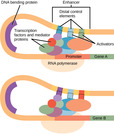
By the end of this section, you will be able to:Discuss the …
By the end of this section, you will be able to:Discuss the role of transcription factors in gene regulationExplain how enhancers and repressors regulate gene expression
Life as an emergent property of networks of chemical reactions involving proteins …
Life as an emergent property of networks of chemical reactions involving proteins and nucleic acids. Mathematical theories of metabolism, gene regulation, signal transduction, chemotaxis, excitability, motility, mitosis, development, and immunity. Applications to directed molecular evolution, DNA computing, and metabolic and genetic engineering.
Explore the relationship between the genetic code on the DNA strand and …
Explore the relationship between the genetic code on the DNA strand and the resulting protein and rudimentary shape it forms. Through models of transcription and translation, you will discover this relationship and the resilience to mutations built into our genetic code. Start by exploring DNA's double helix with an interactive 3D model. Highlight base pairs, look at one or both strands, and turn hydrogen bonds on or off. Next, watch an animation of transcription, which creates RNA from DNA, and translation, which 'reads' the RNA codons to create a protein.
Build a gene network! The lac operon is a set of genes …
Build a gene network! The lac operon is a set of genes which are responsible for the metabolism of lactose in some bacterial cells. Explore the effects of mutations within the lac operon by adding or removing genes from the DNA.
Build a gene network! The lac operon is a set of genes …
Build a gene network! The lac operon is a set of genes which are responsible for the metabolism of lactose in some bacterial cells. Explore the effects of mutations within the lac operon by adding or removing genes from the DNA.
The MIT Biology Department core courses, 7.012, 7.013, and 7.014, all cover …
The MIT Biology Department core courses, 7.012, 7.013, and 7.014, all cover the same core material, which includes the fundamental principles of biochemistry, genetics, molecular biology, and cell biology. Biological function at the molecular level is particularly emphasized and covers the structure and regulation of genes, as well as, the structure and synthesis of proteins, how these molecules are integrated into cells, and how these cells are integrated into multicellular systems and organisms. In addition, each version of the subject has its own distinctive material. 7.012 focuses on the exploration of current research in cell biology, immunology, neurobiology, genomics, and molecular medicine. Acknowledgments The study materials, problem sets, and quiz materials used during Fall 2004 for 7.012 include contributions from past instructors, teaching assistants, and other members of the MIT Biology Department affiliated with course #7.012. Since the following works have evolved over a period of many years, no single source can be attributed.
The MIT Biology Department core Introductory Biology courses, 7.012, 7.013, 7.014, 7.015, …
The MIT Biology Department core Introductory Biology courses, 7.012, 7.013, 7.014, 7.015, and 7.016 all cover the same core material, which includes the fundamental principles of biochemistry, genetics, molecular biology, and cell biology. The focus of 7.013 is on genomic approaches to human biology, including neuroscience, development, immunology, tissue repair and stem cells, tissue engineering, and infectious and inherited diseases, including cancer.
The MIT Biology Department core courses, 7.012, 7.013, and 7.014, all cover …
The MIT Biology Department core courses, 7.012, 7.013, and 7.014, all cover the same core material, which includes the fundamental principles of biochemistry, genetics, molecular biology, and cell biology. 7.013 focuses on the application of the fundamental principles toward an understanding of human biology. Topics include genetics, cell biology, molecular biology, disease (infectious agents, inherited diseases and cancer), developmental biology, neurobiology and evolution. Biological function at the molecular level is particularly emphasized in all courses and covers the structure and regulation of genes, as well as, the structure and synthesis of proteins, how these molecules are integrated into cells, and how these cells are integrated into multicellular systems and organisms. In addition, each version of the subject has its own distinctive material.
The MIT Biology Department core courses, 7.012, 7.013, and 7.014, all cover …
The MIT Biology Department core courses, 7.012, 7.013, and 7.014, all cover the same core material, which includes the fundamental principles of biochemistry, genetics, molecular biology, and cell biology. Biological function at the molecular level is particularly emphasized and covers the structure and regulation of genes, as well as, the structure and synthesis of proteins, how these molecules are integrated into cells, and how these cells are integrated into multicellular systems and organisms. In addition, each version of the subject has its own distinctive material. 7.014 focuses on the application of these fundamental principles, toward an understanding of microorganisms as geochemical agents responsible for the evolution and renewal of the biosphere and of their role in human health and disease. Acknowledgements The study materials, problem sets, and quiz materials used during Spring 2005 for 7.014 include contributions from past instructors, teaching assistants, and other members of the MIT Biology Department affiliated with course 7.014. Since the following works have evolved over a period of many years, no single source can be attributed.
This is a worksheet (with sample answers for instructors) that was developed to …
This is a worksheet (with sample answers for instructors) that was developed to help learners get a better understanding of the nuances related to the regulation of the Lac operon, and to provide them with opportunities to practice analytical thinking. We have used it for years in the biology component of a first year university science course (for science majors).
This exercise is intended to help students understand the role of transcription …
This exercise is intended to help students understand the role of transcription factors and enhancers in differentiation in general and with sex determination specifically. Students will put events in order for male and female sex determination. Note that students do not need to know anything about sex determination to complete the exercise (but they learn it as they play), but they should have been exposed to the concepts of enhancers and transcription factors. It should be noted that the cards saying "It's a boy" and "It's a girl" were selected to emphasize that this pathway is relevant for anatomical sex determination as opposed to gender.
This resource is a video abstract of a research paper created by …
This resource is a video abstract of a research paper created by Research Square on behalf of its authors. It provides a synopsis that's easy to understand, and can be used to introduce the topics it covers to students, researchers, and the general public. The video's transcript is also provided in full, with a portion provided below for preview:
"The hormone and receptor pair IGF-1 and IGF-1R and the Hippo-YAP signaling pathway are critical to breast cancer stem cells, but if or how these pathways interact in these cells remained unclear. So, researchers recently examined YAP and IGF-1R in triple negative breast cancer cell lines and xenograft models. YAP knockdown reduced viability and stemness in cell culture and tumorigenicity in vivo, suggesting that YAP contributes to stemness in breast cancer cells. Further tests determined that IGF-1R regulated YAP expression, and in turn, YAP regulated IGF-1 expression but not IGF-1R. Specifically, depleting IGF-1R decreased YAP expression, while addition of IGF-1 upregulated YAP and increased its nuclear localization. YAP overexpression increased IGF-1 expression without impacting IGF-1R expression. In clinical data from basal-like breast cancer patients, higher levels of YAP and IGF-1 are correlated with shorter overall survival..."
The rest of the transcript, along with a link to the research itself, is available on the resource itself.
This resource is a video abstract of a research paper created by …
This resource is a video abstract of a research paper created by Research Square on behalf of its authors. It provides a synopsis that's easy to understand, and can be used to introduce the topics it covers to students, researchers, and the general public. The video's transcript is also provided in full, with a portion provided below for preview:
"Our genome is a lot like a book. When cells need information critical to their function, they must physically crack the genome open to arrive at the right chapter, or gene sequence. Often, the relevance of details from chapter one isn’t clear until chapter ten. Similarly, non-coding sequences often control the expression of genes far away in linear genomic distance but relatively close in three-dimensional space. Now, a new method of probing these regions could help scientists gain more information from much less starting material—and, in the process, help us learn more about the book of life. The technique is called HiCAR, short for Hi-C on Accessible Regulatory DNA. HiCAR builds off the Hi-C method, which uses high-throughput sequencing to detect how different regions of genomic DNA interact with each other. Specifically, HiCAR targets the regions of chromatin that are open and accessible to proteins with information about gene regulation..."
The rest of the transcript, along with a link to the research itself, is available on the resource itself.
No restrictions on your remixing, redistributing, or making derivative works. Give credit to the author, as required.
Your remixing, redistributing, or making derivatives works comes with some restrictions, including how it is shared.
Your redistributing comes with some restrictions. Do not remix or make derivative works.
Most restrictive license type. Prohibits most uses, sharing, and any changes.
Copyrighted materials, available under Fair Use and the TEACH Act for US-based educators, or other custom arrangements. Go to the resource provider to see their individual restrictions.