Sometime after 1492, the concept of the New World or America came …
Sometime after 1492, the concept of the New World or America came into being, and this concept appeared differently - as an experience or an idea - for different people and in different places. This semester, we will read three groups of texts: first, participant accounts of contact between native Americans and French or English speaking Europeans, both in North America and in the Caribbean and Brazil; second, transformations of these documents into literary works by contemporaries; third, modern texts which take these earlier materials as a point of departure for rethinking the experience and aftermath of contact. The reading will allow us to compare perspectives across time and space, across the cultural geographies of religion, nation and ethnicity, and finally across a range of genres - reports, captivity narratives, essays, novels, poetry, drama, and film. Some of the earlier authors we will read are Michel Montaigne, William Shakespeare, Jean de Léry, Daniel Defoe and Mary Rowlandson; more recent authors include Derek Walcott, and J. M. Coetzee.
This course explores the experiences and understandings of class among Americans positioned …
This course explores the experiences and understandings of class among Americans positioned at different points along the U.S. social spectrum. It considers a variety of classic frameworks for analyzing social class and uses memoirs, novels, and ethnographies to gain a sense of how class is experienced in daily life and how it intersects with other forms of social difference such as race and gender.
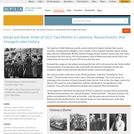
The Lawrence Textile Strike was a public protest mainly of immigrant workers …
The Lawrence Textile Strike was a public protest mainly of immigrant workers from several countries, including Austria, Belgium, Cuba, Canada, France, England, Germany, Greece, Ireland, Italy, Lithuania, Netherlands, Norway, Poland, Portugal, Russia, Scotland, Spain, Syria, and Turkey. According to the 1910 census, 65% of mill workers (many of whom eventually struck) lived in the United States for less than 10 years; 47% for less than five years. Prompted by a wage cut, the walkout spread quickly from mill to mill across the city. Strikers defied the assumptions of conservative trade unions within the American Federation of Labor that immigrant, largely female and ethnically diverse workers could not be organized. The Lawrence strike is referred to as the Bread and Roses strike and The Strike for Three Loaves." The first known source to do so was a 1916 labor anthology, The Cry for Justice: An Anthology of the Literature of Social Protest by Upton Sinclair. Prior to that, the slogan, used as the title of a 1911 poem by James Oppenheim, had been attributed to Chicago Women Trade Unionists. It has also been attributed to socialist union organizer Rose Schneiderman. James Oppenheim claimed his seeing women strikers in Lawrence carrying a banner proclaiming We Want Bread and Roses Too inspired the poem, Bread and Roses. The poem, however, was written and published in 1911 prior to the strike. Later the poem was set to music by Caroline Kohlsaat and then by Mimi Farina. The song and slogan are now important parts of the labor movement and womens movement worldwide. This exhibition was made in collaboration with the Lawrence History Center and the University of Massachusetts Lowell History Department.
This 6th Grade literacy unit focuses on the Required Core Novel The …
This 6th Grade literacy unit focuses on the Required Core Novel The Skin I’m In , by Sharon G. Flake. This unit explores the confusing journey to finding identity as a middle school aged student. The complex identities of five characters from the novel, Maleeka, Char, Mrs. Saunders, Caleb and John-John, are analyzed with multiple supplemental texts. The project for the students includes a daily “Identity Journal,” in which they analyze the characters using text evidence from both the novel and supplemental texts, and then compare these with what they are feeling or seeing within themselves. The unit culminates with a drawing of the student alongside the character the most identify with. Students present their journals with the drawings.
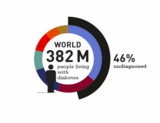
This presentation will look at how the distribution of diabetes is, thus …
This presentation will look at how the distribution of diabetes is, thus we’ll discuss how the distribution of diabetes are by type, gender, age, geographical region and ethnicity. The purpose of this discussion is to understand how serious a health problem the global epidemic of diabetes is, while increasing the understanding that it’s extremely necessary that we do whatever we can to fight against the diabetes epidemic in the future.
Course responsible: Associate Professor Signe Sørensen Torekov, MD Nicolai Wewer Albrechtsen & Professor Jens Juul Holst
This course is an introduction to the cross-cultural study of biomedical ethics, …
This course is an introduction to the cross-cultural study of biomedical ethics, examining moral foundations of the science and practice of Western biomedicine through case studies of abortion, contraception, cloning, organ transplantation and other issues. It evaluates challenges that new medical technologies pose to the practice and availability of medical services around the globe, and to cross-cultural ideas of kinship and personhood. Also discussed are critiques of the biomedical tradition from anthropological, feminist, legal, religious, and cross-cultural theorists.
In this lesson, students will describe aspects of their identities such as …
In this lesson, students will describe aspects of their identities such as race, gender, class, age, ability, religion and more. They will watch two video clips featuring Marley Dias, an eleven-year-old girl who started the #1000BlackGirlBooks campaign, a book drive with the goal of collecting 1,000 books featuring African-American girls. After learning about the campaign, students will review illustrated books in their classroom and school library and analyze whether the characters in the books reflect their own identities or the identities of their families and friends. Finally, students will write a book review on one of the books and examine how the book’s characters are similar to or different from them.
In this project, students research a current or past instance of ethnic …
In this project, students research a current or past instance of ethnic or religious conflict from around the world such as ethnic cleansing and genocide. Following research, students present and reflect on causes and effects of the conflict. The project was designed for AP Human Geography but can be adapted to any global studies or issues courses.
Although this class starts by critically examining the term “ethnic” as it …
Although this class starts by critically examining the term “ethnic” as it defines a wide range of cultural forms over time, we will focus mostly on contemporary writers. Questions to consider will include: How has ethnic writing changed American culture and renovated forms of literary expression? What are the varieties and nuances of what we might call an ethnic subjectivity? What could it mean to harbor fugitives within the self: transgressive thoughts or a “foreign” identity? And what is the future of “ethnic” literature in a global space?
This course is designed to provide students with a broad overview of …
This course is designed to provide students with a broad overview of the major theories on the relationship between ethnicity and politics. The course is divided into three sections. The first covers general theory and discusses the social construction of ethnicity as well as the limits of construction. The second section discusses ethnicity as a dependent variable. This section studies the forces that shape the development of ethnic identities and their motivating power. The third section addresses ethnicity as an independent variable. In other words, it focuses on how ethnicity operates to affect important political and economic outcomes. This course is the first semester of a year-long sequence on ethnic politics. However, each semester is self-contained and students may take the course in either or both semesters. Ethnic Politics I aims for breadth over depth. It covers many works in the “canon” of texts on ethnic politics as well as addressing many major topics (modernization, entrepreneurship, prejudice, ethnic party formation, etc.) in one week sessions. Ethnic Politics II covers some of these topics in greater depth and also requires a major research paper.
An introduction to the cross-cultural study of ethnic and national identity. We …
An introduction to the cross-cultural study of ethnic and national identity. We examine the concept of social identity, and consider the ways in which gendered, linguistic, religious, and ethno-racial identity components interact. We explore the history of nationalism, including the emergence of the idea of the nation-state, as well as ethnic conflict, globalization, identity politics, and human rights.
Discerning the ethnic and racial dimensions of politics is considered by some …
Discerning the ethnic and racial dimensions of politics is considered by some indispensable to understanding contemporary world politics. This course seeks to answer fundamental questions about racial and ethnic politics. To begin, what are the bases of ethnic and racial identities? What accounts for political mobilization based upon such identities? What are the political claims and goals of such mobilization and is conflict between groups and/or with government forces inevitable? How do ethnic and racial identities intersect with other identities, such as gender and class, which are themselves the sources of social, political, and economic cleavages? Finally, how are domestic ethnic/racial politics connected to international human rights? To answer these questions, the course begins with an introduction to dominant theoretical approaches to racial and ethnic identity. The course then considers these approaches in light of current events in Africa, Asia, Latin America, Europe, and the United States.
Ethnic and racial conflict appear to be the hallmark of the new …
Ethnic and racial conflict appear to be the hallmark of the new world order. What accounts for the rise of ethnic/racial and nationalist sentiments and movements? What is the basis of ethnic and racial identity? What are the political claims and goals of such movements and is conflict inevitable? Introduces students to dominant theoretical approaches to race, ethnicity, and nationalism, and considers them in light of current events in Africa, Europe, and the Americas. Discerning the ethnic and racial dimensions of politics is considered by some indispensable to understanding contemporary world politics. This course seeks to answer fundamental questions about racial and ethnic politics. To begin, what are the bases of ethnic and racial identities? What accounts for political mobilization based upon such identities? What are the political claims and goals of such mobilization and is conflict between groups and/or with government forces inevitable? How do ethnic and racial identities intersect with other identities, such as gender and class, which are themselves the sources of social, political, and economic cleavages? Finally, how are domestic ethnic/racial politics connected to international human rights? To answer these questions, the course begins with an introduction to dominant theoretical approaches to racial and ethnic identity. The course then considers these approaches in light of current events in Africa, Asia, Latin America, Europe, and the United States.
A video on Tulsa, Oklahoma Massacre that provides information on the topic …
A video on Tulsa, Oklahoma Massacre that provides information on the topic and additional resources to learn more about the subject. There is also a discussion question on how local, state, and federal branches interact in order to govern.
This course will provide students with an analytic framework to understand the …
This course will provide students with an analytic framework to understand the roles that gender, race, and class play in defining and determining access to leadership and power in the U.S., especially in the context of the workplace. We will explore women and men in leadership positions within the corporate, political and non-profit sectors, with attention to the roles of women of color and immigrant women within this context. We will also look at specific policies such as affirmative action, parental leave, child-care policy, and working-time policies and the role they play–or could play–in achieving parity. We will further investigate ways in which these policies address gender, racial, and class inequities, and think critically about mechanisms for change. The course will be highly interactive, and will combine texts, theater, videos and visual arts.
This resource is a video abstract of a research paper created by …
This resource is a video abstract of a research paper created by Research Square on behalf of its authors. It provides a synopsis that's easy to understand, and can be used to introduce the topics it covers to students, researchers, and the general public. The video's transcript is also provided in full, with a portion provided below for preview:
"Lifestyle changes on both the individual and societal scale cause profound changes to the gut microbial community. Transitioning to a more Western lifestyle has been previously linked with reduced fermentative capability in the gut microbiome, as well as increasing incidence of various diseases like diabetes. To better understand these types of microbial community shifts, researchers looked at over 5000 residents of Amsterdam. They compared first- and second-generation residents from various ethnic backgrounds. The goal was to examine the directional changes in microbiomes after immigration to the Netherlands. Second-generation Moroccans and Turks as well as younger Dutch participants showed an overall shift toward less diverse and less fermentative gut microbes and an increased abundance of a cluster of microbes, here called the BBB cluster, that is associated with a Western lifestyle..."
The rest of the transcript, along with a link to the research itself, is available on the resource itself.
In this lesson, students consider what it means to be an American, …
In this lesson, students consider what it means to be an American, using an opinion piece about the “American Identity Crisis” and several related videos as central texts. They answer a series of text-dependent questions, debate their opinions, write a brief constructed response, and make their own video that reflects their interpretation of “the face of America.”
This course explores how identities, whether of individuals or groups, are produced, …
This course explores how identities, whether of individuals or groups, are produced, maintained, and transformed. Students will be introduced to various theoretical perspectives that deal with identity formation, including constructions of "the normal." We will explore the utility of these perspectives for understanding identity components such as gender, sexual orientation, race, ethnicity, religion, language, social class, and bodily difference. By semester's end students will understand better how an individual can be at once cause and consequence of society, a unique agent of social action as well as a social product.
Intercultural Communication examines culture as a variable in interpersonal and collective communication. …
Intercultural Communication examines culture as a variable in interpersonal and collective communication. It explores the opportunities and problems arising from similarities and differences in communication patterns, processes, and codes among various cultural groups. It explores cultural universals, social categorization, stereotyping and discrimination, with a focus on topics including race, ethnicity, social class, religion, gender and sexuality as they relate to communication.
Through the comparative study of different cultures, anthropology explores fundamental questions about …
Through the comparative study of different cultures, anthropology explores fundamental questions about what it means to be human. It seeks to understand how culture both shapes societies, from the smallest island in the South Pacific to the largest Asian metropolis, and affects the way institutions work, from scientific laboratories to Christian mega-churches. This course will provide a framework for analyzing diverse facets of human experience such as gender, ethnicity, language, politics, economics, and art.
No restrictions on your remixing, redistributing, or making derivative works. Give credit to the author, as required.
Your remixing, redistributing, or making derivatives works comes with some restrictions, including how it is shared.
Your redistributing comes with some restrictions. Do not remix or make derivative works.
Most restrictive license type. Prohibits most uses, sharing, and any changes.
Copyrighted materials, available under Fair Use and the TEACH Act for US-based educators, or other custom arrangements. Go to the resource provider to see their individual restrictions.