This University of California College Prep (UCCP) Advanced Placement (AP) Environmental Science online course has five objectives: Describe the six different forms of energy and the type of work done by each form. Discuss the roles of sources and sinks in an energy budget. Define the Law of Conservation of Energy, and explain how the operation of fuel cell vehicles illustrates this principal. Name the units with which energy, power, and force are measured and described. Use energy flow within a house to explain both theoretical and practical aspects of energy use and conservation.
This text is designed to acquaint students with the physical, ecological, social, and political principles of environmental science. Scientific method is used to analyze and understand the interrelationships between humans and the natural environment. This test shows how ecological realities and the material desire of humans often clash, leading to environmental degradation and pollution.
Sufficient, reliable sources of energy are a necessity for industrialized nations. Energy is used for heating, cooking, transportation and manufacturing. Energy can be generally classified as non-renewable and renewable.....
Motion in two dimensions with one dimensional acceleration (projectile) is analyzed with component motions in coordinate system, whereas motion in two dimensions with two dimensional acceleration (circular motion) is analyzed with the help of component accelerations - tangential and normal accelerations.
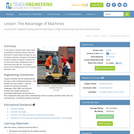
In this lesson, students learn about work as defined by physical science and see that work is made easier through the use of simple machines. Already encountering simple machines everyday, students will be alerted to their widespread uses in everyday life. This lesson serves as the starting point for the Simple Machines Unit.
Subject:
Mathematics and Statistics, Science and Technology
When a city is built, habitat and most organisms living in it are killed or forced to flee. Cities use a lot of energy and water and create a tremendous amount of waste and runoff. Development is the biggest source of pollution.
Highlights of this course include: Major biological, chemical and physical components of the agricultural systems The scientific basis for understanding these systems and their management How has science influenced policies related to agriculture, food safety and environment in the United States? How have the policies evolved over time in the US? What has worked and what has not; what are the reasons and what are the consequences? Beyond science, what other factors influence policies? How do we link what we learn to ecological agriculture? How do we use what we learn for policy analysis?
This lesson provides an introduction to the use of the sun's energy. Topics include the history of solar energy usage and its more recent adaptations. There is also discussion of how the sun produces and radiates energy and what happens when it reaches Earth.
Aluminum cans can be recycled to reduce waste commonly found on roadsides. This will help reduce the amount of energy companies put out to make new cans as well.
Explores the changing roles, ethical conflicts, and public perceptions of science and scientists in American society from World War II to the present. Studies specific historical episodes focusing on debates between scientists and the contextual factors influencing their opinions and decisions. Topics include the atomic bomb project, environmental controversies, the Challenger disaster, biomedical research, genetic engineering, (mis)use of human subjects, scientific misconduct and whistleblowing.
" This course focuses on alternative ways in which the issues of growth, restructuring, innovation, knowledge, learning, and accounting and measurements can be examined, covering both industrialized and emerging countries. We give special emphasis to recent transformations in regional economies throughout the world and to the implications these changes have for the theories and research methods used in spatial economic analyses. Readings will relate mainly to the United States, but we cover pertinent material on foreign countries in lectures."
This educational activity is aimed at helping students to: 1. Define attributes of an energy efficient "green" school.
2. Identify areas of energy waste in their school by:
a. comparing their school to that of a LEED certified school; b. identifying areas that are within the school's capacity to change; c. auditing the school's recycling program.
No restrictions on your remixing, redistributing, or making derivative works.
Give credit to the author, as required.
Your remixing, redistributing, or making derivatives works comes with some
restrictions, including how it is shared.
Your redistributing comes with some restrictions. Do not remix or make
derivative works.
Copyrighted materials, available under Fair Use and the TEACH Act for US-based
educators, or other custom arrangements. Go to the resource provider to see
their individual restrictions.