The United States is no stranger to strange lands. From its founding …
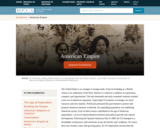
The United States is no stranger to strange lands. From its founding as a British colony to its settlement of the West, America is rooted in a tradition of exploration, conquest, and opportunism. The late nineteenth and early twentieth centuries marked a new era in American expansion. A growing US economy was hungry for more resources and new markets. Politicians pressured the government to protect and promote American interests worldwide. An expanding population was redefining American society. Each of these factors contributed to the age of American imperialism—an era of unprecedented territorial and political growth and cultural development. Following the Spanish-American War of 1898, the US emerged as a formidable world power with territories across the Pacific and Caribbean. Of course, these new borders came with growing pains. As US imperialists insisted that the country had a responsibility to civilize "inferior" peoples, opponents lobbied on behalf of the colonies, insisting that imperialism contradicted the nation's founding principles of sovereignty, equality, and democracy.
This course elaborates the history of Ancient Greece from the Bronze Age …
This course elaborates the history of Ancient Greece from the Bronze Age to the death of Alexander. It covers major social, economic, political, and religious trends. It also includes discussions on Homer, heroism, and the Greek identity; the hoplite revolution and the rise of the city-state; Herodotus, Persia, and the (re)birth of history; Empire, Thucydidean rationalism, and the Peloponnesian War; Platonic constructs; Aristotle, Macedonia, and Hellenism. Emphasis is on use of primary sources in translation.
Chapter 13 Conquest & Empire is a chapter of a history book. …
Chapter 13 Conquest & Empire is a chapter of a history book. We break these up into chapters for our students. This is a community college history course that it is being used in.
Roman Literature of the Golden Age of Augustus Caesar, produced during the …
Roman Literature of the Golden Age of Augustus Caesar, produced during the transition from Republican to Imperial forms of government, was to have a profound and defining influence on Western European and American societies. These writings ultimately established lasting models of aesthetic refinement, philosophical aspiration, and political ambition that continue to shape modern cultures. This class will be exploring the Golden Age of Latin Literature from an historical perspective in order to provide an intensive examination of the cultural contexts in which these monumental works of classical art were first produced. Readings will emphasize the transition from a Republican form of government to an Empire under the rule of Augustus Caesar and the diversity of responses among individual authors to the profound structural changes that Roman society was undergoing at this time. Particular attention will be devoted to the reorganization of society and the self through textuality, the changing dimensions of the public and the private, the roles of class and gender, and the relationship between art and pleasure. Writings covering a wide variety of literary genres will include the works of Caesar, Cicero, Catullus, Livy, Virgil, Horace, and Ovid, with additional readings from Cassius Dio for background.
This collection uses primary sources to explore the motivations and realities behind …
This collection uses primary sources to explore the motivations and realities behind life in the American colonies. Digital Public Library of America Primary Source Sets are designed to help students develop their critical thinking skills and draw diverse material from libraries, archives, and museums across the United States. Each set includes an overview, ten to fifteen primary sources, links to related resources, and a teaching guide. These sets were created and reviewed by the teachers on the DPLA's Education Advisory Committee.
What is Britain now? Its metropolises are increasingly multicultural. Its hold over …
What is Britain now? Its metropolises are increasingly multicultural. Its hold over its distant colonies is a thing of the past. Its sway within the global political arena is weak. Its command over Northern Ireland, Wales, and Scotland is broken or threatened. What have novelists made of all this? What are they writing as the old empire fades away and as new social and political formations emerge? These are the questions that will concern us in this course.
Host Harry Kreisler speaks with Tariq Ali, a British-Pakistani journalist, novelist, playwright, …
Host Harry Kreisler speaks with Tariq Ali, a British-Pakistani journalist, novelist, playwright, publisher, filmmaker, and renowned social critic about Islam, empire, and the left. (57 min)
This course surveys the social, cultural, and political development of western Europe …
This course surveys the social, cultural, and political development of western Europe between 500 and 1350. A number of topics are incorporated into the broad chronological sweep of the course, including: the Germanic conquest of the ancient Mediterranean world; the rise of a distinct northern culture and the Carolingian Renaissance; the emergence of feudalism and the breakdown of political order; contact with the Byzantine and Islamic East and the Crusading movement; the quality of religious life; the vitality of the high medieval economy and culture; and the catastrophes of the fourteenth century.
This subject examines interactions across the Eurasian continent between Russians, Chinese, Mongolian …
This subject examines interactions across the Eurasian continent between Russians, Chinese, Mongolian nomads, and Turkic oasis dwellers during the last millennium and a half. As empires rose and fell, religions, trade, and war flowed back and forth continuously across this vast space. Today, the fall of the Soviet Union and China's reforms have opened up new opportunities for cultural interaction.
This subject examines the paradoxes of contemporary globalization. Through lectures, discussions and …
This subject examines the paradoxes of contemporary globalization. Through lectures, discussions and student presentations, we will study the cultural, linguistic, social and political impact of globalization across broad international borders. We will pay attention to the subtle interplay of history, geography, language and cultural norms that gave rise to specific ways of life. The materials for the course include fiction, nonfiction, audio pieces, maps and visual materials.
This course analyzes Russia's social, cultural, and political heritage in the 18th …
This course analyzes Russia's social, cultural, and political heritage in the 18th and 19th centuries, up to and including the Russian Revolution of 1917. It compares reforming and revolutionary impulses in the context of serfdom, the rise of the intelligentsia, and debates over capitalism, while focusing on historical and literary texts, especially the intersections between the two.
Professor Elleke Boehmer discusses why Kipling's writing, and his poetry of the …
Professor Elleke Boehmer discusses why Kipling's writing, and his poetry of the late nineteenth and early twentieth centuries in particular, launched him to international fame across the British Empire. By comparing him to contemporary popular figures such as Elton John and Paul McCartney, she offers insight into how Kipling's verse captured the popular imagination of the common people throughout the age of imperialism. This audio recording is part the Interviews on Great Writers series presented by Oxford University Podcasts.
This kit covers a historical overview of American representations of natural resources …
This kit covers a historical overview of American representations of natural resources from ancient Indian basketry to contemporary web sites. It compares conflicting media constructions about the Exxon Valdez oil spill, the damning of rivers, and Chukchi sea oil drilling. By showing the slow realization that natural resources are finite, students will learn valuable lessons in earth, natural and environmental sciences.
This course is an an exploration of British culture and politics, focusing …
This course is an an exploration of British culture and politics, focusing on the changing role of the monarchy from the accession of the House of Hanover (later Windsor) in 1714 to the present. The dynasty has encountered a series of crises, in which the personal and the political have been inextricably combined: for example, George III's mental illness; the scandalous behavior of his son, George IV; Victoria's withdrawal from public life after the death of Prince Albert; the abdication of Edward VIII; and the public antagonism sparked by sympathy for Diana, Princess of Wales.
This book is written for you – students early in college – …
This book is written for you – students early in college – to provide a guide to the founding documents and structures of governance that form the United States political system. This book is called American Government and Politics in Principle and Practice because you will notice that what has been inscribed in law has not always been applied in practice-particularly for indigenous peoples, enslaved peoples, people of color, women, LGBTQIA+, people with disabilities, those formerly incarcerated, immigrants and the working class within U.S. society.
In designing this book, we have two goals. First, we want you to know what the founding documents say and how our political institutions were formed. Second, and as important, we season the book with questions for you to investigate and learn concerning who has been excluded and who has benefited from the political structures of the United States. We will examine the contradictions and tensions that erupt, and how social movements have transformed our political landscape. We offer a range of questions/assignments that will allow you to help us keep this book up to date.
You will read, across time, tensions between the federal and state governments, between individual and collective rights, between those with power and those without, and you will notice when and for whom rights have been protected by our government and when and for whom rights have been trampled. We will explore the historical context that informs significant political movements and structures of the present. This is history riddled with racism, xenophobia, sexism and imperialism, and also a vibrant history of struggle where groups of people imagine, fight for, and often achieve a more equitable society.
U.S. History is designed to meet the scope and sequence requirements of …
U.S. History is designed to meet the scope and sequence requirements of most introductory courses. The text provides a balanced approach to U.S. history, considering the people, events, and ideas that have shaped the United States from both the top down (politics, economics, diplomacy) and bottom up (eyewitness accounts, lived experience). U.S. History covers key forces that form the American experience, with particular attention to issues of race, class, and gender.Senior Contributing AuthorsP. Scott Corbett, Ventura CollegeVolker Janssen, California State University, FullertonJohn M. Lund, Keene State CollegeTodd Pfannestiel, Clarion UniversityPaul Vickery, Oral Roberts UniversitySylvie Waskiewicz
U.S. History is designed for a two-semester American history sequence. It is …
U.S. History is designed for a two-semester American history sequence. It is traditional in coverage, following a roughly chronological outline, and using a balanced approach that includes political, economic, social, and cultural developments. At the same time, the book includes a number of innovative and interactive features designed to enhance student learning. Instructors can also customize the book, adapting it to the approach that works best in their classroom.
Queen Victoria of England reigned over a vast British empire from 1837 …
Queen Victoria of England reigned over a vast British empire from 1837 until her death in 1901. During her rule, England rapidly transformed into a modern, technologically-based economy exercising global military and cultural power, roiling with class and racial conflict. Victorianism extended far beyond the boundaries of Britain and informed international movements of the same period, including in the United States.
No restrictions on your remixing, redistributing, or making derivative works. Give credit to the author, as required.
Your remixing, redistributing, or making derivatives works comes with some restrictions, including how it is shared.
Your redistributing comes with some restrictions. Do not remix or make derivative works.
Most restrictive license type. Prohibits most uses, sharing, and any changes.
Copyrighted materials, available under Fair Use and the TEACH Act for US-based educators, or other custom arrangements. Go to the resource provider to see their individual restrictions.