This course is a survey of principal concepts and methods of fluid …
This course is a survey of principal concepts and methods of fluid dynamics. Topics include mass conservation, momentum, and energy equations for continua; Navier-Stokes equation for viscous flows; similarity and dimensional analysis; lubrication theory; boundary layers and separation; circulation and vorticity theorems; potential flow; introduction to turbulence; lift and drag; surface tension and surface tension driven flows.
This course extends fluid mechanic concepts from Unified Engineering to the aerodynamic …
This course extends fluid mechanic concepts from Unified Engineering to the aerodynamic performance of wings and bodies in sub/supersonic regimes. 16.100 generally has four components: subsonic potential flows, including source/vortex panel methods; viscous flows, including laminar and turbulent boundary layers; aerodynamics of airfoils and wings, including thin airfoil theory, lifting line theory, and panel method/interacting boundary layer methods; and supersonic and hypersonic airfoil theory. Course material varies each year depending upon the focus of the design problem.
This course teaches simple reasoning techniques for complex phenomena: divide and conquer, …
This course teaches simple reasoning techniques for complex phenomena: divide and conquer, dimensional analysis, extreme cases, continuity, scaling, successive approximation, balancing, cheap calculus, and symmetry. Applications are drawn from the physical and biological sciences, mathematics, and engineering. Examples include bird and machine flight, neuron biophysics, weather, prime numbers, and animal locomotion. Emphasis is on low-cost experiments to test ideas and on fostering curiosity about phenomena in the world.
The purpose of this activity is to bring together the students' knowledge …
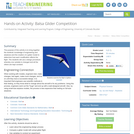
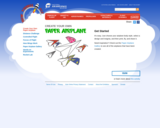
The purpose of this activity is to bring together the students' knowledge of engineering and airplanes and the creation of a glider model to determine how each modification affects the flight. The students will use a design procedure whereby one variable is changed and all the others are kept constant.
Students make a skydiver and parachute contraption to demonstrate how drag caused …
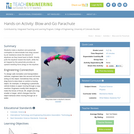
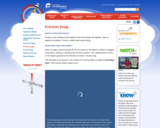
Students make a skydiver and parachute contraption to demonstrate how drag caused by air resistance slows the descent of skydivers as they travel back to Earth. Gravity pulls the skydiver toward the Earth, while the air trapped by the parachute provides an upward resisting force (drag) on the skydiver.
Working in teams of four, students build tetrahedral kites following specific instructions …
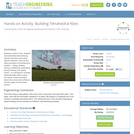
Working in teams of four, students build tetrahedral kites following specific instructions and using specific materials. They use the basic processes of manufacturing systems – cutting, shaping, forming, conditioning, assembling, joining, finishing, and quality control – to manufacture complete tetrahedral kites within a given time frame. Project evaluation takes into account team efficiency and the quality of the finished product.
The course begins with the basics of compressible fluid dynamics, including governing …
The course begins with the basics of compressible fluid dynamics, including governing equations, thermodynamic context and characteristic parameters. The next large block of lectures covers quasi-one-dimensional flow, followed by a discussion of disturbances and unsteady flows. The second half of the course comprises gas dynamic discontinuities, including shock waves and detonations, and concludes with another large block dealing with two-dimensional flows, both linear and non-linear.
After a discussion about what a parachute is and how it works, …
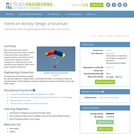
After a discussion about what a parachute is and how it works, students create parachutes using different materials that they think will work best. They test their designs, and then contribute to a class discussion (and possible journal writing) to report which paper materials worked best.
Students learn how to use wind energy to combat gravity and create …
Students learn how to use wind energy to combat gravity and create lift by creating their own tetrahedral kites capable of flying. They explore different tetrahedron kite designs, learning that the geometry of the tetrahedron shape lends itself well to kites and wings because of its advantageous strength-to-weight ratio. Then they design their own kites using drinking straws, string, lightweight paper/plastic and glue/tape. Student teams experience the full engineering design cycle as if they are aeronautical engineers—they determine the project constraints, research the problem, brainstorm ideas, select a promising design and build a prototype; then they test and redesign to achieve a successful flying kite. Pre/post quizzes and a worksheet are provided.
This unit provides the framework for conducting an “engineering design field day” …
This unit provides the framework for conducting an “engineering design field day” that combines 6 hands-on engineering activities into a culminating school (or multi-school) competition. The activities are a mix of design and problem-solving projects inspired by real-world engineering challenges: kite making, sail cars, tall towers, strong towers and a ball and tools obstacle course. The assortment of events engage children who have varied interests and cover a range of disciplines such as aerospace, mechanical and civil engineering. An optional math test—for each of grades 1-6—is provided as an alternative activity to incorporate into the field day event. Of course, the 6 activities in this unit also are suitable to conduct as standalone activities that are unaffiliated with a big event.
This class provides students with an introduction to principal concepts and methods …
This class provides students with an introduction to principal concepts and methods of fluid mechanics. Topics covered in the course include pressure, hydrostatics, and buoyancy; open systems and control volume analysis; mass conservation and momentum conservation for moving fluids; viscous fluid flows, flow through pipes; dimensional analysis; boundary layers, and lift and drag on objects. Students will work to formulate the models necessary to study, analyze, and design fluid systems through the application of these concepts, and to develop the problem-solving skills essential to good engineering practice of fluid mechanics in practical applications.
During the associated lesson, students have learned about Newton's three laws of …
During the associated lesson, students have learned about Newton's three laws of motion and free-body diagrams and have identified the forces of thrust, drag and gravity. As students begin to understand the physics behind thrust, drag and gravity and how these relate these to Newton's three laws of motion, groups assemble and launch the rockets that they designed in the associated lesson. The height of the rockets, after constructed and launched, are measured and compared to the theoretical values calculated during the rocket lesson. Effective teamwork and attention to detail is key for successful launches.
Students learn about weight and drag forces by making paper helicopters and …
Students learn about weight and drag forces by making paper helicopters and measuring how adding more weight affects the time it takes for the helicopters to fall to the ground.
Students apply their mathematics and team building skills to explore the concept …
Students apply their mathematics and team building skills to explore the concept of rocketry. They learn about design issues faced by aerospace engineers when trying to launch rocketships or satellites in order to land them safely in the ocean, for example. Students learn the value of designing within constraints while brainstorming a rocketry system using provided materials and a specified project budget. Throughout the design process, teamwork is emphasized since the most successful launches occur when groups work effectively to generate creative ideas and solutions to the rocket challenge.
A higher lift to drag ratio is a major goal of wing …
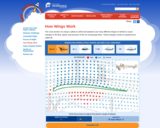
A higher lift to drag ratio is a major goal of wing design. Can you find the best lift drag ratio for this plane? Adjust the angle of attack and watch the dots of air flow past the airfoil.
This course covers the development of the fundamental equations of fluid mechanics …
This course covers the development of the fundamental equations of fluid mechanics and their simplifications for several areas of marine hydrodynamics and the application of these principles to the solution of engineering problems. Topics include the principles of conservation of mass, momentum and energy, lift and drag forces, laminar and turbulent flows, dimensional analysis, added mass, and linear surface waves, including wave velocities, propagation phenomena, and descriptions of real sea waves. Wave forces on structures are treated in the context of design and basic seakeeping analysis of ships and offshore platforms. Geophysical fluid dynamics will also be addressed including distributions of salinity, temperature, and density; heat balance in the ocean; major ocean circulations and geostrophic flows; and the influence of wind stress. Experimental projects conducted in ocean engineering laboratories illustrating concepts taught in class, including ship resistance and model testing, lift and drag forces on submerged bodies, and vehicle propulsion.
This lesson explores the drag force on airplanes. The students will be …
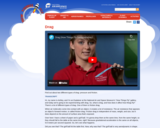
This lesson explores the drag force on airplanes. The students will be introduced to the concept of conservation of energy and how it relates to drag. Students will explore the relationship between drag and the shape, speed and size of an object.
No restrictions on your remixing, redistributing, or making derivative works. Give credit to the author, as required.
Your remixing, redistributing, or making derivatives works comes with some restrictions, including how it is shared.
Your redistributing comes with some restrictions. Do not remix or make derivative works.
Most restrictive license type. Prohibits most uses, sharing, and any changes.
Copyrighted materials, available under Fair Use and the TEACH Act for US-based educators, or other custom arrangements. Go to the resource provider to see their individual restrictions.