In this activity, students will talk about their summer. They will also …
In this activity, students will talk about their summer. They will also introduce themselves and get to know the rest of their lab/group mates. Students will finish the lab by playing a speeddating game.
This activity is an indoor/outdoor activity that incorporates both literacy and scientific …
This activity is an indoor/outdoor activity that incorporates both literacy and scientific observation to make an ABC book based on Antler, Bear, Canoe by Betsy Bowen. Family participation is encouraged.
Students practice discussing advice they would have given themselves in the past. …
Students practice discussing advice they would have given themselves in the past. Students will also practice talking about what they would do in a particular situation.
Better Arguments can help students learn to engage productively across differences and …
Better Arguments can help students learn to engage productively across differences and grapple with differing viewpoints. Linked are resources that are applicable to school-based learning activities and after school programs. These include a curriculum, exit ticket exercise and current events exercise.
Biology is designed for multi-semester biology courses for science majors. It is …
Biology is designed for multi-semester biology courses for science majors. It is grounded on an evolutionary basis and includes exciting features that highlight careers in the biological sciences and everyday applications of the concepts at hand. To meet the needs of today’s instructors and students, some content has been strategically condensed while maintaining the overall scope and coverage of traditional texts for this course. Instructors can customize the book, adapting it to the approach that works best in their classroom. Biology also includes an innovative art program that incorporates critical thinking and clicker questions to help students understand—and apply—key concepts.
By the end of this section, you will be able to:Identify the …
By the end of this section, you will be able to:Identify the shared characteristics of the natural sciencesSummarize the steps of the scientific methodCompare inductive reasoning with deductive reasoningDescribe the goals of basic science and applied science
By the end of this section, you will be able to:Identify the …
By the end of this section, you will be able to:Identify the shared characteristics of the natural sciencesSummarize the steps of the scientific methodCompare inductive reasoning with deductive reasoningDescribe the goals of basic science and applied science
While many study skills, composition and reading skills texts separate these activities …
While many study skills, composition and reading skills texts separate these activities into discrete skills to be learned separately, this books recognizes that these skills are interconnected. A student who struggles with the reading will have a hard time writing about it or discussing it. A student who has inadequate strategies for listening to lectures will struggle to see the connections between the lecture and the reading. Therefore, this book moves away from the “skills and drills” texts that are so common in reading and writing textbooks. Instead, this book features process and provides opportunities for students (and instructors) to think about the best ways to approach academic tasks. For example, a “skills and drills” oriented book might teach students how to take Cornell Notes and use graphic organizers, but it does not provide any information for students that would allow them to decide when it would be best to choose one note taking method over the other. This book’s main focus is helping students develop that sort of judgement.
CREATES is a set of 6 steps that help learners read and …
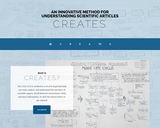
CREATES is a set of 6 steps that help learners read and critically analyze scientific papers. The CREATES method, pioneered by Dr. Sally Hoskins, has a demonstrated positive impact on undergraduate students' self-confidence in scientific reading, as well as in their general perceptions of and beliefs about science and scientific thinking (Hoskins, et. al, 2017).
The new CREATES site, created in collaboration with Jordan Moberg Parker, UCLA's Director of Undergraduate Laboratory Curriculum and Assessment in Microbiology, Immunology, and Molecular Genetics, uses interactive media, step-by-step directions, and detailed annotation of authentic examples to guide students through the process.
The short story "The Cask of Amontillado," by Edgar Allan Poe is …
The short story "The Cask of Amontillado," by Edgar Allan Poe is an effective venue for teaching English I literary terms. The following lesson plan is designed to engage the reader in a deeper than superficial reading of the text. It is also designed to elicit discussion and written critical-thinking responses. This lesson assumes that the literary terms have already been introduced. However, if they have not, the teacher may use this lesson to introduce these terms in the context of the literature.
This is the second semester of the intermediate level sequence intended for …
This is the second semester of the intermediate level sequence intended for students whose conversational ability exceeds their reading and writing skills. Focus is on reading and writing, as well as broadening conversational skills and control of standard pronunciation, for students with background in conversational Chinese. Lab work is required. On completing this course, students should be able to speak the language with standard pronunciation, to converse with some fluency on everyday topics, as well as on some specialized topics, to read edited, as well as authentic texts, in simplified or traditional characters with suitable fluency, and to be able to write composition on certain topics. The class consists of a combination of practice, reading, discussion, dictation, composition and feedback, net exploration via the web, and presentation. This course is conducted in Mandarin.
This course is a sequel to 21G.113 Chinese V (Streamlined). It is …
This course is a sequel to 21G.113 Chinese V (Streamlined). It is designed to further help students develop sophisticated conversational, reading and writing skills by combining authentic reading and audio-visual material with their own explorations of Chinese speaking societies, using the human, literary, and electronic resources available at MIT, in the Boston area and on the web. Some special features of Chinese societies, cultures and customs will be introduced. The class consists of readings, discussion, student presentations and network exploration. The course is conducted in Mandarin.
No restrictions on your remixing, redistributing, or making derivative works. Give credit to the author, as required.
Your remixing, redistributing, or making derivatives works comes with some restrictions, including how it is shared.
Your redistributing comes with some restrictions. Do not remix or make derivative works.
Most restrictive license type. Prohibits most uses, sharing, and any changes.
Copyrighted materials, available under Fair Use and the TEACH Act for US-based educators, or other custom arrangements. Go to the resource provider to see their individual restrictions.