Measuring the dimensions of nano-circuits requires an expensive, high-resolution microscope with integrated …
Measuring the dimensions of nano-circuits requires an expensive, high-resolution microscope with integrated video camera and a computer with sophisticated imaging software, but in this activity, students measure nano-circuits using a typical classroom computer and (the free-to-download) GeoGebra geometry software. Inserting (provided) circuit pictures from a high-resolution microscope as backgrounds in GeoGebra's graphing window, students use the application's tools to measure lengths and widths of circuit elements. To simplify the conversion from the on-screen units to the real circuits' units and the manipulation of the pictures, a GeoGebra measuring interface is provided. Students export their data from GeoGebra to Microsoft® Excel® for graphing and analysis. They test the statistical significance of the difference in circuit dimensions, as well as obtain a correlation between average changes in original vs. printed circuits' widths. This activity and its associated lesson are suitable for use during the last six weeks of the AP Statistics course; see the topics and timing note below for details.
Students work in groups to create soap bubbles on a smooth surface, …
Students work in groups to create soap bubbles on a smooth surface, recording their observations from which they formulate theories to explain what they see (color swirls on the bubble surfaces caused by refraction). Then they apply this theory to thin films in general, including porous films used in biosensors, listing factors that could change the color(s) that become visible to the naked eye, and learn how those factors can be manipulated to give information on gene detection. Finally (by experimentation or video), students see what happens when water is dropped onto the surface of a Bragg mirror.
Students create and decorate their own spectrographs using simple materials and holographic …
Students create and decorate their own spectrographs using simple materials and holographic diffraction gratings. A holographic diffraction grating acts like a prism, showing the visual components of light. After building the spectrographs, students observe the spectra of different light sources as homework.
This activity is a chance for students to apply the diffraction grating …
This activity is a chance for students to apply the diffraction grating equation m*Λ/d = Θ to solve a real life problem: find the wavelength of given source of light. It is also useful for them to apply trigonometry to real life scenarios.
This activity demonstrates the spectral nature of light and the identifiable features …
This activity demonstrates the spectral nature of light and the identifiable features of the visible light spectrum. Students learn the elemental spectrum, and the ROYGBIV distribution of colors in a rainbow. Students compare the spectra of various light sources, and how to identify specific elements based on their spectral signature.
This course covers the following topics: X-ray diffraction: symmetry, space groups, geometry …
This course covers the following topics: X-ray diffraction: symmetry, space groups, geometry of diffraction, structure factors, phase problem, direct methods, Patterson methods, electron density maps, structure refinement, how to grow good crystals, powder methods, limits of X-ray diffraction methods, and structure data bases.
Students find and calculate the angle that light is transmitted through a …
Students find and calculate the angle that light is transmitted through a holographic diffraction grating using trigonometry. After finding this angle, student teams design and build their own spectrographs, researching and designing a ground- or space-based mission using their creation. At project end, teams present their findings to the class, as if they were making an engineering conference presentation. Student must have completed the associated Building a Fancy Spectrograph activity before attempting this activity.
In this optics activity, demonstrate diffraction using a candle or a small …
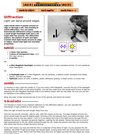
In this optics activity, demonstrate diffraction using a candle or a small bright flashlight bulb and a slide made with two pencils. Learners will observe the diffraction pattern and learn that light has wavelike properties.
This activity from the Exploratorium provides an introduction to the diffraction of …
This activity from the Exploratorium provides an introduction to the diffraction of light which indicates its wavelike properties. Two pencils are used to create a slit through which a flashlight bulb or candle˘ďď_s light is examined. The site contains an explanation of the observed interference patterns, additional materials that can be experimented with, and an extension activity. This activity is part of Exploratorium's Science Snacks series.
6.632 is a graduate subject on electromagnetic wave theory, emphasizing mathematical approaches, …
6.632 is a graduate subject on electromagnetic wave theory, emphasizing mathematical approaches, problem solving, and physical interpretation. Topics covered include: waves in media, equivalence principle, duality and complementarity, Huygens' principle, Fresnel and Fraunhofer diffraction, dyadic Green's functions, Lorentz transformation, and Maxwell-Minkowski theory. Examples deal with limiting cases of Maxwell's theory and diffraction and scattering of electromagnetic waves.
This course explores electromagnetic phenomena in modern applications, including wireless communications, circuits, …
This course explores electromagnetic phenomena in modern applications, including wireless communications, circuits, computer interconnects and peripherals, optical fiber links and components, microwave communications and radar, antennas, sensors, micro-electromechanical systems, motors, and power generation and transmission. Fundamentals covered include: quasistatic and dynamic solutions to Maxwell's equations; waves, radiation, and diffraction; coupling to media and structures; guided and unguided waves; resonance; and forces, power, and energy. Acknowledgments The instructors would like to thank Robert Haussman for transcribing into LaTeX the problem set and Quiz 2 solutions.
Students use simple materials to design an open spectrograph so they can …
Students use simple materials to design an open spectrograph so they can calculate the angle light is bent when it passes through a holographic diffraction grating. A holographic diffraction grating acts like a prism, showing the visual components of light. After finding the desired angles, students use what they have learned to design their own spectrograph enclosure.
Students are introduced to different ways of displaying visual spectra, including colored …
Students are introduced to different ways of displaying visual spectra, including colored "barcode" spectra, like those produced by a diffraction grating, and line plots displaying intensity versus color, or wavelength. Students learn that a diffraction grating acts like a prism, bending light into its component colors.
MAS.450 is a laboratory course about holography and holographic imaging. This course …
MAS.450 is a laboratory course about holography and holographic imaging. This course teaches holography from a scientific and analytical point of view, moving from interference and diffraction to imaging of single points to the display of three-dimensional images. Using a "hands-on" approach, students explore the underlying physical phenomena that make holograms work, as well as designing laboratory setups to make their own images. The course also teaches mathematical techniques that allow the behavior of holography to be understood, predicted, and harnessed. Holography today brings together the fields of optics, chemistry, computer science, electrical engineering, visualization, three-dimensional display, and human perception in a unique and comprehensive way. As such, MAS.450 offers interesting and useful exposure to a wide range of principles and ideas. As a course satisfying the Institute Laboratory Requirement, MAS.450 teaches about science, scientific research, and the scientific method through observation and exploration, hinting at the excitement that inventors feel before they put their final equations to paper.
Through two classroom demos, students are introduced to the basic properties of …
Through two classroom demos, students are introduced to the basic properties of lasers through various mediums. In the Making an Electric Pickle demonstration, students see how cellular tissue is able to conduct electricity, and how this is related to various soaking solutions. In the Red/Green Lasers through Different Mediums demonstration, students see the properties of lasers, especially diffraction, in various mediums. Follow-up lecture material introduces students to the mechanisms by which lasers function and relates these functions to the properties of light. In the associated activity, student teams research specific laser types and present their findings to the class.
Students learn the basic properties of light the concepts of light absorption, …
Students learn the basic properties of light the concepts of light absorption, transmission, reflection and refraction, as well as the behavior of light during interference. Lecture information briefly addresses the electromagnetic spectrum and then provides more in-depth information on visible light. With this knowledge, students better understand lasers and are better prepared to design a security system for the mummified troll.
This course concerns the theory and practice of optical methods in engineering …
This course concerns the theory and practice of optical methods in engineering and system design, with an emphasis on diffraction, statistical optics, holography, and imaging. It provides the engineering methodology skills necessary to incorporate optical components in systems serving diverse areas such as precision engineering and metrology, bio-imaging, and computing (sensors, data storage, communication in multi-processor systems). Experimental demonstrations and a design project are included.
No restrictions on your remixing, redistributing, or making derivative works. Give credit to the author, as required.
Your remixing, redistributing, or making derivatives works comes with some restrictions, including how it is shared.
Your redistributing comes with some restrictions. Do not remix or make derivative works.
Most restrictive license type. Prohibits most uses, sharing, and any changes.
Copyrighted materials, available under Fair Use and the TEACH Act for US-based educators, or other custom arrangements. Go to the resource provider to see their individual restrictions.