Some of the topics that this book addresses are: Vector spaces; finite-dimensional …
Some of the topics that this book addresses are: Vector spaces; finite-dimensional vector spaces; differential calculus; compactness and completeness; scalar product space; differential equations; multilenear functionals; integration; differentiable manifolds; integral calculus on manifolds; exterior calculus.
An open-source textbook covering vector calculus, ordinary and partial differential equations, and …
An open-source textbook covering vector calculus, ordinary and partial differential equations, and Fourier series. The textbook is used in a first-year graduate level course in the Department of Mechanical Engineering at the Colorado School of Mines. It undergoes extensive revisions annually, but is relatively complete.
First published in 1991 by Wellesley-Cambridge Press, this updated 3rd edition of …
First published in 1991 by Wellesley-Cambridge Press, this updated 3rd edition of the book is a useful resource for educators and self-learners alike. It is well organized, covers single variable and multivariable calculus in depth, and is rich with applications. There is also an online and a student .
Calculus Revisited is a series of videos and related resources that covers …
Calculus Revisited is a series of videos and related resources that covers the materials normally found in freshman- and sophomore-level introductory mathematics courses. Complex Variables, Differential Equations, and Linear Algebra is the third course in the series, consisting of 20 Videos, 3 Study Guides, and a set of Supplementary Notes. Students should have mastered the first two courses in the series (Single Variable Calculus and Multivariable Calculus) before taking this course. The series was first released in 1972, but equally valuable today for students who are learning these topics for the first time. About the Instructor Herb Gross has taught math as senior lecturer at MIT and was the founding math department chair at Bunker Hill Community College. He is the developer of the Mathematics As A Second Language website, providing arithmetic and algebra materials to elementary and middle school teachers. Acknowledgements Funding for this resource was provided by the Gabriella and Paul Rosenbaum Foundation. Other Resources by Herb Gross Calculus Revisited: Single Variable Calculus Calculus Revisited: Multivariable Calculus
Calculus Revisited is a series of videos and related resources that covers …
Calculus Revisited is a series of videos and related resources that covers the materials normally found in a freshman-level introductory calculus course. The series was first released in 1970 as a way for people to review the essentials of calculus. It is equally valuable for students who are learning calculus for the first time. About the Instructor Herb Gross has taught math as senior lecturer at MIT and was the founding math department chair at Bunker Hill Community College. He is the developer of the Mathematics As A Second Language website, providing arithmetic and algebra materials to elementary and middle school teachers. Acknowledgements Funding for this resource was provided by the Gabriella and Paul Rosenbaum Foundation. Other Resources by Herb Gross Calculus Revisited: Multivariable Calculus Calculus Revisited: Complex Variables, Differential Equations, and Linear Algebra
Calculus is designed for the typical two- or three-semester general calculus course, …
Calculus is designed for the typical two- or three-semester general calculus course, incorporating innovative features to enhance student learning. The book guides students through the core concepts of calculus and helps them understand how those concepts apply to their lives and the world around them. Due to the comprehensive nature of the material, we are offering the book in three volumes for flexibility and efficiency. Volume 2 covers integration, differential equations, sequences and series, and parametric equations and polar coordinates.
Our writing is based on three premises. First, life sciences students are …
Our writing is based on three premises. First, life sciences students are motivated by and respond well to actual data related to real life sciences problems. Second, the ultimate goal of calculus in the life sciences primarily involves modeling living systems with difference and differential equations. Understanding the concepts of derivative and integral are crucial, but the ability to compute a large array of derivatives and integrals is of secondary importance. Third, the depth of calculus for life sciences students should be comparable to that of the traditional physics and engineering calculus course; else life sciences students will be short changed and their faculty will advise them to take the 'best' (engineering) course.
This is an undergraduate course on differential calculus in one and several …
This is an undergraduate course on differential calculus in one and several dimensions. It is intended as a one and a half term course in calculus for students who have studied calculus in high school. The format allows it to be entirely self contained, so that it is possible to follow it without any background in calculus.
This course applies the concepts of reaction rate, stoichiometry and equilibrium to …
This course applies the concepts of reaction rate, stoichiometry and equilibrium to the analysis of chemical and biological reacting systems, derivation of rate expressions from reaction mechanisms and equilibrium or steady state assumptions, design of chemical and biochemical reactors via synthesis of chemical kinetics, transport phenomena, and mass and energy balances. Topics covered include: chemical/biochemical pathways; enzymatic, pathway, and cell growth kinetics; batch, plug flow and well-stirred reactors for chemical reactions and cultivations of microorganisms and mammalian cells; heterogeneous and enzymatic catalysis; heat and mass transport in reactors, including diffusion to and within catalyst particles and cells or immobilized enzymes.
This 10-minute video lesson provides an introduction to 2nd order, linear, homogeneous …
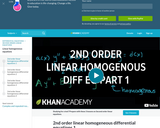
This 10-minute video lesson provides an introduction to 2nd order, linear, homogeneous differential equations with constant coefficients. [Differential Equations playlist: Lesson 13 of 45]
This 8-minute video lesson continues the discussion from the previous video and …
This 8-minute video lesson continues the discussion from the previous video and shows how to find the general solution. [Differential Equations playlist: Lesson 14 of 45]
This 6-minute video lesson continues the discussion from the previous videos and …
This 6-minute video lesson continues the discussion from the previous videos and introduces some initial conditions to solve for the particular solution. [Differential Equations playlist: Lesson 15 of 45]
This 9-minute video lesson continues the discussion from the previous videos and …
This 9-minute video lesson continues the discussion from the previous videos and provides another example using initial conditions. [Differential Equations playlist: Lesson 16 of 45]
This 10-minute video lesson looks at what happens when the characteristic equations …
This 10-minute video lesson looks at what happens when the characteristic equations has complex roots. [Differential Equations playlist: Lesson 17 of 45]
This 10-minute video lesson continues the discussion of what happens when the …
This 10-minute video lesson continues the discussion of what happens when the characteristic equation has complex roots. [Differential Equations playlist: Lesson 18 of 45]
This 10-minute video lesson concludes the series on complex roots of characteristic …
This 10-minute video lesson concludes the series on complex roots of characteristic equations and demonstrates an example with initial conditions. [Differential Equations playlist: Lesson 19 of 45]
No restrictions on your remixing, redistributing, or making derivative works. Give credit to the author, as required.
Your remixing, redistributing, or making derivatives works comes with some restrictions, including how it is shared.
Your redistributing comes with some restrictions. Do not remix or make derivative works.
Most restrictive license type. Prohibits most uses, sharing, and any changes.
Copyrighted materials, available under Fair Use and the TEACH Act for US-based educators, or other custom arrangements. Go to the resource provider to see their individual restrictions.