This course focuses on the practical applications of the continuum concept for …
This course focuses on the practical applications of the continuum concept for deformation of solids and fluids, emphasizing force balance. Topics include stress tensor, infinitesimal and finite strain, and rotation tensors. Constitutive relations applicable to geological materials, including elastic, viscous, brittle, and plastic deformation are studied.
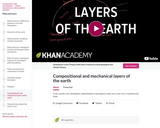
This lesson discusses the interior structure of the earth as defined by …
This lesson discusses the interior structure of the earth as defined by research on the behavior of seismic waves as they move through the layers inside of the planet. The lesson details both compositional layers as well as mechanical layers.
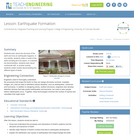
Students learn about the structure of the earth and how an earthquake …
Students learn about the structure of the earth and how an earthquake happens. In one activity, students make a model of the earth including all of its layers. In a teacher-led demonstration, students learn about continental drift. In another activity, students create models demonstrating the different types of faults.
This course deals with mechanics of deformation of the crust and mantle, …
This course deals with mechanics of deformation of the crust and mantle, with emphasis on the importance of different rheological descriptions: brittle, elastic, linear and nonlinear fluids, and viscoelastic.
The Earth's crust is primarily composed of melting products from mantle plumes …
The Earth's crust is primarily composed of melting products from mantle plumes and mid-ocean ridges - both presently and over the course of Earth history. While both systems represent upwelling features in a convective mantle, they can be viewed as end-member systems in that plumes represent buoyant flow whereas mid-ocean ridges represent passive corner flow. This paradigm is not strict - flow beneath ridges may be buoyant in some places, for example, but it does provide a reasonable framework for enquiry. Plumes and ridges can be studied independently, but in many places across the globe the systems interact, often in intriguing fashion. The nature of these interactions provides an opportunity to improve our understanding of both systems, and provides new perspectives on the mantle, crustal, and water column processes associated converting heat from the Earth's interior into new crust, hydrothermal flow, and biological communities on the seafloor. The approach taken for the 2001 Plume-Ridge Interactions Seminar series was to start with basic ideas about mantle convection and tectonics, and an overview of the global hotspot and ridge systems. We then addressed three case studies of plume-ridge interactions in detail. Our first case was the interaction of the. Each of these systems provides a different perspective on the nature of plume-ridge interactions, and by comparison and contrast we are able to distill the fundamental aspects out of the complex array of geophysical and geochemical data associated with plume-ridge systems.
Build your own miniature "greenhouse" out of a plastic container and plastic …
Build your own miniature "greenhouse" out of a plastic container and plastic wrap, and fill it with different things such as dirt and sand to observe the effect this has on temperature. Monitor the temperature using temperature probes and digitally plot the data on the graphs provided in the activity.
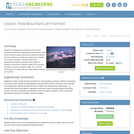
Students investigate how mountains are formed. Concepts include the composition and structure …
Students investigate how mountains are formed. Concepts include the composition and structure of the Earth's tectonic plates and tectonic plate boundaries, with an emphasis on plate convergence as it relates to mountain formation. Students learn that geotechnical engineers design technologies to measure movement of tectonic plates and mountain formation, as well as design to alter the mountain environment to create safe and dependable roadways and tunnels.
These series of lesson are designed to help students understand the theory …
These series of lesson are designed to help students understand the theory of plate tectonics. This content could easily be adapted to reach younger or older audiences.
This is a series of lessons about Plate Tectonics contains a science …
This is a series of lessons about Plate Tectonics contains a science lab and follow-up multimedia research project for both upper elementary and middle school age students. It can be adapted to be completely project based and integrate with other subjects beyond language arts and science.
This is a series of lessons about Plate Tectonics contains a science …
This is a series of lessons about Plate Tectonics contains a science lab and follow-up multimedia research project for both upper elementary and middle school age students. It can be adapted to be completely project based and integrate with other subjects beyond language arts and science.
On this site, through a variety of activities, you can learn about …
On this site, through a variety of activities, you can learn about anthropology, archaeology, astronomy, biodiversity, the brain, climate change, the Earth, Einstein, expeditions, genetics, marine biology, paleontology, water, and zoology.
Rocks cover the earth's surface, including what is below or near human-made …
Rocks cover the earth's surface, including what is below or near human-made structures. With rocks everywhere, breaking rocks can be hazardous and potentially disastrous to people. Students are introduced to three types of material stress related to rocks: compressional, torsional and shear. They learn about rock types (sedimentary, igneous and metamorphic), and about the occurrence of stresses and weathering in nature, including physical, chemical and biological weathering.
In this lesson, students learn about major landforms (e.g., mountains, rivers, plains, …
In this lesson, students learn about major landforms (e.g., mountains, rivers, plains, valleys, canyons and plateaus) and how they occur on the Earth's surface. They learn about the civil and geotechnical engineering applications of geology and landforms, including the design of transportation systems, mining, mapping and measuring natural hazards.
To experience the three types of material stress related to rocks â …
To experience the three types of material stress related to rocks â tensional, compressional and shear â students break bars of soap using only their hands. They apply force created by the muscles in their own hands to put pressure on the soap, a model for the larger scale, real-world phenomena that forms, shapes and moves the rocks of our planet. They also learn the real-life implications of understanding stress in rocks, both for predicting natural hazards and building safe structures.
In this course, principles of thermodynamics are used to infer the physical …
In this course, principles of thermodynamics are used to infer the physical conditions of formation and modification of igneous and metamorphic rocks. The course includes phase equilibria of homogeneous and heterogeneous systems and thermodynamic modeling of non-ideal crystalline solutions. It also surveys the processes that lead to the formation of metamorphic and igneous rocks in the major tectonic environments in the Earth's crust and mantle.
No restrictions on your remixing, redistributing, or making derivative works. Give credit to the author, as required.
Your remixing, redistributing, or making derivatives works comes with some restrictions, including how it is shared.
Your redistributing comes with some restrictions. Do not remix or make derivative works.
Most restrictive license type. Prohibits most uses, sharing, and any changes.
Copyrighted materials, available under Fair Use and the TEACH Act for US-based educators, or other custom arrangements. Go to the resource provider to see their individual restrictions.