How do strong and weak acids differ? Use lab tools on your …
How do strong and weak acids differ? Use lab tools on your computer to find out! Dip the paper or the probe into solution to measure the pH, or put in the electrodes to measure the conductivity. Then see how concentration and strength affect pH. Can a weak acid solution have the same pH as a strong acid solution?
The PhET project at the University of Colorado creates "fun, interactive, research-based …
The PhET project at the University of Colorado creates "fun, interactive, research-based simulations of physical phenomena." This particular one deals with Beer's Law. "The thicker the glass, the darker the brew, the less the light that passes through." Make colorful concentrated and dilute solutions and explore how much light they absorb and transmit using a virtual spectrophotometer! The simulation is also paired with a teachers' guide and related resources from PhET. The simulation is also available in multiple languages.
Learn about chemical calculations through engaging, bitesize animated videos. They are organised …
Learn about chemical calculations through engaging, bitesize animated videos. They are organised into these chapters: chemical calculations, mass calculations, volume calculations and concentration calculations.
Students investigate the property dependence between concentrations and boiling point. In section …
Students investigate the property dependence between concentrations and boiling point. In section 1, students first investigate the boiling point of various liquid solutions. In section 2, they analyze data collected by the entire class to generate two boiling point curves, one for salt solutions and one for sugar solutions. Finally, in section 3, students use the data they have analyzed to determine how to create a solution that has a particular boiling point and is a cost-effective design.
Watch your solution change color as you mix chemicals with water. Then …
Watch your solution change color as you mix chemicals with water. Then check molarity with the concentration meter. What are all the ways you can change the concentration of your solution? Switch solutes to compare different chemicals and find out how concentrated you can go before you hit saturation!
Students experiment with various ways to naturally dye materials using sources found …
Students experiment with various ways to naturally dye materials using sources found in nature—roots, leaves, seeds, spices, etc.—as well as the method of extracting dyes. Then they analyze various materials using statistical methods and tackle an engineering design challenge—to find dyes that best suit the needs of a startup sustainable clothing company.
This work consists of original text, adapted OpenStax content, and other Open …
This work consists of original text, adapted OpenStax content, and other Open Educational Resources (OER). Each image is attributed with the source page in the figure description, in accordance to each respective license. OpenStax content has been remixed into the “Theory and Background,” “Lab Examples,” and “Relations to Health Sciences” sections of this work. OpenStax remixing consists of rearrangement and minor instructional design augmentations. All other sections within this work are originally created content with adopted OER images, where indicated.
This work consists of original content and content adapted from Open Educational …
This work consists of original content and content adapted from Open Educational Resources (OER). Each image is attributed with the source page in the figure description, in accordance to each respective license. OER content has been remixed into the “Theory and Background” section of this work. Remixing consists of rearrangement, minor instructional design augmentations, and minor phrasing edits. All other sections within this work are originally created content.
As a young man, Takashi Hoshizaki was imprisoned on McNeil Island, Washington …
As a young man, Takashi Hoshizaki was imprisoned on McNeil Island, Washington in 1944 for resisting the draft for World War II. His resistance was part of a broader legal battle for the civil rights of over 120,000 Japanese Americans, including Takashi's family, imprisoned in American concentration camps. This lesson includes a 7-minute introduction video, lesson plan notes, activities, vocabulary, and educator resources.
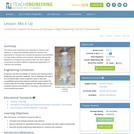
This lesson plan introduces the properties of mixtures and solutions. A class …
This lesson plan introduces the properties of mixtures and solutions. A class demonstration gives the students the opportunity to compare and contrast the physical characteristics of a few simple mixtures and solutions. Students discuss the separation of mixtures and solutions back into their original components as well as different engineering applications of mixtures and solutions.
What determines the concentration of a solution? Learn about the relationships between …
What determines the concentration of a solution? Learn about the relationships between moles, liters, and molarity by adjusting the amount of solute and solution volume. Change solutes to compare different chemical compounds in water.
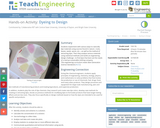
Students conduct an experiment to determine how varying the composition of a …
Students conduct an experiment to determine how varying the composition of a construction material affects its strength. They make several adobe bricks with differing percentages of sand, soil, fibrous material and water. They test the bricks for strength by dropping them onto a concrete surface from progressively greater heights. Students graph the experiment results and use what they learn to design their own special mix that maximizes the bricks' strength. During the course of the experiment, students learn about variables (independent, dependent, control) and the steps of the engineering design process.
Explore what makes a reaction happen by colliding atoms and molecules. Design …
Explore what makes a reaction happen by colliding atoms and molecules. Design experiments with different reactions, concentrations, and temperatures. When are reactions reversible? What affects the rate of a reaction?
Explore what makes a reaction happen by colliding atoms and molecules. Design …
Explore what makes a reaction happen by colliding atoms and molecules. Design experiments with different reactions, concentrations, and temperatures. When are reactions reversible? What affects the rate of a reaction?
Student teams are challenged to evaluate the design of several liquid soaps …
Student teams are challenged to evaluate the design of several liquid soaps to answer the question, “Which soap is the best?” Through two simple teacher class demonstrations and the activity investigation, students learn about surface tension and how it is measured, the properties of surfactants (soaps), and how surfactants change the surface properties of liquids. As they evaluate the engineering design of real-world products (different liquid dish washing soap brands), students see the range of design constraints such as cost, reliability, effectiveness and environmental impact. By investigating the critical micelle concentration of various soaps, students determine which requires less volume to be an effective cleaning agent, factors related to both the cost and environmental impact of the surfactant. By investigating the minimum surface tension of the soap, students determine which dissolves dirt and oil most effectively and thus cleans with the least effort. Students evaluate these competing criteria and make their own determination as to which of five liquid soaps make the “best” soap, giving their own evidence and scientific reasoning. They make the connection between gathered data and the real-world experience in using these liquid soaps.
Students perform one of the first steps that environmental engineers do to …
Students perform one of the first steps that environmental engineers do to determine water quality sampling and analysis. Student teams measure the electrical conductivity of four water samples (deionized water, purified water, school tap water and a salt-water solution) using teacher-made LED-conductivity testers and commercially available electrical conductivity meters. They use multimeters to also measure the resistance of the samples. They graph their collected data to see the relationship between the conductivity and resistance. Then, all students measure the conductivity of tap water samples brought to school from their homes; they organize and average their data by sub areas within their local school district to see if house location has any relationship to the water conductivity in their community.
Students build and use a very basic Coulter electric sensing zone particle …
Students build and use a very basic Coulter electric sensing zone particle counter to count an unknown number of particles in a sample of "paint" to determine if enough particles per ml of "paint" exist to meet a quality standard. In a lab experiment, student teams each build an apparatus and circuit, set up data acquisition equipment, make a salt-soap solution, test liquid flow in the apparatus, take data, and make graphs to count particles.
What happens when sugar and salt are added to water? Pour in …
What happens when sugar and salt are added to water? Pour in sugar, shake in salt, and evaporate water to see the effects on concentration and conductivity. Zoom in to see how different sugar and salt compounds dissolve. Zoom in again to explore the role of water.
Test the pH of things like coffee, spit, and soap to determine …
Test the pH of things like coffee, spit, and soap to determine whether each is acidic, basic, or neutral. Visualize the relative number of hydroxide ions and hydronium ions in solution. Switch between logarithmic and linear scales. Investigate whether changing the volume or diluting with water affects the pH. Or you can design your own liquid!
No restrictions on your remixing, redistributing, or making derivative works. Give credit to the author, as required.
Your remixing, redistributing, or making derivatives works comes with some restrictions, including how it is shared.
Your redistributing comes with some restrictions. Do not remix or make derivative works.
Most restrictive license type. Prohibits most uses, sharing, and any changes.
Copyrighted materials, available under Fair Use and the TEACH Act for US-based educators, or other custom arrangements. Go to the resource provider to see their individual restrictions.