In this module we will provide a comprehensive description of the legal …
In this module we will provide a comprehensive description of the legal landscape of the assistive technology locally and on an international level as well as best practices.
African Americans have a long history in Oklahoma. They first came to …
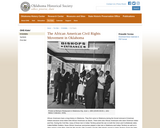
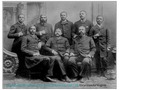
African Americans have a long history in Oklahoma. They first came to Oklahoma during the forced removal of American Indians because some tribes held African Americans as slaves. There were also African Americans who were American Indian and free. During the Civil War, many of these men in Indian Territory joined the war on both the Union and Confederate sides. Called Buffalo Soldiers, these African American servicemen played a vital role in Oklahoma and Indian Territory as well as in other regions of the West. Both the 9th and the 10th Cavalries and the 24th Infantry served in Indian Territory during the latter nineteenth century. Stationed at Fort Gibson, the 1st Kansas Colored Volunteers Infantry Regiment (later supplemented with the 2nd Kansas) fought at Cabin Creek and at the pivotal engagement of Honey Springs in July 1863. After the Civil War ended in 1865, all of the slaves in the United States, including Indian Territory, were freed. Known as freedmen, many continued living among the Indians.
Our Teacher's Guide offers a collection of lessons and resources for K-12 …
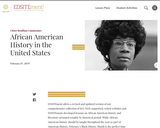
Our Teacher's Guide offers a collection of lessons and resources for K-12 social studies, literature, and arts classrooms that center around the achievements, perspectives, and experiences of African Americans across U.S. history. Below you will find materials for teaching and learning about the perspectives of slaves and free African Americans during the American Revolution, the work of the Freedman’s Bureau during and after Reconstruction, the artistry of Jacob Lawrence, the reality faced by African American soldiers returning home after fighting in WWI, the songs and efforts of the Freedom Riders during the long civil rights movements, and the works of Lorraine Hansberry, Langston Hughes, Zora Neale Hurston, and Maya Angelou.
In this lesson, students will survey the extent of and experiences of …
In this lesson, students will survey the extent of and experiences of African Americans in military service during US war efforts from the Revolution to the Vietnam Conflict using a Hyperdoc (see attached) that can be assigned using your LMS system.
In this lesson, students view archival photographs, combine their efforts to comb …
In this lesson, students view archival photographs, combine their efforts to comb through a database of more than 2,000 archival newspaper accounts about race relations in the United States, and read newspaper articles written from different points of view about post-war riots in Chicago.
Late in 1917, the War Department created two all-black infantry divisions. The …
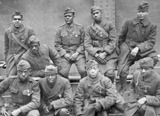
Late in 1917, the War Department created two all-black infantry divisions. The 93rd Infantry Division received unanimous praise for its performance in combat, fighting as part of France's 4th Army. In this lesson, students combine their research in a variety of sources, including firsthand accounts, to develop a hypothesis evaluating contradictory statements about the performance of the 92nd Infantry Division in World War I.
As a historic unit of the National Park Service, the Mary McLeod …
As a historic unit of the National Park Service, the Mary McLeod Bethune Council House is listed in the National Register of Historic Places. The site also is within the boundaries of the Logan Circle Historic District. This lesson is based on the Historic Resources Study for Mary McLeod Bethune Council House National Historic Site, as well as other materials on Bethune and the National Council of Negro Women. The lesson was written by Brenda K. Olio, former Teaching with Historic Places historian, and edited by staff of the Teaching with Historic Places program and Mary McLeod Bethune Council House National Historic Site.
A look at the Slavery and Freedom exhibit at the recently opened …
A look at the Slavery and Freedom exhibit at the recently opened National Museum of African American History and Culture on Washington, D.C.'s National Mall.
American History TV presented live coverage from the National Museum of African American History and Culture on Washington, D.C.'s National Mall. They showed exhibits chronicling the African American story from slavery through the inauguration of the first African American president. This clip features elements surrounding the African Slave Trade and the Middle Passage
This activity was produced in conjunction with The Library of Congress and …
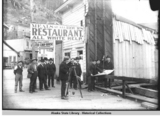
This activity was produced in conjunction with The Library of Congress and the TPS at Metropolitan State University of Denver. This activity will allow learners to: Demonstrate an understanding of the civil rights movement in Alaska and the role Elizabeth Peratrovich played in making that happen during the territorial days in Alaska.
American Government is designed to meet the scope and sequence requirements of …
American Government is designed to meet the scope and sequence requirements of the single-semester American government course. This title includes innovative features designed to enhance student learning, including Insider Perspective features and a Get Connected Module that shows students how they can get engaged in the political process. The book provides an important opportunity for students to learn the core concepts of American government and understand how those concepts apply to their lives and the world around them. American Government includes updated information on the 2016 presidential election.Senior Contributing AuthorsGlen Krutz (Content Lead), University of OklahomaSylvie Waskiewicz, PhD (Lead Editor)
This collection uses primary sources to explore the American Indian Movement between …
This collection uses primary sources to explore the American Indian Movement between 1968 and 1978. Digital Public Library of America Primary Source Sets are designed to help students develop their critical thinking skills and draw diverse material from libraries, archives, and museums across the United States. Each set includes an overview, ten to fifteen primary sources, links to related resources, and a teaching guide. These sets were created and reviewed by the teachers on the DPLA's Education Advisory Committee.
In this learning experience, the students will complete a primary source inquiry …
In this learning experience, the students will complete a primary source inquiry into the impacts of Reconstruction on Black experiences in Virginia and the South. The students will use the Claim-Evidence-Reasoning structure to defend one of two claims.Students will analyze sources that depict/detail Black experiences and perspectives before, during, and after the Reconstruction. This learning experience will be most effective after students have been introduced to the what and when of Reconstruction.
Organized around the compelling question "How have Asian Americans and Pacific Islanders …
Organized around the compelling question "How have Asian Americans and Pacific Islanders engaged civically and contributed to U.S. culture?" and grounded in inquiry-based teaching and learning, this lesson brings history, civics, and the arts together to learn about the experiences and perspectives of Asian Americans and Pacific Islanders (AAPI) in U.S. history. Primary sources, literature, and works of art created by AAPI individuals and related organizations provide an historical as well as contemporary context for concepts and issues including civic participation, immigration, and culture.
Students will explore Asian American and Pacific Islander (“AAPI”) women’s poetry in …
Students will explore Asian American and Pacific Islander (“AAPI”) women’s poetry in order to craft and inspire their own poetry, studying central idea and six different poetic elements over the course of the unit. After analyzing and interpreting poems, students will recognize poetry as a vehicle to express untold stories about events small and large. Students will learn about the experiences of and challenges faced by AAPI women, including topics of retaining culture, climate change, and more.
2021 Social Science Standards Integrated with Ethnic Studies: Civics and Government: 5.1, 7.5 Economics: 4.4 Historical Knowledge: 5.22 Social Science Analysis: 3.19, 4.21, 4.24, 5.26, 52.27, 6.26, 7.28, 7.29
For Asian Americans living, working, and growing up in the margins in …
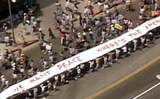
For Asian Americans living, working, and growing up in the margins in the United States during the 1960s and 70s, participating in social activism played an important role in advancing justice for them as citizens of the United States. Asian Americans worked in partnership with other ethnic and racial groups to overcome unfair treatment. Through the examples of the United Farm Workers Movement and the student strike at San Francisco State College, and at the Peace Rally after the L.A. Civil Unrest, students will learn how Asian Americans spoke out against injustice and stood up for the better treatment of all Americans.
2021 Social Science Standards Integrated with Ethnic Studies: Civics and Government: 3.2 Geography: 5.13 Historical Knowledge: 1.12, 5.22 Historical Thinking: 2.21 Social Science Analysis: 1.12, 3.18, 3.19, 4.21, 4.24, 5.28
This curriculum unit of three lessons examines the social, political and economic …
This curriculum unit of three lessons examines the social, political and economic conditions of the southern states in the aftermath of the Civil War and shows how these factors helped to shape the Reconstruction debate as well as the subsequent history of American race relations.
No restrictions on your remixing, redistributing, or making derivative works. Give credit to the author, as required.
Your remixing, redistributing, or making derivatives works comes with some restrictions, including how it is shared.
Your redistributing comes with some restrictions. Do not remix or make derivative works.
Most restrictive license type. Prohibits most uses, sharing, and any changes.
Copyrighted materials, available under Fair Use and the TEACH Act for US-based educators, or other custom arrangements. Go to the resource provider to see their individual restrictions.