Student groups create working radios by soldering circuit components supplied from AM …
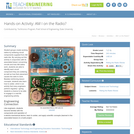
Student groups create working radios by soldering circuit components supplied from AM radio kits. By carrying out this activity in conjunction with its associated lesson concerning circuits and how AM radios work, students are able to identify each circuit component they are soldering, as well as how their placement causes the radio to work. Besides reinforcing lesson concepts, students also learn how to solder, which is an activity that many engineers perform regularly giving students a chance to be able to engage in a real-life engineering activity.
Following a brief classroom discussion of relevant principles, each student in this …
Following a brief classroom discussion of relevant principles, each student in this course completes the paper design of several advanced circuits such as multiplexers, sample-and-holds, gain-controlled amplifiers, analog multipliers, digital-to-analog or analog-to-digital converters, and power amplifiers. One of each student's designs is presented to the class, and one may be built and evaluated. Associated laboratory assignments emphasize the use of modern analog building blocks. This course is worth 12 Engineering Design Points.
An introductory course in analog circuit synthesis for microelectronic designers. Topics include: …
An introductory course in analog circuit synthesis for microelectronic designers. Topics include: Review of analog design basics; linear and non-linear analog building blocks: harmonic oscillators, (static and dynamic) translinear circuits, wideband amplifiers, filters; physical layout for robust analog circuits; design of voltage sources ranging from simple voltage dividers to high-performance bandgaps, and current source implementations from a single resistor to high-quality references based on negative-feedback structures.
6.374 examines the device and circuit level optimization of digital building blocks. …
6.374 examines the device and circuit level optimization of digital building blocks. Topics covered include: MOS device models including Deep Sub-Micron effects; circuit design styles for logic, arithmetic and sequential blocks; estimation and minimization of energy consumption; interconnect models and parasitics; device sizing and logical effort; timing issues (clock skew and jitter) and active clock distribution techniques; memory architectures, circuits (sense amplifiers) and devices; testing of integrated circuits. The course employs extensive use of circuit layout and SPICE in design projects and software labs.
Does the real-world application of science depend on mathematics? In this activity, …
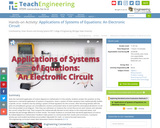
Does the real-world application of science depend on mathematics? In this activity, students answer this question as they experience a real-world application of systems of equations. Given a system of linear equations that mathematically models a specific circuit—students start by solving a system of three equations for the currents. After becoming familiar with the parts of a breadboard, groups use a breadboard, resistors and jumper wires to each build the same (physical) electric circuit from the provided circuit diagram. Then they use voltmeters to measure the current flow across each resistor and calculate the current using Ohm’s law. They compare the mathematically derived current values to the measured values, and calculate the percentage difference of their results. This leads students to conclude that real-world applications of science do indeed depend on mathematics! Students make posters to communicate their results and conclusions. A pre/post-activity quiz and student worksheet are provided. Adjustable for math- or science-focused classrooms.
This course focuses on feedback control mechanisms that living organisms implement at …
This course focuses on feedback control mechanisms that living organisms implement at the molecular level to execute their functions, with emphasis on techniques to design novel systems with prescribed behaviors. Students will learn how biological functions can be understood and designed using notions from feedback control.
Students create projects that introduce them to Arduino—a small device that can …
Students create projects that introduce them to Arduino—a small device that can be easily programmed to control and monitor a variety of external devices like LEDs and sensors. First they learn a few simple programming structures and commands to blink LEDs. Then they are given three challenges—to modify an LED blinking rate until it cannot be seen, to replicate a heartbeat pattern and to send Morse code messages. This activity prepares students to create more involved multiple-LED patterns in the Part 2 companion activity.
In the companion activity, students experimented with Arduino programming to blink a …
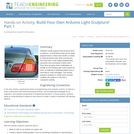
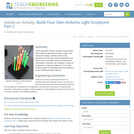
In the companion activity, students experimented with Arduino programming to blink a single LED. During this activity, students build on that experience as they learn about breadboards and how to hook up multiple LEDs and control them individually so that they can complete a variety of challenges to create fun patterns! To conclude, students apply the knowledge they have gained to create LED-based light sculptures.
Working as if they are engineers who work for (the hypothetical) Build-a-Toy …
Working as if they are engineers who work for (the hypothetical) Build-a-Toy Workshop company, students apply their imaginations and the engineering design process to design and build prototype toys with moving parts. They set up electric circuits using batteries, wire and motors. They create plans for project material expenses to meet a budget.
Student groups construct simple conductivity probes and then integrate them into two …
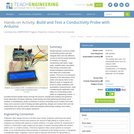
Student groups construct simple conductivity probes and then integrate them into two different circuits to test the probe behavior in solutions of varying conductivity (salt water, sugar water, distilled water, tap water). The activity culminates with student-designed experiments that utilize the constructed probes. The focus is to introduce students to the fabrication of the probe and expose them to two different ways to integrate the probe to obtain qualitative and quantitative measurements, while considering the application and utility of a conductivity probe within an engineering context. A provided handout guides teams through the process: background reading and questions; probe fabrication including soldering; probe testing and data gathering (including circuit creation on breadboard); probe connection to Arduino (including circuit creation and code entry) and a second round of testing and data gathering; design and conduct their own lab experiments that use the probes; online electrolyte/nonelectrolyte reading, short video, comprehension check and analysis questions.
What does the brain look like? As engineers, how can we look …
What does the brain look like? As engineers, how can we look at neural networks without invasive surgery? In this activity, students design and build neuron models based on observations made while viewing neurons through a microscope. The models are used to explain how each structure of the neuron contributes to the overall function. Students share their models with younger students and explain what a neuron is, its function, and how engineers use their understanding of the neuron to make devices to activate neurons.
We are surrounded everyday by circuits that utilize "in parallel" and "in …
We are surrounded everyday by circuits that utilize "in parallel" and "in series" circuitry. Complicated circuits designed by engineers are made of many simpler parallel and series circuits. In this hands-on activity, students build parallel circuits, exploring how they function and their unique features.
Everyday we are surrounded by circuits that use "in parallel" and "in …
Everyday we are surrounded by circuits that use "in parallel" and "in series" circuitry. Complicated circuits designed by engineers are composed of many simpler parallel and series circuits. During this activity, students build a simple series circuit and discover the properties associated with series circuits.
In this demonstration, cook a cake using the heat produced when the …
In this demonstration, cook a cake using the heat produced when the cake batter conducts an electric current. Because of safety concerns, this activity should be conducted as a demonstration only and learners should be kept at a safe distance.
This lab demonstrates Ohm's law as students set up simple circuits each …
This lab demonstrates Ohm's law as students set up simple circuits each composed of a battery, lamp and resistor. Students calculate the current flowing through the circuits they create by solving linear equations. After solving for the current, I, for each set resistance value, students plot the three points on a Cartesian plane and note the line that is formed. They also see the direct correlation between the amount of current flowing through the lamp and its brightness.
Students are introduced to several key concepts of electronic circuits. They learn …
Students are introduced to several key concepts of electronic circuits. They learn about some of the physics behind circuits, the key components in a circuit and their pervasiveness in our homes and everyday lives. Students learn about Ohm's Law and how it is used to analyze circuits.
In the everyday electrical devices we use calculators, remote controls and cell …
In the everyday electrical devices we use calculators, remote controls and cell phones a voltage source such as a battery is required to close the circuit and operate the device. In this hands-on activity, students use batteries, wires, small light bulbs and light bulb holders to learn the difference between an open circuit and a closed circuit, and understand that electric current only occurs in a closed circuit.
Students make a simple conductivity tester using a battery and light bulb. …
Students make a simple conductivity tester using a battery and light bulb. They learn the difference between conductors and insulators of electrical energy as they test a variety of materials for their ability to conduct electricity.
Students put their STEAM knowledge and skills to the test by creating …
Students put their STEAM knowledge and skills to the test by creating indoor light fixture “clouds” that mimic current weather conditions or provide other colorful lighting schemes they program and control with smartphones. Groups fabricate the clouds from paper lanterns and pillow stuffing, adding LEDs to enable the simulation of different lighting conditions. They code the controls and connect the clouds to smart devices and the Internet cloud to bring their floating clouds to life as they change color based on the weather outside.
Students’ background understanding of electricity and circuit-building is reinforced as they create …
Students’ background understanding of electricity and circuit-building is reinforced as they create wearable, light-up e-textile pins. They also tap their creative and artistic abilities as they plan and produce attractive end product “wearables.” Using fabric, LED lights, conductive thread (made of stainless steel) and small battery packs, students design and fabricate their own unique light-up pins. This involves putting together the circuitry so the sewn-in LEDs light up. Connecting electronics with stitching instead of soldering gives students a unique and tangible understanding of how electrical circuits operate.
No restrictions on your remixing, redistributing, or making derivative works. Give credit to the author, as required.
Your remixing, redistributing, or making derivatives works comes with some restrictions, including how it is shared.
Your redistributing comes with some restrictions. Do not remix or make derivative works.
Most restrictive license type. Prohibits most uses, sharing, and any changes.
Copyrighted materials, available under Fair Use and the TEACH Act for US-based educators, or other custom arrangements. Go to the resource provider to see their individual restrictions.