(Complete Item Description)
- Abstract:
-
Using chocolate as a theme, students will become involved in reading, writing, math, word study/spelling and other developmentally appropriate (integrated) activities. The unit includes centers for the classroom along with whole group activities.
- Subject:
-
Humanities,
Mathematics and Statistics
- Grade Level:
-
Primary
- Collection:
-
LEARN NC Lesson Plans
Rate this resource by using the left and right arrow keys and pressing Enter.
Evaluated
Remix and Share
(Complete Item Description)
- Abstract:
-
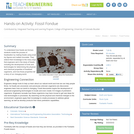
To understand how fossils are formed, students model the process of fossilization by making fossils using small toy figures and melted chocolate. They extend their knowledge to the many ways that engineers aid in the study of fossils, including the development of tools and technologies for determining the physical and chemical properties of fossilized organisms, and how those properties tell a story of our changing world.
- Subject:
-
Mathematics and Statistics,
Science and Technology
- Grade Level:
-
Secondary
- Collection:
-
TeachEngineering
Rate this resource by using the left and right arrow keys and pressing Enter.
Read the Fine Print
(Complete Item Description)
- Abstract:
-
In this activity, learners discover that sand is the major ingredient in glass. They carry out a guided investigation involving chocolate to see what happens when heat is applied to a material that appears solid at room temperature. They learn that glass has special physical properties that allow it to be formed into many different and beautiful objects. At the end, learners can eat the outcomes of the investigation! This activity is featured on pp.32-34 of the "Fireworks of Glass: The Art of Dale Chihuly" unit of study for grades 3-5.
- Subject:
-
Science and Technology,
Social Sciences
- Grade Level:
-
Primary
- Collection:
-
Children's Museum of Indianapolis
Rate this resource by using the left and right arrow keys and pressing Enter.
Read the Fine Print
(Complete Item Description)
- Abstract:
-
This biodiversity Web site for kids, part of the museum's Kids in Our Halls program, was produced by high school interns at the Museum. In includes these sections: What Do You Think About Extinction?, an interview with kids visiting the Hall of Biodiversity; Did You Know?, a collection of fun facts that includes challenges to be solved; a five-question interactive biodiversity quiz; a Q&A interview with the head of the museum's Ichthyology Department; brief articles about the origins of chocolate and the ecological importance of coral reefs; a downloadable poster to color.
- Subject:
-
Science and Technology
- Grade Level:
-
Primary
- SubTopics:
-
Endangered Species
- Collection:
-
American Museum of Natural History
Rate this resource by using the left and right arrow keys and pressing Enter.
Read the Fine Print
(Complete Item Description)
- Abstract:
-
" This seminar is designed to be an experimental and hands-on approach to applied chemistry (as seen in cooking). Cooking may be the oldest and most widespread application of chemistry and recipes may be the oldest practical result of chemical research. We shall do some cooking experiments to illustrate some chemical principles, including extraction, denaturation, and phase changes."
- Subject:
-
Science and Technology
- Grade Level:
-
Post-secondary
- Collection:
-
MIT OpenCourseWare
Rate this resource by using the left and right arrow keys and pressing Enter.
Remix and Share
(Complete Item Description)
- Abstract:
-
In this activity, learners explore the history of making objects from glass and artistry of Dale Chihuly. Learners visit an online "hot shop" to discover how glass is transformed into works of art and create a virtual "Macchia" or a special glass form that Chihuly invented. They investigate the way that Chihuly uses drawings to design his sculptures and create their own sculptures by combining smaller parts to make a whole. This activity is featured on pp.35-38 of the "Fireworks of Glass: The Art of Dale Chihuly" unit of study for grades 3-5.
- Subject:
-
Science and Technology,
Social Sciences
- Grade Level:
-
Primary
- Collection:
-
Children's Museum of Indianapolis
Rate this resource by using the left and right arrow keys and pressing Enter.
Read the Fine Print
(Complete Item Description)
- Abstract:
-
In this activity, learners make edible T. rex teeth (with adult assistance). The treat is a white and dark chocolate covered banana on a stick. The white chocolate represents the tooth and the dark chocolate represents the strong part of the T. rex tooth. While learners wait for each chocolate layer to cool, they must count the Cretaceous Period by fives all the way to 65 Cretaceous million years ago. This activity is featured on page 41 of the "Dinosphere" unit of study for K-2 learners.
- Subject:
-
Science and Technology,
Social Sciences
- Grade Level:
-
Primary
- Collection:
-
Children's Museum of Indianapolis
Rate this resource by using the left and right arrow keys and pressing Enter.
Read the Fine Print
No restrictions on your remixing, redistributing, or making derivative works. Give credit to the author, as required.
Your remixing, redistributing, or making derivatives works comes with some restrictions, including how it is shared.
Your redistributing comes with some restrictions. Do not remix or make derivative works.
Copyrighted materials, available under Fair Use and the TEACH Act for US-based educators, or other custom arrangements. Go to the resource provider to see their individual restrictions.