In this activity, students will practice answer the phone and having a …
In this activity, students will practice answer the phone and having a conversation in Chinese, using mannerisms common in Chinese. They will practice trying to make plans with someone over the phone, explaining their schedule, and politely accepting or declining an invitation.
In this activity, students will practice answer the phone and having a …
In this activity, students will practice answer the phone and having a conversation in a Chinese style. They will practice trying to make plans with someone over the phone, explaining their schedule, and politely accepting or declining an invitation.
In this activity, students will practice asking someone they meet where they …
In this activity, students will practice asking someone they meet where they are from and their nationality. Students will start by asking each other what country they are from, and then each student will be given a country card at random. Students will then practice asking and answering questions about various nationalities.
COERLL produces online language learning materials (for example language courses, reference grammars, …
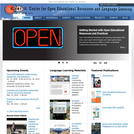
COERLL produces online language learning materials (for example language courses, reference grammars, assessment tools, and corpora) for teachers to adopt, adapt, modify, and share, and also provides professional development tools for teachers. You can browse materials on the COERLL website.
This curriculum focuses on child maltreatment issues and effective practice strategies among …
This curriculum focuses on child maltreatment issues and effective practice strategies among immigrant Asian families. Specifically, it elucidates demographic and behavioral characteristics of child abuse victims and perpetrators in four major immigrant Asian communities (Cambodian, Chinese, Korean, and Vietnamese), factors contributing to the selection of two types of placement (in-home and out-of-home) by child protective services workers, and effective child welfare practice with immigrant Asian families. (106 pages)Rhee, S., Chang, J. (2006).
This podcast series consists of simple dialogue exchanges. The listening materials are …
This podcast series consists of simple dialogue exchanges. The listening materials are suitable for beginners and help them take the first step toward becoming proficient listeners. The contents of these 72 dialogues are completely based on the beginning level Chinese curriculum; they are creative yet realistic scenarios on topics that listeners can relate to, such as the social, family and school aspects of one’s life. Full transcripts transcripts in both traditional and simplified characters as well as English translations are provided as downloadable PDF documents. The podcast format enables a generation of increasingly ‘mobile’ learners to study the material ‘on-the-go’.
4-6 weeks of distance (remote) learning content provided for middle through high …
4-6 weeks of distance (remote) learning content provided for middle through high school-level Chinese programs. These units were adapted from existing Unit & Pacing guides created by teachers from Tacoma Public Schools in Washington State.
Practice vocabulary on the go! The original idea conceived by a fellow …
Practice vocabulary on the go! The original idea conceived by a fellow Chinese language student, this flashcard exercise is an engaging and effective way to review vocabulary terms from the convenience of your mobile device.
This lecture course provides students with a comprehensive introduction to the international …
This lecture course provides students with a comprehensive introduction to the international relations of the People’s Republic of China. China’s foreign relations during the Cold War as well as contemporary diplomatic, security and economic issues will be examined to identify and explain China’s foreign policy goals and their implementation since 1949. Throughout, this course will investigate the sources of conflict and cooperation in China’s behavior, assessing competing explanations for key events and policies. Readings will be drawn from political science, history, and international relations theory.
This course is the intermediate level of the streamlined curriculum, which is …
This course is the intermediate level of the streamlined curriculum, which is intended for students who, when they began streamlined I, had some background in the language, whether it be comprehension with limited speaking ability or quite fluent speaking ability. The focus of the course is on standard pronunciation and usage, on reading in both complex and simplified characters, and on writing. It is presupposed that students in Chinese III have already learned the pinyin system of representing pronunciation sufficiently well to be able to read texts in pinyin accurately. (If not, there are pinyin tutorials to assist you to learn the system.)
This subject is the second semester of four that forms an introduction …
This subject is the second semester of four that forms an introduction to modern standard Chinese, commonly called Mandarin. The emphasis is on further developing students' abilities to participate in simple, practical conversations on everyday topics as well as enhancing their abilities on reading and writing. The relationship between Chinese language and culture and the sociolinguistically appropriate use of language will be stressed throughout. A typical class includes performance of memorized basic conversations, drills, questions and discussion, and various types of communicative exercises. At the end of this course, students are expected to develop an understanding of the language learning process so that they will be able to continue studying effectively on their own.
This course, along with 21G.107 / 157 Chinese I (Streamlined) offered in …
This course, along with 21G.107 / 157 Chinese I (Streamlined) offered in the previous fall, form the elementary level of the streamlined sequence, which is intended for students who, when they began the sequence at beginning level, had basic conversational skills (gained, typically, from growing up in a Chinese speaking environment), but lacked a corresponding level of literacy. The focus of the course is on standard usage, on reading in both traditional and simplified characters, and on writing. The course is conducted entirely in Chinese. Streamlined I and II—each section is limited to 16 students for pedagogical purposes. Pre-registered students have priority. Continuing students get first priority, followed, in order, by students in 21G.076, declared concentrators and minors, sophomores, freshmen, juniors, seniors, and graduate students. Pre-registered students who did not show up for the first two days of class without warning will be eliminated. Students beginning their studies of Chinese language at MIT above the elementary level must contact the Chinese instructors for a placement test. No auditors allowed.
This course, along with 21G.108 / 158 offered in the spring, form …
This course, along with 21G.108 / 158 offered in the spring, form the elementary level of the streamlined sequence, which is for students who have some basic conversational skills gained, typically, from growing up in a Chinese speaking environment, but lack a corresponding level of literacy. The focus of the course is on learning standard everyday usage, on reading in both full and simplified characters, and on writing. This course, along with 21G.108 / 158 offered in the spring, are conducted entirely in Chinese.
This is the second semester of the intermediate level sequence intended for …
This is the second semester of the intermediate level sequence intended for students whose conversational ability exceeds their reading and writing skills. Focus is on reading and writing, as well as broadening conversational skills and control of standard pronunciation, for students with background in conversational Chinese. Lab work is required. On completing this course, students should be able to speak the language with standard pronunciation, to converse with some fluency on everyday topics, as well as on some specialized topics, to read edited, as well as authentic texts, in simplified or traditional characters with suitable fluency, and to be able to write composition on certain topics. The class consists of a combination of practice, reading, discussion, dictation, composition and feedback, net exploration via the web, and presentation. This course is conducted in Mandarin.
Welcome to the Chinese wikibook, a free Chinese textbook on the Standard …
Welcome to the Chinese wikibook, a free Chinese textbook on the Standard Mandarin dialect. This page links to lessons using simplified characters (used in mainland China, Singapore and Malaysia). There is also a Traditional Character Version available (used in Taiwan, Macau, and Hong Kong).
This is a Connections Standards lesson for Chinese high school students. Learners …
This is a Connections Standards lesson for Chinese high school students. Learners will be able to:
• Identify a base of vocabulary on Chinese musical instruments and develop interpersonal communication skills through discussions of the key elements of Chinese musical instruments. • Develop interpretive skills through reading articles and watching video clips about Chinese musical instruments. • Write an essay about Chinese musical instruments. • Gain knowledge of traditional Chinese musical instruments through Internet research on both English and Chinese language websites. • Gain knowledge of cultural products of Chinese music instruments and their relationship with the Chinese cultural perspective of “harmony but not uniformity”. • Make connections with other subjects, such as music, geography, history and religion. • Compare the linguistic difference between the Chinese characters for pipa 琵琶 and guitar 吉他. • Discuss the major characteristics of Chinese musical instruments and compare and contrast them with those of musical instruments from other cultures in terms of structures, finger movements, hand positions, cultural symbols, etc. • Apply what students learn from this unit to their own musical learning and personal entertainment in the future. • Explain their understanding of the Chinese cultural concept of “harmony but not uniformity”. • Create a presentation for the community to promote Chinese musical instruments. • Connect with the sister school in Chongqing, China to learn more about Chinese musical instruments.
The authors of Chinese Rhetoric and Writing offer a response to the …
The authors of Chinese Rhetoric and Writing offer a response to the argument that Chinese students' academic writing in English is influenced by "culturally nuanced rhetorical baggage that is uniquely Chinese and hard to eradicate." Noting that this argument draws from "an essentially monolingual and Anglo-centric view of writing," they point out that the rapid growth in the use of English worldwide calls for "a radical reassessment of what English is in today's world." The result is a book that provides teachers of writing, and in particular those involved in the teaching of English academic writing to Chinese students, an introduction to key stages in the development of Chinese rhetoric, a wide-ranging field with a history of several thousand years. Understanding this important rhetorical tradition provides a strong foundation for assessing and responding to the writing of this growing group of students.
No restrictions on your remixing, redistributing, or making derivative works. Give credit to the author, as required.
Your remixing, redistributing, or making derivatives works comes with some restrictions, including how it is shared.
Your redistributing comes with some restrictions. Do not remix or make derivative works.
Most restrictive license type. Prohibits most uses, sharing, and any changes.
Copyrighted materials, available under Fair Use and the TEACH Act for US-based educators, or other custom arrangements. Go to the resource provider to see their individual restrictions.