In this course, you will engage in the biology of cells of …
In this course, you will engage in the biology of cells of higher organisms. You will study the structure, function, and biosynthesis of cellular membranes and organelles; cell growth and oncogenic transformation; transport, receptors, and cell signaling; the cytoskeleton, the extracellular matrix, and cell movements; cell division and cell cycle; functions of specialized cell types. This course emphasizes the current molecular knowledge of cell biological processes as well as the genetic, biochemical, and other experimental approaches that resulted in these discoveries. This course, based on the MIT course 7.06 Cell Biology taken by enrolled MIT students, was organized as a three-part series on edX by MIT’s Department of Biology. It is self-paced and free as long as you enroll in the Audit Track option, which you can select after creating a free account on edX.
This course is an in-depth adventure through the molecular mechanisms that control …
This course is an in-depth adventure through the molecular mechanisms that control the maintenance, expression, and evolution of prokaryotic and eukaryotic genomes. Through lectures and readings of relevant literature, students will explore gene regulation, DNA replication, genetic recombination, transcription, and mRNA translation. The quizzes are designed to build students' experimental design and data analysis skills. This course, based on the MIT course 7.28/7.58 Molecular Biology taken by enrolled MIT students, was organized as a three-part series on edX by MIT’s Department of Biology. It is self-paced and free as long as you enroll in the Audit Track option, which you can select after creating a free account on edX.
This site is a searchable encyclopedia of thousands of photos, descriptions, sound …
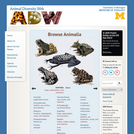
This site is a searchable encyclopedia of thousands of photos, descriptions, sound recordings, and other information about individual animal species. Find out about amphibians, arthropods, birds, fishes, insects, mammals, mollusks, reptiles, and sharks. Explore special features on mammals, skulls, and frog calls. Students are invited to contribute.
The purpose of this video lesson is to expand the student's knowledge …
The purpose of this video lesson is to expand the student's knowledge about enzymes by introducing the antioxidant enzymes that are intimately involved in the prevention of cellular damage and eventual slowing of the aging process and prevention of several diseases. Students will learn that natural antioxidant enzymes are manufactured in the body and provide an important defense against free radicals. The topic of free radical action is introduced, covering how they are constantly generated in living cells both by ''accidents of chemistry'' and also by specific metabolic processes.
A grasp of the logic and practice of science is essential to …
A grasp of the logic and practice of science is essential to understand the rest of the world around us. To that end, the CMB4e iText (like earlier editions) remains focused on experimental support for what we know about cell and molecular biology, and on showing students the relationship of cell structure and function. Rather than trying to be a comprehensive reference book, CMB4e selectively details investigative questions, methods and experiments that lead to our understanding of cell biology. This focus is nowhere more obvious than in the chapter learning objectives and in external links to supplementary material. The Basic CMB3e version of the iText includes links to external web-sources as well as the author’s short, just-in-time YouTube VOPs (with edited, optional closed captions), all embedded in or near relevant text. Each video is identified with a descriptive title and video play and QR bar codes.
BioNook is Whitehead Institute's online biology resource, offering exciting learning enrichment for …
BioNook is Whitehead Institute's online biology resource, offering exciting learning enrichment for students, parents and teachers. Find videos, podcasts and stories on Whitehead Institute Science, as well as virtual workshop opportunities through BioNook’s After School Science Club, and ideas for nature-based activities. Explore free materials on biology and research—from deep explorations of how science is done, to stories following the lives of scientists, to suggestions for fun outside activities and hands-on citizen science projects.
This 14-minute video lesson provides an overview of B cells (B lymphocytes) …
This 14-minute video lesson provides an overview of B cells (B lymphocytes) and how they are activated and produce antibodies. [Biology playlist: Lesson 53 of 71].
This 10-minute video lesson discusses how cytotoxic T-Cells get activated by MHC-I/antigen …
This 10-minute video lesson discusses how cytotoxic T-Cells get activated by MHC-I/antigen complexes and then proceed to kill infected cells. [Biology playlist: Lesson 56 of 71].
This 12-minute video lesson looks at how professional antigen presenting cells present …
This 12-minute video lesson looks at how professional antigen presenting cells present parts of engulfed pathogens on MHC II complexes (major histocompatibility complexes). [Biology playlist: Lesson 54 of 71].
No restrictions on your remixing, redistributing, or making derivative works. Give credit to the author, as required.
Your remixing, redistributing, or making derivatives works comes with some restrictions, including how it is shared.
Your redistributing comes with some restrictions. Do not remix or make derivative works.
Most restrictive license type. Prohibits most uses, sharing, and any changes.
Copyrighted materials, available under Fair Use and the TEACH Act for US-based educators, or other custom arrangements. Go to the resource provider to see their individual restrictions.