The Adventures of Josie True is a web-based historical adventure game for girls. The hero of the game is Chinese-American Josie True, a regular girl who becomes involved in intrigue across time and space as she tries to find her inventor-turned-teacher Ms. Trombone. She time travels with one of Ms. Trombone's inventions, the Intellicat. Includes a guide for teachers and parents with lesson plans. For girls 9-11 years of age. We want to give real girls good content and provide real historical role models to girls in a science and math context. So send friends and family our way!
Astro-Venture is an educational, interactive, multimedia Web environment highlighting NASA careers and astrobiology research in the areas of Astronomy, Geology, Biology and Atmospheric Science. Students in grades five through eight are transported to the future where they role play NASA occupations and use scientific inquiry, as they search for and build a planet with the necessary characteristics for human habitation. Supporting activities include chats with real NASA scientists, online collaborations, classroom lessons, student publishing area and occupations fact sheets and trading cards.
Astro-Venture is an educational, interactive, multimedia Web environment highlighting NASA careers and astrobiology research in the areas of Astronomy, Geology, Biology and Atmospheric Sciences. Students in grades 5-8 role play NASA occupations and use scientific inquiry, as they search for and design a planet with the necessary characteristics for human habitation.
This is the second of four curriculum guides focusing on astrobiology and careers for grades 5-8. Students are confronted with the challenge of searching for and designing a planet that would be habitable to humans. Using an online, multimedia module, students change the amounts of gases in our atmosphere and draw conclusions about which factors are necessary for human survival. Students then engage in classroom activities that help them to form an understanding of atoms, elements, and molecules as the components of gases that have unique properties that makes each gas important to human survival. They further explore the process of chemical change, with a focus on some of the chemical reactions most important to human survival. In contrast, they learn how the inert gas, nitrogen, is important to human life by contributing to our surface pressure. Finally, they connect their learning to the systems they explored in Astronomy.
Astro-Venture is an educational, interactive, multimedia Web environment highlighting NASA careers and astrobiology research in the areas of Astronomy, Geology, Biology and Atmospheric Sciences. Students in grades 5-8 role play NASA occupations and use scientific inquiry, as they search for and design a planet with the necessary characteristics for human habitation.
This features scientists and machines that explore the universe's tiniest particles. Follow a proton through the accelerator. Meet scientists at CERN. Hear why they search for the secrets of matter. Learn about the antimatter, the Big Bang, and other big ideas behind experiments at CERN.
This site explores career options in advanced manufacturing, automotive, construction, energy, financial services, health care, hospitality, information technology, retail, and transportation industries, as well as in emerging industries -- biotechnology, geospatial technology, and nanotechnology. Learn which industries are growing, how to qualify for a good job, and where to get started.
There are two lessons in this group. The first lesson is a lab activity that illustrates the importance of hand washing as a way to prevent the spread disease. The second lesson includes discussion of various careers in the health field and allows students to explore careers utilizing various resources.
This NASA site (for kids) features the career of oceanographer Will Sager, who narrates how the Ocean Drilling Program is involved in drilling and interpreting rocks and sediments from the ocean floor. Color images are also included.
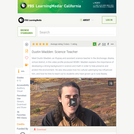
In this video profile produced for Teachers' Domain, meet teacher Dustin Madden, an Iñupiaq who hopes to inspire students to take an active role in protecting the natural environment by giving them a foundation in math and science.
This module engages students in the use of a clean room and in the planning of assembly of solar collector wafers for the Genesis space mission. They will work in production design teams to explore how the Genesis spacecraft will collect bulk solar wind with the collector arrays and learn to work as a team in a restrictive environment. The module includes several activities with accompanying video clips. Downloadable, printable teachers' guides and students pages are provided for each one.
Who Are NASA's Earth Explorers? The elementary school student questioning if El Nino occurs anywhere besides the Pacific Ocean... The researcher investigating connections between Arctic ozone depletion and global climate change... The consumer comparing hydrocarbon versus hydrogen-powered cars... And the business person projecting future needs for harvest, delivery, and storage of crops... All of these people are Earth Explorers -- they are all connected by their curiosity about Earth system processes. This monthly series will introduce you to NASA Earth Explorers, young and old, with a variety of backgrounds and interests.
The Institute for Global Environmental Strategies (IGES) maintains an Earth Explorers topic index for educators, students and others who want to browse articles by subject. IGES is a nonprofit organization that works with NASA's Science Mission Directorate to provide educational Earth and space science content for the NASA portal.
In this video from Science City, meet Eduardo Torres-Jara, a postdoctoral associate in electrical engineering and computer science at the MIT Artificial Intelligence Lab. He describes his work on innovative robots that use tactile feedback to locate and grasp objects.
The School of Chemical and Environmental Engineering has concerns about the lack of knowledge amongst school pupils, and their teachers, of the type of work undertaken by an Environmental Engineer. The interactive presentation was developed as part of an awareness raising exercise for aspects of Environmental Engineering. Targeted at KS3 pupils particularly in Year 9 (Y9) the themes of air/ soil/water pollution were chosen because of their links to the KS3 National Curriculum for Science ( eg unit 9g Environmental Chemistry). The rationale behind the presentation was that visually it must be engaging and provide a clear indication of the consequences of actions but at the same time have questions using appropriate language that provide a basis for extending discussion / teaching beyond students/teachers current experience.
The presentation has been made available through our website and demonstrated at a variety of events where School Teachers meet eg 14-19 Conference ( School of Education) and PGCE Science Mentor Meetings ( School of Education).
This educator guide provides information and activities related to meteorites and their origins. Topics include sources and collection of meteorites, meteorite mineralogy and classification, famous meteorite falls, and others.
This site profiles women of NASA who achieved a variety of women's firsts -- the first woman programmer, the first woman shuttle commander, the first woman in space, and more. Web chat archives feature conversations with more than a dozen pioneering women.
Findings magazine showcases diverse scientists who do cutting-edge research and lead interesting lives. Each issue also contains brief research highlights, a puzzle or other activity, and online extras.
This site helps students learn about aerosols, ozone, air pressure, tropical rainfall and hurricanes, plate tectonics, earth science careers, and more.
This interactive field trip features interviews with scientists and technicians who work in the Genesis cleanroom at NASA Johnson Space Center. The field trip includes an interactive diagram of the laboratory with photos of various areas. Video shows scientists donning cleanroom clothing, washing samples, and assembling sampling wafers onto the array frame of the Genesis probe.
Students take on different roles to learn about DNA and genetic diseases, including how a genetic disease causes a person to get sick, how we test for and treat a genetic disease, and how we help people to make better decisions regarding all the complicated issues involved with genetic diseases. This webquest, designed for high school and undergraduate students, is an ideal introduction to the concepts of bioinformatics, genetic diseases, and potential careers in science fields. The activity can be used in conjunction with a visit to the Koshland Science Museum’s exhibit: “Infectious Disease: Evolving Challenges to Human Health,” or as a stand-alone lesson
No restrictions on your remixing, redistributing, or making derivative works.
Give credit to the author, as required.
Your remixing, redistributing, or making derivatives works comes with some
restrictions, including how it is shared.
Your redistributing comes with some restrictions. Do not remix or make
derivative works.
Copyrighted materials, available under Fair Use and the TEACH Act for US-based
educators, or other custom arrangements. Go to the resource provider to see
their individual restrictions.