This course will guide graduate students through the process of using rapid …
This course will guide graduate students through the process of using rapid prototyping and CAD/CAM devices in a studio environment. The class has a theoretical focus on machine use within the process of design. Each student is expected to have completed one graduate level of design computing with a full understanding of solid modeling in CAD. Students are also expected to have completed at least one graduate design studio.
Students practice creating rudimentary detail drawings. They learn how engineers communicate the …
Students practice creating rudimentary detail drawings. They learn how engineers communicate the technical information about their designs using the basic components of detail drawings. They practice creating their own drawings of a three-dimensional block and a special LEGO piece, and then make 3D sketches of an unknown object using only the information provided in its detail drawing.
Instructional materials for the course "ENGR 1110: Engineering Graphics" include videos, assignments, …
Instructional materials for the course "ENGR 1110: Engineering Graphics" include videos, assignments, slides, and drawings on the following topics: engineering graphics and scales, orthographic views, isometric views, dimensioning, section views, AutoCAD, layers, colors, mirrors, fillet, arrays, chamfer, blocks, Fusion 360, sheet metal modeling, tracing, textures, lofting and more.
Instructional materials for the course "ENTC 2160: Architectural CAD" include videos demonstrating …
Instructional materials for the course "ENTC 2160: Architectural CAD" include videos demonstrating how to create CAD drawings and use CAD tools. Videos cover the following topics: exterior walls, interior walls, doors, windows, dimensioning, linetypes, electrical, slab, stairs, hatching, fireplaces, and roofing.
Instructional materials for the course "ENTC 2170: Computer Aided Design and Drafting" …
Instructional materials for the course "ENTC 2170: Computer Aided Design and Drafting" include videos, assignments, slides, and drawings on the following topics: engineering graphics and scales, orthographic views, isometric views, dimensioning, section views, AutoCAD, layers, colors, mirrors, fillet, arrays, chamfer, blocks, Fusion 360, sheet metal modeling, tracing, textures, lofting and more.
This is an advanced course on modeling, design, integration and best practices …
This is an advanced course on modeling, design, integration and best practices for use of machine elements such as bearings, springs, gears, cams and mechanisms. Modeling and analysis of these elements is based upon extensive application of physics, mathematics and core mechanical engineering principles (solid mechanics, fluid mechanics, manufacturing, estimation, computer simulation, etc.). These principles are reinforced via (1) hands-on laboratory experiences wherein students conduct experiments and disassemble machines and (2) a substantial design project wherein students model, design, fabricate and characterize a mechanical system that is relevant to a real world application. Students master the materials via problems sets that are directly related to, and coordinated with, the deliverables of their project. Student assessment is based upon mastery of the course materials and the student's ability to synthesize, model and fabricate a mechanical device subject to engineering constraints (e.g. cost and time/schedule).
This course provides students with an opportunity to conceive, design and implement …
This course provides students with an opportunity to conceive, design and implement a product, using rapid prototyping methods and computer-aid tools. The first of two phases challenges each student team to meet a set of design requirements and constraints for a structural component. A course of iteration, fabrication, and validation completes this manual design cycle. During the second phase, each team conducts design optimization using structural analysis software, with their phase one prototype as a baseline. Acknowledgements This course is made possible thanks to a grant by the alumni sponsored Teaching and Education Enhancement Program (Class of '51 Fund for Excellence in Education, Class of '55 Fund for Excellence in Teaching, Class of '72 Fund for Educational Innovation). The instructors gratefully acknowledge the financial support. The course was approved by the Undergraduate Committee of the MIT Department of Aeronautics and Astronautics in 2003. The instructors thank Prof. Manuel Martinez-Sanchez and the committee members for their support and suggestions.
This course provides students with an opportunity to conceive, design and implement …
This course provides students with an opportunity to conceive, design and implement a product, using rapid prototyping methods and computer-aid tools. The first of two phases challenges each student team to meet a set of design requirements and constraints for a structural component. A course of iteration, fabrication, and validation completes this manual design cycle. During the second phase, each team conducts design optimization using structural analysis software, with their phase one prototype as a baseline. Acknowledgements This course is made possible thanks to a grant by the alumni sponsored Teaching and Education Enhancement Program (Class of '51 Fund for Excellence in Education, Class of '55 Fund for Excellence in Teaching, Class of '72 Fund for Educational Innovation). The instructors gratefully acknowledge the financial support. The course was approved by the Undergraduate Committee of the MIT Department of Aeronautics and Astronautics in 2003. The instructors thank Prof. Manuel Martinez-Sanchez and the committee members for their support and suggestions.
Prologue: All too often current “CAD” text books concentrate too much on …
Prologue: All too often current “CAD” text books concentrate too much on the software and not enough on the basic fundamental principles that are required to create a working industrial drawing. More and more college freshman enter the post-secondary arena knowing one or more cad software packages. A skilled instructor can rapidly get a group of students up to speed on whatever software package that is being used at that institution. However, over the last 25 years it has been my experience that many students only know the software…and not what to do with it. Now, this is not the fault of the technology education teachers in the secondary school system. They are most likely trained with a Charles Prosser philosophy that students leave high school with a set of skills grounded in meeting the needs of industry. However, since very few technology education teachers have actually spent any time in industry as a draftsman, designers, or engineers…the product they produce only knows “some” of what is required to be successful in the post-secondary arena. Make no mistake, this is not something done intentionally…it is simply the way “the American Education System” works. This document and the material contained within is being created to assist in both secondary and post-secondary educators who lack either the educational component of how to facilitate the required material…or more importantly, what that required material is.
This series of lessons will teach all of the key features in …
This series of lessons will teach all of the key features in Tinkercad, a free, web-based 3D design platform. When you have finished the lessons you will have a comprehensive knowledge of how to design/draw in 3D. After that all you need is practice to improve your skills.
This course introduces the fundamentals of machine tool and computer tool use. …
This course introduces the fundamentals of machine tool and computer tool use. Students work with a variety of machine tools including the bandsaw, milling machine, and lathe. Instruction given on MATLAB®, MAPLE®, XESS™, and CAD. Emphasis is on problem solving, not programming or algorithmic development. Assignments are project-oriented relating to mechanical engineering topics. It is recommended that students take this subject in the first IAP after declaring the major in Mechanical Engineering. This course was co-created by Prof. Douglas Hart and Dr. Kevin Otto.
In the past building prototypes of electronic components for new projects/products was …
In the past building prototypes of electronic components for new projects/products was limited to using protoboards and wirewrap. Manufacturing a printed-circuit-board was limited to final production, where mistakes in the implementation meant physically cutting traces on the board and adding wire jumpers - the final products would have these fixes on them! Today that is no longer the case, while you will still cut traces and use jumpers when debugging a board, manufacturing a new final version without the errors is a simple and relatively inexpensive task. For that matter, manufacturing a prototype printed circuit board which you know is likely to have errors but which will get the design substantially closer to the final product than a protoboard setup is not only possible, but desirable. In this class, you'll learn to design, build, and debug printed-circuit-boards.
Students practice human-centered design by imagining, designing and prototyping a product to …
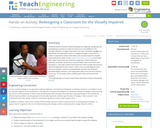
Students practice human-centered design by imagining, designing and prototyping a product to improve classroom accessibility for the visually impaired. To begin, they wear low-vision simulation goggles (or blindfolds) and walk with canes to navigate through a classroom in order to experience what it feels like to be visually impaired. Student teams follow the steps of the engineering design process to formulate their ideas, draw them by hand and using free, online Tinkercad software, and then 3D-print (or construct with foam core board and hot glue) a 1:20-scale model of the classroom that includes the product idea and selected furniture items. Teams use a morphological chart and an evaluation matrix to quantitatively compare and evaluate possible design solutions, narrowing their ideas into one final solution to pursue. To conclude, teams make posters that summarize their projects.
This subject teaches students, having an initial interest in sailing design, how …
This subject teaches students, having an initial interest in sailing design, how to design good yachts. Topics covered include hydrostatics, transverse stability, and the incorporation of the design spiral into one's working methods. Computer aided design (CAD) is used to design the shapes of hulls, appendages and decks, and is an important part of this course. The capstone project in this course is the Final Design Project in which each student designs a sailing yacht, complete in all major respects. The central material for this subject is the content of the book Principals of Yacht Design by Larssson and Eliasson (see further description in the syllabus). All the class lectures are based on the material in this book. The figures in the book which are shown in class (but not reproduced on this site), contain the essential material and their meaning is explained in detail during the lecture sessions. Mastery of the material in the book and completing a design project provides the desired and needed education. This course was originally offered in Course 13 (Department of Ocean Engineering) as 13.734. In 2005, ocean engineering subjects became part of Course 2 (Department of Mechanical Engineering), and this course was renumbered 2.996.
This class focuses on representation tools used by architects during the design …
This class focuses on representation tools used by architects during the design process and attempts to discuss the relationship they develop with the object of design. Representation plays a key role in architectural design, not only as a medium of conveying and narrating a determined meaning or a preconceived idea, but also as a code of creating new meaning, while the medium seeks to establish a relationship with itself. In this sense, mediums of representation, as external parameters to the design process, are not neutral tools of translating an idea into its concrete form. They are neither authentic means of creativity, nor vapid carriers of an idea. Therefore, an important aspect in issues of meaning is how the architect manipulates the play of translating a concept to its concrete version, through the use of a medium of representation. The course is a continuation of the equivalent course taught in the fall semester and specifically focuses on digital media. The course is intended to establish a reciprocal relationship with the design studio, feeding from and contributing to its content.
In this activity, students learn about creating a design directly from a …
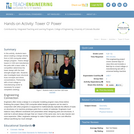
In this activity, students learn about creating a design directly from a CAD (computer-aided design) program. They will design a tower in CAD and manufacture the parts with a laser cutter. A competition determines the tower design with the best strength:weight ratio. Students also investigate basic structural truss concepts and stress concentrations. Partnership with a local college or manufacturing center is necessary for the completion of this project.
No restrictions on your remixing, redistributing, or making derivative works. Give credit to the author, as required.
Your remixing, redistributing, or making derivatives works comes with some restrictions, including how it is shared.
Your redistributing comes with some restrictions. Do not remix or make derivative works.
Most restrictive license type. Prohibits most uses, sharing, and any changes.
Copyrighted materials, available under Fair Use and the TEACH Act for US-based educators, or other custom arrangements. Go to the resource provider to see their individual restrictions.