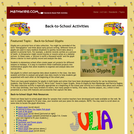
September is a great time for data collection activities as students are naturally curious about their new classmates. Ask questions that require students to analyze data and support their conclusions.
This case was developed to use in leadership courses with specific implications for school law and supervision of instruction. Varied data are presented about the school and district for students to analyze. School instructional policies of inclusion of special needs students and supervision of teachers play a role in the course of events at Washington Elementary School. Dr. Long, a first year principal faces the challenge of addressing the issue of a special education teacher who does not perform responsibilities, and there are direct implications for district personnel procedures regarding providing teachers with assistance.
Because Common Core promotes the importance of all students studying the arts, we have highlighted places where ELA instruction could be enhanced by connecting a genre or particular text, or a theme of a unit, to works of art, music, or film. We suggest, for example, that students study self-portraiture when they are encountering memoirs. Students might compare a novel, story, or play to its film or musical rendition. Where a particular period of literature or the literature of a particular region or country is addressed, works of art from that period or country may also be examined. In each case, connections are made to the standards in the CCSS themselves.
In this course, teachers be introduced to thematic learning and cooperative learning techniques. Teachers will have a chance to develop lesson plans with these ideas in mind. You are given practical tools for classroom management and ways in which you can guide students to think about their own process of learning. Portions of this course have been reproduced from the encyclopedia of informal education: www.infed.org
Download the supporting PDF file for this episode http://bit.ly/f1v3iH from the Learning to Teach Online project website.
This case study examines the use of eBooks and eReaders as an extension of the usual Blackboard Learning Management System (LMS). This initiative was undertaken as part of the DUCKLING research project (Delivering University Curricula: Knowledge, Learning and Innovation Gains) conducted by the Beyond Distance Research Alliance at the University of Leicester in the UK.
While the context of this study involves distance students, using electronic books can have applications in any discipline where students are required to undertake a significant amount of reading. This case study discusses some advantages of using eBooks, and outlines the process involved in creating and uploading them to an eReader device.
Nationally recognized experts in the field of educational leadership and administration contribute to this book, with chapters focused on the past, present, and future of the preparation of our nation's school leaders. Every field of professional practice must periodically reflect on its past, assess current conditions, and chart a course for the future. This book is designed to stimulate thinking and action for the field of educational leadership. The authors portray historical achievements and short comings, describe what is transpiring now, and explore implications of current developments.
This audiotape is linked to Creating People Centred Schools learning guide, but carries debates which could also be used in a free-standing way by anyone interested in school organization and change.
Curriculum Design and Educational Technology is a course offered by the University of Washington Tacoma Education Program. The course recognizes the reality that K-12 teachers are often forced to alter or update existing curriculum or create units of curriculum from scratch. Knowing some methods of curriculum design and instructional design can assist teachers in meeting this need for both classroom instruction and online instruction.
Download the supporting PDF file for this episode http://bit.ly/ijlL3g from the Learning to Teach Online project website.
Engaging students in online learning is critical for success. In this episode, we speak with teachers and students about strategies for improving engagement and motivation in online learning environments. Effective facilitation, creating learning communities, strategies for motivating students, and encouraging and sustaining participation are discussed.
Subject:
Arts, Business, Humanities, Mathematics and Statistics, Science and Technology, Social Sciences
The content in this module is one way to acquaint school leaders with the importance of establishing a relationship with the parents of limited English proficient students. Beginning with an orientation program that opens the doors of the school and creates an inviting atmosphere that respects diversity is one way of forging such a bond. This module offers suggestions for a framework to assist leaders in planning and implementing an initial informational meeting.
Open Educational Resources (OER) offer opportunities for increasing equity and access to high-quality K–12 education. Many state education agencies now have offices devoted to identifying and using OERs and other digital resources in their states. To help states, districts, teachers, and other users determine the degree of alignment of OERs to the Common Core State Standards, and to determine aspects of quality of OERs, Achieve has developed eight rubrics in collaboration with leaders from the OER community.
Subject:
Arts, Business, Humanities, Mathematics and Statistics, Science and Technology, Social Sciences
In the elementary years, parents are usually involved with their students’ education; volunteering at school, keeping up with homework, and communicating with teachers. When students get to the middle school level, parents seem to pull back more, especially after the sixth grade year, generally being more involved when it comes to sports and/or discipline issues rather than what is taking place in the classroom.
The Primary goal of this module is for the reader to become aware of the support a school division "Intake Center" contributes to helping an ever increasing English language learner population assimilate into the local schools and local community.
This audiotape is linked to Creating People Centred Schools learning guide, but carries debates which could also be used in a free-standing way by anyone interested in school organization and change.
In Summer 2007, a Virginia Tech Doctoral cohort completed EDAE 6924, School Community Partnerships. Here is a personal reflection authored by Douglas Shifflett.
Mentoring, observation and interviews are three important strategies in developing student teachers. This unit, which gives a flavour of the Open University's flexible PGCE course, introduces student–teacher centred strategies both inside and outside of
The first day of class sets the tone for the rest of the term. It is natural for both students and instructors to feel anticipation, excitement, anxiety, and uncertainty. To pique students' interest and anticipation, convey your enthusiasm for the material and stimulate students' curiosity about topics that will be covered during the term. To reduce students' anxiety and uncertainty, try to create a relaxed, open classroom environment conducive to inquiry and participation, and let students know what you will expect from them and what they can expect from you and the course. The following suggestions, intended to help you get your class off to a good start, address the three important tasks of the first day: handling administrative matters, creating an open friendly classroom environment, and setting course expectations and standards.
This site houses a compilation of curricular materials. Dozens of courses are listed, representing a broad spectrum of topics in the sciences and humanities. Most of the material was written for middle school and high school, but could be adapted to a wider audience. There are several courses in the earth sciences, including geology, global change, and environmental science. Each course includes self-contained modules, lesson plans, student activities and background materials.
Subject:
Humanities, Science and Technology, Social Sciences
No restrictions on your remixing, redistributing, or making derivative works.
Give credit to the author, as required.
Your remixing, redistributing, or making derivatives works comes with some
restrictions, including how it is shared.
Your redistributing comes with some restrictions. Do not remix or make
derivative works.
Copyrighted materials, available under Fair Use and the TEACH Act for US-based
educators, or other custom arrangements. Go to the resource provider to see
their individual restrictions.