By watching and performing several simple experiments, students develop an understanding of …
By watching and performing several simple experiments, students develop an understanding of the properties of air: it has mass, it takes up space, it can move, it exerts pressure, it can do work.
Air pressure is pushing on us all the time although we do …
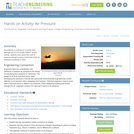
Air pressure is pushing on us all the time although we do not usually notice it. In this activity, students learn about the units of pressure and get a sense of just how much air pressure is pushing on them.
Students engage in hands-on, true-to-life research experiences on air quality topics chosen …
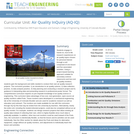
Students engage in hands-on, true-to-life research experiences on air quality topics chosen for personal interest through a unit composed of one lesson and five associated activities. Using a project-based learning approach suitable for secondary science classrooms and low-cost air quality monitors, students gain the background and skills needed to conduct their own air quality research projects. The curriculum provides: 1) an introduction to air quality science, 2) data collection practice, 3) data analysis practice, 4) help planning and conducting a research project and 5) guidance in interpreting data and presenting research in professional poster format. The comprehensive curriculum requires no pre-requisite knowledge of air quality science or engineering. This curriculum takes advantage of low-cost, next-generation, open-source air quality monitors called Pods. These monitors were developed in a mechanical engineering lab at the University of Colorado Boulder and are used for academic research as well as education and outreach. The monitors are made available for use with this curriculum through AQ-IQ Kits that may be rented from the university by teachers. Alternatively, nearly the entire unit, including the student-directed projects, could also be completed without an air quality monitor. For example, students can design research projects that utilize existing air quality data instead of collecting their own, which is highly feasible since much data is publically available. In addition, other low-cost monitors could be used instead of the Pods. Also, the curriculum is intentionally flexible, so that the lesson and its activities can be used individually. See the Other section for details about the Pods and ideas for alternative equipment, usage without air quality monitors, and adjustments to individually teach the lesson and activities.
In this module, students engage in a visual demonstration on the causes …
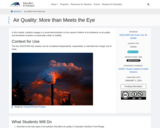
In this module, students engage in a visual demonstration on the causes & effects of air pollutants on air quality and kinesthetic activities on particulate matter & visibility.
Students are introduced to air masses, with an emphasis on the differences …
Students are introduced to air masses, with an emphasis on the differences between and characteristics of high- versus low-pressure air systems. Students also hear about weather forecasting instrumentation and how engineers work to improve these instruments for atmospheric measurements on Earth and in space.
In this informational text, elementary school readers learn about the difference between …
In this informational text, elementary school readers learn about the difference between weather and climate and about components of the climate system. The text can be used to practice visualizing and other comprehension strategies. Available in K-2 and 3-5 grade bands and as an illustrated book as well as a text document, the story appears in the online magazine Beyond Weather and the Water Cycle.
This lab exercise provides students with activities utilizing vector operations within the …
This lab exercise provides students with activities utilizing vector operations within the context of the atmospheric and oceanic environments.
(Note: this resource was added to OER Commons as part of a batch upload of over 2,200 records. If you notice an issue with the quality of the metadata, please let us know by using the 'report' button and we will flag it for consideration.)
This undergraduate class is designed to introduce students to the physics that …
This undergraduate class is designed to introduce students to the physics that govern the circulation of the ocean and atmosphere. The focus of the course is on the processes that control the climate of the planet. Acknowledgments Prof. Ferrari wishes to acknowledge that this course was originally designed and taught by Prof. John Marshall.
"This undergraduate class is designed to introduce students to the physics that …
"This undergraduate class is designed to introduce students to the physics that govern the circulation of the ocean and atmosphere. The focus of the course is on the processes that control the climate of the planet.AcknowledgmentsProf. Ferrari wishes to acknowledge that this course was originally designed and taught by Prof. John Marshall."
This course explores the physical processes that control Earth's atmosphere, ocean, and …
This course explores the physical processes that control Earth's atmosphere, ocean, and climate. Quantitative methods for constructing mass and energy budgets. Topics include clouds, rain, severe storms, regional climate, the ozone layer, air pollution, ocean currents and productivity, the seasons, El Nio, the history of Earth's climate, global warming, energy, and water resources.
In this feature, adapted from Interactive NOVA: "Earth," students explore the relationship …
In this feature, adapted from Interactive NOVA: "Earth," students explore the relationship between oxygen concentration and the well-being of various organisms by simulating a change in oxygen levels and observing what happens.
Survey of atmospheric and oceanic phenomena including the discussion of observations and …
Survey of atmospheric and oceanic phenomena including the discussion of observations and theoretical interpretations. Topics covered include: monsoons; El Nino; planetary waves; atmospheric synoptic eddies and fronts; gulf stream rings; hurricanes; surface and internal gravity waves; and tides. In this course, we will look at many important aspects of the circulation of the atmosphere and ocean, from length scales of meters to thousands of km and time scales ranging from seconds to years. We will assume familiarity with concepts covered in course 12.003 (Physics of the Fluid Earth). In the early stages of the present course, we will make somewhat greater use of math than did 12.003, but the math we will use is no more than that encountered in elementary electromagnetic field theory, for example. The focus of the course is on the physics of the phenomena which we will discuss.
The numerical methods, formulation and parameterizations used in models of the circulation …
The numerical methods, formulation and parameterizations used in models of the circulation of the atmosphere and ocean will be described in detail. Widely used numerical methods will be the focus but we will also review emerging concepts and new methods. The numerics underlying a hierarchy of models will be discussed, ranging from simple GFD models to the high-end GCMs. In the context of ocean GCMs, we will describe parameterization of geostrophic eddies, mixing and the surface and bottom boundary layers. In the atmosphere, we will review parameterizations of convection and large scale condensation, the planetary boundary layer and radiative transfer.
Experiment with a helium balloon, a hot air balloon, or a rigid …
Experiment with a helium balloon, a hot air balloon, or a rigid sphere filled with different gases. Discover what makes some balloons float and others sink.
Using gumdrops and toothpicks, students conduct a large-group, interactive ozone depletion model. …
Using gumdrops and toothpicks, students conduct a large-group, interactive ozone depletion model. Students explore the dynamic and competing upper atmospheric roles of the protective ozone layer, the sun's UV radiation and harmful human-made CFCs (chlorofluorocarbons).
Using photographs and models, students are taken on a virtual journey to …
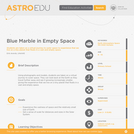
Using photographs and models, students are taken on a virtual journey to outer space. They can look back at the Earth as they travel further away and see it growing increasingly smaller, giving the experience that we live on a tiny planet that floats in a vast and empty space.
Students construct three-dimensional models of water catchment basins using everyday objects to …
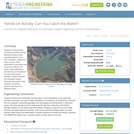
Students construct three-dimensional models of water catchment basins using everyday objects to form hills, mountains, valleys and water sources. They experiment to see where rain travels and collects, and survey water pathways to see how they can be altered by natural and human activities. Students discuss how engineers design structures that impact water collection, as well as systems that clean and distribute water.
Students are introduced to the concept of energy cycles by learning about …
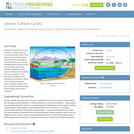
Students are introduced to the concept of energy cycles by learning about the carbon cycle. They will learn how carbon atoms travel through the geological (ancient) carbon cycle and the biological/physical carbon cycle. Students will consider how human activities have disturbed the carbon cycle by emitting carbon dioxide into the atmosphere. They will discuss how engineers and scientists are working to reduce carbon dioxide emissions. Lastly, students will consider how they can help the world through simple energy conservation measures.
No restrictions on your remixing, redistributing, or making derivative works. Give credit to the author, as required.
Your remixing, redistributing, or making derivatives works comes with some restrictions, including how it is shared.
Your redistributing comes with some restrictions. Do not remix or make derivative works.
Most restrictive license type. Prohibits most uses, sharing, and any changes.
Copyrighted materials, available under Fair Use and the TEACH Act for US-based educators, or other custom arrangements. Go to the resource provider to see their individual restrictions.