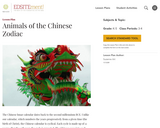
In this lesson plan, students will learn about the 12 animals of …
In this lesson plan, students will learn about the 12 animals of the Chinese zodiac. In the introductory first lesson, they will see how animals are often used as symbols. In the second lesson, they will hear one of several versions of how the 12 animals were chosen. They will then focus upon a few of the animals in the story and see how they can be used as symbols of certain human characteristics. In the third lesson, they will be introduced to the other animals of the zodiac, and they will be given a chart on which they will assign traits to each animal. Then they will consult a number of websites to find the traits traditionally associated with the animals, which they will add to their list. Then, they will come up with a number of ways to compare and contrast the animals in the list. In the third lesson, they will focus upon the animal associated with the year of their birth, learning about its traits and discussing whether or not these apply to themselves and their peers. Finally, each student will make an acrostic, combining the letters of his or her first name with adjectives that relate to his or her zodiac sign.
In this guide, you will find books, articles, and websites that help …
In this guide, you will find books, articles, and websites that help teachers of astronomy address some of the weird topics on the fringes of science that students sometimes hear about and want to have clarification for. Included are astrology, UFOs as alien spaceships, crop circles, denial of evolution and the big bang, the “face” on Mars, claims that NASA never landed astronauts on the Moon, and others.
This course provides an introduction to major political, social, cultural and intellectual …
This course provides an introduction to major political, social, cultural and intellectual changes in Europe from the beginnings of the Renaissance in Italy around 1300 to the outbreak of the French Revolution at the end of the 1700s. It focuses on the porous boundaries between categories of theology, magic and science, as well as print. It examines how developments in these areas altered European political institutions, social structures, and cultural practices. It also studies men and women, nobles and commoners, as well as Europeans and some non-Europeans with whom they came into contact.
This course explores the relationship between music and the supernatural, focusing on …
This course explores the relationship between music and the supernatural, focusing on the social history and context of supernatural beliefs as reflected in key literary and musical works from 1600 to the present. It provides an understanding of the place of ambiguity and the role of interpretation in culture, science and art. Great works of art by Shakespeare, Verdi, Goethe (in translation), Gounod, Henry James and Benjamin Britten are explored, as well as readings from the most recent scholarship on magic and the supernatural.
No restrictions on your remixing, redistributing, or making derivative works. Give credit to the author, as required.
Your remixing, redistributing, or making derivatives works comes with some restrictions, including how it is shared.
Your redistributing comes with some restrictions. Do not remix or make derivative works.
Most restrictive license type. Prohibits most uses, sharing, and any changes.
Copyrighted materials, available under Fair Use and the TEACH Act for US-based educators, or other custom arrangements. Go to the resource provider to see their individual restrictions.