Teaching and learning strategies resource that describes 70+ Google Forms for the Classroom. Examples include forms for getting to know your class, spelling tests, assessments, and more.
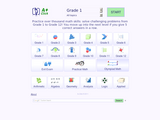
A+ Click is an interactive collection of more than 1000 mathematical problems and answers for K-1 K-12 school program. It defines the personal level of math knowledge. You move up into the next level if you give 5 correct answers in a row.
Discover the kinds of formative and summative classroom assessments that best coordinate with the new generation of testing consortia for the Common Core State Standards. Participants will take a close look at the Smarter Balanced Assessment Consortium (SBAC) and the Partnership for Assessment of Readiness for College and Careers (PARCC) assessments and discover how to create classroom assessments that form a balanced system that supports student learning and aligns to the Common Core State Standards. In addition, Brookhart will overview SBAC and PARCC assessments. Identify assessments shifts. Share the implications of the Common Core for school-based formative and summative assessments.
Subject:
Humanities, Mathematics and Statistics, Science and Technology, Social Sciences
Too often, high standards and a whole child approach are seen as opposite ends of the education spectrum. In this webinar, Molly McCloskey debunks the myth of standards versus support and shares the relationship between the Common Core State Standards and a school improvement approach that ensures each child, in each school, in each community, is healthy, safe, engaged, supported, and challenged. Going beyond the silos of too many school reform efforts, this webinar will explore integration, collaboration, and comprehensive framing rooted in high expectations for student and staff achievement.
Subject:
Humanities, Mathematics and Statistics, Science and Technology, Social Sciences
This unit explores outcomes-based assessment of mathematics in terms of five main questions -- Why assess? (the purposes of assessment); What to assess? (achievement of outcomes, but also understanding, reasoning and problem-solving ability); How to assess? (methods, tools and techniques); How to interpret the results of assessment? (the importance of criteria and rubrics for outcomes-based assessment) ; and How to report on assessment? (developing meaningful report cards).
This assessment is used in a class titled Ethical Leadership as part of a graduate level principal preparation program. The assessment has been approved by NCATE as meeting all of the stipulated ELCC standards for which it is designed (ELCC 5.1, 5.1. & 5.3). The assignment has two sections. In the first section candidates are asked to interview people in the field about a difficult decision or dilemma they had to deal with and analyze the responses. In the second section candidates interview each other about moral failures they have experienced in their own decision making and analyze the responses through the lens of two key concepts taught in class: schema theory and a moral decision-making model.
This booklet was first developed in 2004, shortly after the introduction of the Revised National Curriculum Statement in South Africa. The intention of the booklet was to help teachers of senior phase (junior secondary) to integrate assessment into their teaching and learning.
Providing an overview of current issues in UK science education, this unit examines what type of science the curriculum should cover and for what purpose. The unit will introduce you to practical problems in the delivery of an effective science curriculum, and particular questions at all three educational tiers - primary, secondary and tertiary - will be touched on.
This module adopts and adapts an exercise found at the Southern Illinois University at Edwardsville website on assessment: www.siue.edu/ ?deder/assess/cats/muddy3.html. Developed first by Harvard Professor Mosteller, it has been modified from the Edward
Used for students receiving Advanced Placement credit and transfer credit. Program of study or research to be arranged with a Department faculty member. Written report required. Permission of Department required. Do you like teaching, but find yourself frustrated by how little students seem to learn? Would you like to try teaching, but are nervous about whether you will be any good at it? Are you interested in new research on science education? Research in science education shows that the greatest obstacle to student learning is the failure to identify and confront the misconceptions with which the students enter the class or those that they acquire during their studies. This weekly seminar course focuses on developing the participants' ability to uncover and confront student misconceptions and to foster student understanding and retention of key concepts. Participants read primary literature on science education, uncover basic concepts often overlooked when teaching biology, and lead a small weekly discussion session for students currently enrolled in introductory biology classes. The instructor for this course, Dr. Julia Khodor, is a member of the HHMI Education Group.
Used for students receiving Advanced Placement credit and transfer credit. Program of study or research to be arranged with a Department faculty member. Written report required. Permission of Department required.
Confronting the Burden of Injuries- A Global Perspective is a course offered by the Department of International Health and the Department of Health Policy and Management at the Bloomberg School of Public Health, Johns Hopkins University. This course is intended to guide students interested in working on injury control in areas with little to no tradition in injury prevention from a public health perspective. Students will learn to define the injury problem and assess its magnitude; identify data sources and assess the quality of the data; identify which agencies or institutions should be involved in the solution of the problem; identify which interventions are in place and need to be implemented and evaluated; produce a strategic plan for the establishment and/or improvement of injury prevention programs in such areas; and present such a plan to authorities in a compelling manner.
Subject:
Mathematics and Statistics, Science and Technology, Social Sciences
An interactive applet and associated web page that demonstrate the properties of a cube. A 3-D cube is shown in the applet which can be interactively manipulated using the mouse. Research has shown that some younger students have difficulty visualizing the parts of a 3D object that are hidden. To help with this, the student can rotate the cube in any axis simply by dragging it with the mouse. It can also be 'exploded' - where a slider gradually separates the faces to reveal the ones behind. The cube can also be made translucent so you see through it to the other side. Applet can be enlarged to full screen size for use with a classroom projector, and printed to make handouts. This resource is a component of the Math Open Reference Interactive Geometry textbook project at http://www.mathopenref.com.
This module is designed to introduce educational leaders to an organizational assessment tool called a "culture audit." Literature on organizational cultural competence suggests that culture audits are a valuable tool for determining how well school policies, programs, and practices respond to the needs of diverse groups and prepare students to interact globally. Data gathered from culture audits can guide school and community-wide strategic planning efforts to close achievement gaps, promote prosocial behaviors, and develop global competencies.
This module of the course focuses on educative assessment. Educative assessment is designed to provide educators and learners with feedback to improve their work. In this module you will learn the UbD-DI principles of authentic assessment and understand how UDL integrates with them. You will then use a protocol to generate valid assessment criteria based on a review of student work samples.
This lesson is intended to be used as a final assessment of a student's understanding of an inch, foot, and yard. It will also assess their ability to use a yardstick, follow written directions, and work with a partner to draw a house on the school blacktop as part of a class neighborhood.
A work in progress, CK-12's Earth Science Honors For Middle School Teacher's Edition complements its Earth Science book on Earth: its minerals, energy resources, processes, past, water, weather, climate, environment, human actions, and astronomy.
Introduces the basic methods for infectious disease epidemiology and case studies of important disease syndromes and entities. Methods include definitions and nomenclature, outbreak investigations, disease surveillance, case-control studies, cohort studies, laboratory diagnosis, molecular epidemiology, dynamics of transmission, and assessment of vaccine field effectiveness. Case-studies focus on acute respiratory infections, diarrheal diseases, hepatitis, HIV, tuberculosis, sexually transmitted diseases, malaria, and other vector-borne diseases.
No restrictions on your remixing, redistributing, or making derivative works.
Give credit to the author, as required.
Your remixing, redistributing, or making derivatives works comes with some
restrictions, including how it is shared.
Your redistributing comes with some restrictions. Do not remix or make
derivative works.
Copyrighted materials, available under Fair Use and the TEACH Act for US-based
educators, or other custom arrangements. Go to the resource provider to see
their individual restrictions.