Students’ background understanding of electricity and circuit-building is reinforced as they create …
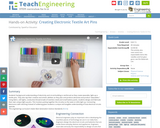
Students’ background understanding of electricity and circuit-building is reinforced as they create wearable, light-up e-textile pins. They also tap their creative and artistic abilities as they plan and produce attractive end product “wearables.” Using fabric, LED lights, conductive thread (made of stainless steel) and small battery packs, students design and fabricate their own unique light-up pins. This involves putting together the circuitry so the sewn-in LEDs light up. Connecting electronics with stitching instead of soldering gives students a unique and tangible understanding of how electrical circuits operate.
Students combine art, gaming culture and engineering by fabricating light-up patches to …
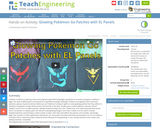
Students combine art, gaming culture and engineering by fabricating light-up patches to increase youngsters’ visibility at night. The open-ended project is presented as a hypothetical design challenge: Students are engineers who have been asked by a group of parents whose children go out Pokémon hunting at night to create glowing patches that they adhere to clothing or backpacks to help vehicle drivers see the kids in the dark. Student pairs create Pokémon character stencil designs cut from iron-on fabric patches, adding transparent layers for color. Placed over an EL (electroluminescent) panel that is connected to a battery pack, the stencils create glowing designs. Each team creates a circuit, which includes lengthening the EL panel wiring to make it easier to wear. Then they sew/adhere the patches onto hoodies, messenger bags, hats, pockets or other applications they dream up. The project concludes with team presentations as if to an audience of project clients. Keep the project simple by hand cutting and ironing/sewing, or use cutting machines, laser cutters and sewing machines, if available.
Drama combines the literary arts of storytelling and poetry with the world …
Drama combines the literary arts of storytelling and poetry with the world of live performance. As a form of ritual as well as entertainment, drama has served to unite communities and challenge social norms, to vitalize and disturb its audiences. In order to understand this rich art form more fully, we will study and discuss a sampling of plays that exemplify different kinds of dramatic structure; class members will also participate in, attend, and review dramatic performances.
Students make their own design decisions about controlling the LEDs in a …
Students make their own design decisions about controlling the LEDs in a light-up, e-textile circuit, plush toy project that they make using LilyPad ProtoSnap components and conductive thread. They follow step-by-step instructions to assemble a product while applying their own creativity to customize it. They first learn about the switches—an on/off switch and a button—exploring these two ways of controlling the flow of electric current to LEDs and showing them the difference between closed and open circuits. Then they craft their creative light-up plush pals made from sewn and stuffed felt pieces (template provided) that include sewn electric circuits. Through this sewable electronics project, students gain a familiarity with microcontrollers, circuits, switches and LEDs—everyday items in today’s world and the components used in so many engineered devices.
Students learn about engineering applications in artistic venues by designing and creating …
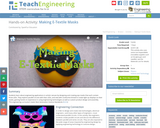
Students learn about engineering applications in artistic venues by designing and creating eye masks that each contain three LEDs. They explore parallel circuits with their LEDs, and sew with conductive thread to create light-up displays on their masks, gaining hands-on experience in using engineering technologies as well as custom product design and assembly.
Students learn the functions of pre-programmed microcontroller units such as the LilyMini …
Students learn the functions of pre-programmed microcontroller units such as the LilyMini ProtoSnap as they use them to create light-up pennants with LED components. Students design their own felt pennants and sew on circuit components using conductive thread. This activity gives students hands-on experience with engineering technologies while making creative pennants with LED lights that can illuminate in three pre-programmed sequences: all on, breathing, and twinkle.
Light up your love with paper circuits this Valentine’s Day—no soldering required! …
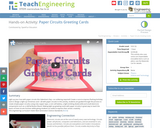
Light up your love with paper circuits this Valentine’s Day—no soldering required! Create a sure-to-impress flashing birthday card or design a light-up Christmas card—all with paper circuits! In this activity, students are guided through the process to create simple paper circuitry using only copper tape, a coin cell battery, a light-emitting diode (LED) and small electronic components such as a LilyPad Button Board. Making light-up greeting cards with paper circuitry is great way to teach the basics of how circuits function while giving students an outlet to express their artistic creativity.
Unlike film, theater in America does not have a ratings board that …
Unlike film, theater in America does not have a ratings board that censors content. So plays have had more freedom to explore and to transgress normative culture. Yet censorship of the theater has been part of American culture from the beginning, and continues today. How and why does this happen, and who decides whether a play is too dangerous to see or to teach? Are plays dangerous? Sinful? Even demonic? In our seminar, we will study plays that have been censored, either legally or extra-legally (i.e. refused production, closed down during production, denied funding, or taken off school reading lists). We'll look at laws, both national and local, relating to the "obscene", as well as unofficial practices, and think about the way censorship operates in American life now. And of course we will study the offending texts, themselves, to find what is really dangerous about them, for ourselves.
No restrictions on your remixing, redistributing, or making derivative works. Give credit to the author, as required.
Your remixing, redistributing, or making derivatives works comes with some restrictions, including how it is shared.
Your redistributing comes with some restrictions. Do not remix or make derivative works.
Most restrictive license type. Prohibits most uses, sharing, and any changes.
Copyrighted materials, available under Fair Use and the TEACH Act for US-based educators, or other custom arrangements. Go to the resource provider to see their individual restrictions.