Students are presented with a hypothetical scenario in which they are biomedical …
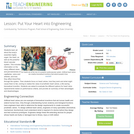
Students are presented with a hypothetical scenario in which they are biomedical engineers asked to design artificial hearts. Using the engineering design process as a guide, the challenge is established and students brainstorm to list everything they might need to know about the heart in order to create a complete mechanical replacement (size, how it functions, path of blood etc.). They conduct research to learn the information and organize it through various activities. They research artificial heart models that have already been used and rate their performance in clinical trials. Finally, they analyze the data to identify the artificial heart features and properties they think work best and document their findings in essay form.
Biology is designed for multi-semester biology courses for science majors. It is …
Biology is designed for multi-semester biology courses for science majors. It is grounded on an evolutionary basis and includes exciting features that highlight careers in the biological sciences and everyday applications of the concepts at hand. To meet the needs of today’s instructors and students, some content has been strategically condensed while maintaining the overall scope and coverage of traditional texts for this course. Instructors can customize the book, adapting it to the approach that works best in their classroom. Biology also includes an innovative art program that incorporates critical thinking and clicker questions to help students understand—and apply—key concepts.
By the end of this section, you will be able to:Describe the …
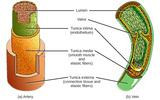
By the end of this section, you will be able to:Describe the structure of the heart and explain how cardiac muscle is different from other musclesDescribe the cardiac cycleExplain the structure of arteries, veins, and capillaries, and how blood flows through the body
By the end of this section, you will be able to:Describe the …
By the end of this section, you will be able to:Describe the structure of the heart and explain how cardiac muscle is different from other musclesDescribe the cardiac cycleExplain the structure of arteries, veins, and capillaries, and how blood flows through the body
Students are introduced to the circulatory system with an emphasis on the …
Students are introduced to the circulatory system with an emphasis on the blood clotting process, including coagulation and the formation and degradation of polymers through their underlying atomic properties. They learn about the medical emergency of strokes the loss of brain function commonly due to blood clots including various causes and the different effects depending on the brain location, as well as blood clot removal devices designed by biomedical engineers.
Students are introduced to the circulatory system, the heart, and blood flow …
Students are introduced to the circulatory system, the heart, and blood flow in the human body. Through guided pre-reading, during-reading and post-reading activities, students learn about the circulatory system's parts, functions and disorders, as well as engineering medical solutions. By cultivating literacy practices as presented in this lesson, students can improve their scientific and technological literacy.
Following the steps of the engineering design process and acting as biomedical …
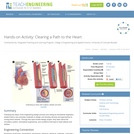
Following the steps of the engineering design process and acting as biomedical engineers, student teams use everyday materials to design and develop devices and approaches to unclog blood vessels. Through this open-ended design project, they learn about the circulatory system, biomedical engineering, and conditions that lead to heart attacks and strokes.
This resource is a video abstract of a research paper created by …
This resource is a video abstract of a research paper created by Research Square on behalf of its authors. It provides a synopsis that's easy to understand, and can be used to introduce the topics it covers to students, researchers, and the general public. The video's transcript is also provided in full, with a portion provided below for preview:
"Increased blood flow to the uterus during pregnancy is essential to the health of both mother and baby But the cellular processes that promote blood flow during pregnancy aren’t fully understood Now, researchers have discovered that fat surrounding blood vessels in the uterus plays a key role In pregnant rats, uterine blood flow was up to 3 times higher than in non-pregnant rats But blood flow plummeted when fat tissue was removed from the uterus of pregnant rats Interestingly, tests on isolated vessels demonstrated that fat tissue-shrinking factors could be at play which seems counterintuitive because narrow vessels generally mean low blood flow One explanation is that isolating tissue from its natural surroundings could produce changes not observed in a live animal Future studies will explore this apparent contradiction and hopefully reveal the role of fat tissue in human pregnancy Osikoya et al..."
The rest of the transcript, along with a link to the research itself, is available on the resource itself.
Students learn about the heart and its role at the center of …
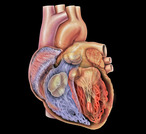
Students learn about the heart and its role at the center of the human cardiovascular system. In the associated activity, students play out a scenario in which they are biomedical engineers asked to design artificial hearts. They learn about the path of blood flow through the heart and use that knowledge to evaluate designs of artificial hearts on the market.
Students work as biomedical engineers to find liquid solutions that can clear …
Students work as biomedical engineers to find liquid solutions that can clear away polyvinyl acetate polymer "blood clots" in model arteries (made of clear, flexible tubing). Teams create samples of the "blood clot" polymer with different concentrations to discover the concentration of the model clot and then test a variety of liquids to determine which most effectively breaks down the model blood clot. Students learn the importance of the testing phase in the engineering design process, because they are only given one chance to present the team's solution and apply it to the model blood clot.
Acting as biomedical engineers, students design, build, test and redesign prototype heart …
Acting as biomedical engineers, students design, build, test and redesign prototype heart valves using materials such as waterproof tape, plastic tubing, flexible plastic and foam sheets, clay, wire and pipe cleaners. They test them with flowing water, representing blood moving through the heart. As students creatively practice engineering problem solving, they demonstrate their understanding of how one-way heart valves work.
This lesson contains background about the blood vascular system and the heart. …
This lesson contains background about the blood vascular system and the heart. Also, the different sizes of capillaries, veins, and arteries, and how they affect blood flow through the system. We will then proceed to talk about the heart's function in the blood vascular system. This will lead into a discussion of heart valves, how they work and what might cause them to fail. Then we will discuss prosthetic heart valves.
This unit focuses on teaching students about the many aspects of biomedical …
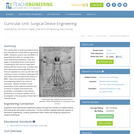
This unit focuses on teaching students about the many aspects of biomedical engineering (BME). Students come to see that BME is a broad field that relies on concepts from many engineering disciplines. They also begin to understand some of the special considerations that must be made when dealing with the human body. Activities and class discussions encourage students to think as engineers to come up with their own solutions to some of medical challenges that have been solved throughout the history of BME. Class time iincludes brainstorming and presenting ideas to the class for discussion. Specific activities include examination of the material properties and functions of surgical instruments and prosthetics, a simulation of the training experience of a surgical resident, and an investigation of the properties of fluid flow in vascular tissue.
This resource is a video abstract of a research paper created by …
This resource is a video abstract of a research paper created by Research Square on behalf of its authors. It provides a synopsis that's easy to understand, and can be used to introduce the topics it covers to students, researchers, and the general public. The video's transcript is also provided in full, with a portion provided below for preview:
"Physicians may soon be able to get a detailed look at blood vessels surrounding breast tumors quickly, painlessly, and without radiation, thanks to the work of a team of Japanese researchers. One application of the technology is earlier and more accurate tracking of when cancer has turned deadly. The formation of new blood vessels around a tumor is a key sign that cancer is getting ready to spread. But getting a clear look at these blood vessels can be tricky. Approaches like MRI or computed tomography often come with a hefty price tag, and exposure to contrast agent or radiation may pose health risks. To sidestep these issues, the researchers optimized a way to perform photoacoustic imaging. This type of imaging utilizes the light-absorbing properties of hemoglobin to show where blood is flowing in the body. When hemoglobin is exposed to pulses of laser light, it produces small vibrations. These vibrations are picked up by scanners and used to generate a detailed map of blood vessel architecture..."
The rest of the transcript, along with a link to the research itself, is available on the resource itself.
No restrictions on your remixing, redistributing, or making derivative works. Give credit to the author, as required.
Your remixing, redistributing, or making derivatives works comes with some restrictions, including how it is shared.
Your redistributing comes with some restrictions. Do not remix or make derivative works.
Most restrictive license type. Prohibits most uses, sharing, and any changes.
Copyrighted materials, available under Fair Use and the TEACH Act for US-based educators, or other custom arrangements. Go to the resource provider to see their individual restrictions.