The American Revolution was a war of political and economic concern to …
The American Revolution was a war of political and economic concern to more than the American colonies and Great Britain. Each country needed to secure military supplies, protect consumer trade and ensure the cooperation of foreign powers. France, Spain, Holland, Portugal and Caribbean territories engaged in activities which directly affected events of the war. By broadening the scope of the war, students should develop a broader perspective of the diplomacy and business of war.
Aswaat Arabiyya is an archive of 245 videos in Arabic, listed by …
Aswaat Arabiyya is an archive of 245 videos in Arabic, listed by difficulty level and accompanied by glossaries and four worksheets each that focus on every aspect of listening comprehension. Selections come largely from Arabic media, with some cultural presentations by native speakers. Videos cover the entire Arabic-speaking world and include MSA and different dialects. Materials are designed to be used both as in-class activities and homework assignments. Videos can be slowed down.
Beginning January 2014, Psychological Science gave authors the opportunity to signal open …
Beginning January 2014, Psychological Science gave authors the opportunity to signal open data and materials if they qualified for badges that accompanied published articles. Before badges, less than 3% of Psychological Science articles reported open data. After badges, 23% reported open data, with an accelerating trend; 39% reported open data in the first half of 2015, an increase of more than an order of magnitude from baseline. There was no change over time in the low rates of data sharing among comparison journals. Moreover, reporting openness does not guarantee openness. When badges were earned, reportedly available data were more likely to be actually available, correct, usable, and complete than when badges were not earned. Open materials also increased to a weaker degree, and there was more variability among comparison journals. Badges are simple, effective signals to promote open practices and improve preservation of data and materials by using independent repositories.
When we teach World War One, we start with a small regional …
When we teach World War One, we start with a small regional conflict in the Balkans, but don’t stay there. Quickly we show the interactions between alliance members, the interconnection of multiple theaters of conflict, and the implications of a truly global war. This short framework might be helpful in persuading that we should do the same when we teach the global American Revolutionary War.
In this unit, students become active archivists, gathering photos, artifacts, and stories …
In this unit, students become active archivists, gathering photos, artifacts, and stories for a museum exhibit that highlights one decade in their school's history.
This is a full length monograph aimed at helping libraries, archives, and …
This is a full length monograph aimed at helping libraries, archives, and museums navigate copyright law involving digitization. In the course of the book, though, the authors helpfully unpack many areas of copyright law including Section 108 of the Copyright Act, Fair Use, Licensing, and Risk Management. It is a great primer on copyright law and includes many helpful key points, flowcharts and timelines.
This site contains many books of every language that have entered the …
This site contains many books of every language that have entered the public domain or that were uploaded by copyright holders. A growing number of Arabic texts, as well as audio and video files (including famous speeches and songs), may be found by searching this site. Searches can be performed using Latin characters or Arabic characters, and advanced search options can help isolate desired resources.
The Rockefeller Archive Center (RAC) is a mixed-media repository that holds the …
The Rockefeller Archive Center (RAC) is a mixed-media repository that holds the historical records related to the study of philanthropy. These archival materials serve as the entry point into learning how to identify, read, and analyze primary sources in the workshop. This workshop teaches students the value of primary source literacy and ownership of the research process.
Cet album contient 78 photographies prises durant la Première Guerre mondiale à …
Cet album contient 78 photographies prises durant la Première Guerre mondiale à l’Hôpital de l’Océan. Petit hôtel de charme de la côte belge, plus précisément de Calais, l’hôtel de l’Océan est reconverti dès 1914 en hôpital de la Croix-Rouge sous la direction de l’excellent chirurgien Antoine Depage et avec le soutien de la Reine Elisabeth. L’Hôpital de l’Océan acquiert vite une réputation de premier plan et est capable de recevoir plus de mille blessés simultanément. S’y jouent ainsi de grandes avancées dans le domaine de la médecine, avec la création de nombreuses annexes dont un atelier de fabrication de prothèses.
Les archives de Georges Lemaître (797) concernent ses activités d'enseignement, de recherche …
Les archives de Georges Lemaître (797) concernent ses activités d'enseignement, de recherche et de sa vie sacerdotale et religieuse. Les archives Lemaître sont constituées de documents scientifiques relatifs à la cosmologie, à la mécanique, à l'algèbre et au calcul numérique, de cours et de notes manuscrites diverses, de livres scientifiques, de documents religieux et philosophiques (cahiers de retraites...), d'objets sacerdotaux (ciboire, patène, cuillère). Il y est également rassemblé du mobilier de bureau, du matériel de calcul, dont le premier ordinateur de l'UCL, la Burrough E101 du laboratoire d'astronomie et de géodésie des années 50 et 60. Une collection de photos, de diapositives (cours d'astronomie, voyages), d'articles de presse, sans oublier des souvenirs divers (décorations et distinctions honorifiques...) complètent cette collection. Tout récemment, des documents détenus par Christiane et Pierre Lemaître, sont venus enrichir le fonds : document attribuant le Prix Francqui, cahiers et photos, petits albums et diapositives de voyages et du cours d'astronomie. Les copies numériques sont consultables sur le portail "UCL Archives" (https://archives.uclouvain.be).
Policies that mandate public data archiving (PDA) successfully increase accessibility to data …
Policies that mandate public data archiving (PDA) successfully increase accessibility to data underlying scientific publications. However, is the data quality sufficient to allow reuse and reanalysis? We surveyed 100 datasets associated with nonmolecular studies in journals that commonly publish ecological and evolutionary research and have a strong PDA policy. Out of these datasets, 56% were incomplete, and 64% were archived in a way that partially or entirely prevented reuse. We suggest that cultural shifts facilitating clearer benefits to authors are necessary to achieve high-quality PDA and highlight key guidelines to help authors increase their data’s reuse potential and compliance with journal data policies.
This is the second open educational resource inspired by the Daisy Asquith's …
This is the second open educational resource inspired by the Daisy Asquith's film Queerama (2017). Queerama marks the 50th anniversary of the Sexual Offenses Act, which partially decriminalized private homosexual acts in England and Wales. The documentary was created from footage from the BFI National Archive and captures the relationships, desires, fears and expressions of gay men and women. You can follow the three learning blocks in order or pick and choose. This OER produced under a CC-BY license. This module is designed to help us think about what happens when we bring different stories together in to collections or archives.
This class is an introduction to studies in science, technology, and society …
This class is an introduction to studies in science, technology, and society (STS), through examining a series of issues, events, conflicts, and problems as illuminated by STS approaches. This iteration includes units on the Aaron Swartz case, photography, and utopia / dystopia. There are regular guest speakers, and several field trips to encourage hands on learning.
Replication is the cornerstone of a cumulative science. However, new tools and …
Replication is the cornerstone of a cumulative science. However, new tools and technologies, massive amounts of data, interdisciplinary approaches, and the complexity of the questions being asked are complicating replication efforts, as are increased pressures on scientists to advance their research. As full replication of studies on independently collected data is often not feasible, there has recently been a call for reproducible research as an attainable minimum standard for assessing the value of scientific claims. This requires that papers in experimental science describe the results and provide a sufficiently clear protocol to allow successful repetition and extension of analyses based on original data. The importance of replication and reproducibility has recently been exemplified through studies showing that scientific papers commonly leave out experimental details essential for reproduction, studies showing difficulties with replicating published experimental results, an increase in retracted papers, and through a high number of failing clinical trials. This has led to discussions on how individual researchers, institutions, funding bodies, and journals can establish routines that increase transparency and reproducibility. In order to foster such aspects, it has been suggested that the scientific community needs to develop a “culture of reproducibility” for computational science, and to require it for published claims. We want to emphasize that reproducibility is not only a moral responsibility with respect to the scientific field, but that a lack of reproducibility can also be a burden for you as an individual researcher. As an example, a good practice of reproducibility is necessary in order to allow previously developed methodology to be effectively applied on new data, or to allow reuse of code and results for new projects. In other words, good habits of reproducibility may actually turn out to be a time-saver in the longer run. We further note that reproducibility is just as much about the habits that ensure reproducible research as the technologies that can make these processes efficient and realistic. Each of the following ten rules captures a specific aspect of reproducibility, and discusses what is needed in terms of information handling and tracking of procedures. If you are taking a bare-bones approach to bioinformatics analysis, i.e., running various custom scripts from the command line, you will probably need to handle each rule explicitly. If you are instead performing your analyses through an integrated framework (such as GenePattern, Galaxy, LONI pipeline, or Taverna), the system may already provide full or partial support for most of the rules. What is needed on your part is then merely the knowledge of how to exploit these existing possibilities.
The primary sources in this set can be used for inquiry-based learning …
The primary sources in this set can be used for inquiry-based learning exercises and projects. Each document falls under the umbrella topic of tenements and immigration, and students are encouraged to annotate in the margins in order to support the development of document analysis and critical thinking skills. Suggested projects that make use of this set’s primary sources are also included for the educator as a springboard for research-based projects.
Written in 2006 by Iowa State University librarians Nancy L. Pelzer and …
Written in 2006 by Iowa State University librarians Nancy L. Pelzer and William H. Wiese, Veterinary Medical Libraries in the 21st Century provides an in-depth introduction to managing an academic veterinary medical library at the turn of the 21st century, with overviews of selected libraries; discussions of collection development, technical services, and reference services; and a comprehensive list of resources on academic veterinary medical libraries.
Open data is a vital pillar of open science and a key …
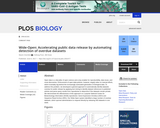
Open data is a vital pillar of open science and a key enabler for reproducibility, data reuse, and novel discoveries. Enforcement of open-data policies, however, largely relies on manual efforts, which invariably lag behind the increasingly automated generation of biological data. To address this problem, we developed a general approach to automatically identify datasets overdue for public release by applying text mining to identify dataset references in published articles and parse query results from repositories to determine if the datasets remain private. We demonstrate the effectiveness of this approach on 2 popular National Center for Biotechnology Information (NCBI) repositories: Gene Expression Omnibus (GEO) and Sequence Read Archive (SRA). Our Wide-Open system identified a large number of overdue datasets, which spurred administrators to respond directly by releasing 400 datasets in one week.
No restrictions on your remixing, redistributing, or making derivative works. Give credit to the author, as required.
Your remixing, redistributing, or making derivatives works comes with some restrictions, including how it is shared.
Your redistributing comes with some restrictions. Do not remix or make derivative works.
Most restrictive license type. Prohibits most uses, sharing, and any changes.
Copyrighted materials, available under Fair Use and the TEACH Act for US-based educators, or other custom arrangements. Go to the resource provider to see their individual restrictions.