This resource is a video abstract of a research paper created by …
This resource is a video abstract of a research paper created by Research Square on behalf of its authors. It provides a synopsis that's easy to understand, and can be used to introduce the topics it covers to students, researchers, and the general public. The video's transcript is also provided in full, with a portion provided below for preview:
"Renal cancer affects over 400,000 people each year, and new treatment options are needed. A new study unraveled a paradox taking place in the immune systems of cancer patients. Myeloid-derived suppressor cells (MDSCs), driven by tumor cells, have the ability to suppress the immune responses of T cells, preventing T-cell recognition of tumor cells and allowing immune escape. However, mice and humans with renal tumors do not experience systemic immunosuppression. Researchers used mice to examine renal cancer-derived exosomes (RDEs), extracellular vesicles derived from tumor cells. They found that the proportion and activity of MDSCs in the spleen and bone marrow changed after internalization of RDEs. RDE-stimulated MDSCs inhibited T cell proliferation and cytotoxicity, and these effects were antigen-specific and driven by the molecule HSP70 in RDEs and TLR2 on MDSCs, explaining the targeted immunosuppression of the renal cancer-specific immune response..."
The rest of the transcript, along with a link to the research itself, is available on the resource itself.
Biology is designed for multi-semester biology courses for science majors. It is …
Biology is designed for multi-semester biology courses for science majors. It is grounded on an evolutionary basis and includes exciting features that highlight careers in the biological sciences and everyday applications of the concepts at hand. To meet the needs of today’s instructors and students, some content has been strategically condensed while maintaining the overall scope and coverage of traditional texts for this course. Instructors can customize the book, adapting it to the approach that works best in their classroom. Biology also includes an innovative art program that incorporates critical thinking and clicker questions to help students understand—and apply—key concepts.
By the end of this section, you will be able to:Explain adaptive …
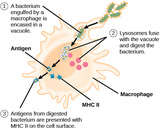
By the end of this section, you will be able to:Explain adaptive immunityCompare and contrast adaptive and innate immunityDescribe cell-mediated immune response and humoral immune responseDescribe immune tolerance
This course covers cells and tissues of the immune system, lymphocyte development, …
This course covers cells and tissues of the immune system, lymphocyte development, the structure and function of antigen receptors, the cell biology of antigen processing and presentation, including molecular structure and assembly of MHC molecules, the biology of cytokines, leukocyte-endothelial interactions, and the pathogenesis of immunologically mediated diseases. The course is structured as a series of lectures and tutorials in which clinical cases are discussed with faculty tutors. Lecturers Frederick W. Alt, Marcus Altfeld, Paul Anderson, Jon C. Aster, Hugh Auchincloss, Steven P. Balk, Samuel M. Behar, Richard S. Blumberg, Francisco Bonilla, Bobby Cherayil, Benjamin Davis, David Hafler, Nir Harcohen, Bruce Horwitz, David M. Lee, Andrew Lichtman, Diane Mathis, Richard Mitchell, Hidde Ploegh, Emmett Schmidt, Arlene Sharpe, Megan Sykes, Shannon Turley, Dale T. Umetsu, Ulrich von Andrian, Bruce Walker, Kai Wucherpfennig, Ramnik Xavier, Sarah Henrickson
Thisslide will help students understand the difference between an immunogen and an …
Thisslide will help students understand the difference between an immunogen and an antigen. Students can understand how a hapten which is non immunogenic can be converted to an immunogen by linking it to a carrier molecule.
This resource is a video abstract of a research paper created by …
This resource is a video abstract of a research paper created by Research Square on behalf of its authors. It provides a synopsis that's easy to understand, and can be used to introduce the topics it covers to students, researchers, and the general public. The video's transcript is also provided in full, with a portion provided below for preview:
"Residing in the stomachs of over half the human population, the bacterium Helicobacter pylori, also known as H pylori, has become a major cause of digestive complications, ranging from peptic ulcers to stomach cancer. But despite this link, scientists still aren’t sure how these disorders arise after infection. Now, researchers have homed in on a single protein produced by H pylori that seems to rev up the immune system, causing a state of inflammation that may pave the way for cancer growth or other types of gut breakdown. The protein, HP1454, is naturally released from H pylori -- both actively by living cells and passively as cells die. The scientists found that when special immune cells known as T cells encounter this secreted HP1454, they kick into action, mounting an inflammatory response. This relationship was particularly strong in people with stomach cancer..."
The rest of the transcript, along with a link to the research itself, is available on the resource itself.
Through this concluding lesson and its associated activity, students experience one valuable …
Through this concluding lesson and its associated activity, students experience one valuable and often overlooked skill of successful scientists and engineers communicating your work and ideas. They explore the importance of scientific communication, including the basic, essential elements of communicating new information to the public and pitfalls to avoid. In the associated activity, student groups create posters depicting their solutions to the unit's challenge question accurate, efficient methods for detecting cancer-causing genes using optical biosensors which includes providing a specific example with relevant equations. Students are also individually assessed on their understanding of refraction via a short quiz. This lesson and its associated activity conclude the unit and serve as the culminating Go Public phase of the Legacy Cycle, providing unit review and summative assessment.
This resource is a video abstract of a research paper created by …
This resource is a video abstract of a research paper created by Research Square on behalf of its authors. It provides a synopsis that's easy to understand, and can be used to introduce the topics it covers to students, researchers, and the general public. The video's transcript is also provided in full, with a portion provided below for preview:
"PD-L1 is a powerful cloaking protein for cancer cells. Abundant PD-L1 on their surface binds with the receptor PD-1 on immune cells. The PD-L1/PD-1 axis transfers inhibitory signaling to the immune system that the cancer cells pose no danger. How this cloaking process unfolds has remained unclear. Now, researchers report the prominence of the enzyme USP22. USP22 is overexpressed in malignant tumors of several types, including those of the lung. Initial experiments on human lung cancer cells showed that USP22 might regulate PD-L1. A closer look revealed that USP22 deubiquitinated and stabilized PD-L1. USP22 enlists the help another protein, CSN5, to stabilize PD-L1. By inhibiting USP22 genetically, researchers could suppress the formation of tumors. Targeting USP22 in the clinic could therefore be one way to decloak cancer cells and make them vulnerable to existing anti-cancer therapies..."
The rest of the transcript, along with a link to the research itself, is available on the resource itself.
Students are introduced to the unit challenge discovering a new way to …
Students are introduced to the unit challenge discovering a new way to assess a person's risk of breast cancer. Solving this challenge requires knowledge of refraction and the properties of light. After being introduced to the challenge question, students generate ideas related to solving the challenge, and then read a short online article on optical biosensors that guides their research towards solving the problem.
This learning object describes the inflammatory response - a series of local …
This learning object describes the inflammatory response - a series of local cellular and vascular responses which are triggered when the body is injured or invaded by micro-organisms or antigen.
No restrictions on your remixing, redistributing, or making derivative works. Give credit to the author, as required.
Your remixing, redistributing, or making derivatives works comes with some restrictions, including how it is shared.
Your redistributing comes with some restrictions. Do not remix or make derivative works.
Most restrictive license type. Prohibits most uses, sharing, and any changes.
Copyrighted materials, available under Fair Use and the TEACH Act for US-based educators, or other custom arrangements. Go to the resource provider to see their individual restrictions.