In this class, we will explore America's diversity through questions of immigration, …
In this class, we will explore America's diversity through questions of immigration, race, gender/sexuality and class--some of the major ways our culture is organized. It is comprised of 9 lessons based on online resources, plus 2 auto-ethnography assignments. This class was originally taught by Huma Mohibullah at Renton Technical College.
Fieldwork 1: How we communicate through gender role socialization and child rearing. …
Fieldwork 1: How we communicate through gender role socialization and child rearing. Observation of gender role socialization and child rearing at an activity or specific place, where it is not a single family gathering or your family. It must be an observation done now and not from memory.
Fieldwork 2: This fieldwork observation focuses on how symbolic capital is deployed in discourse and provides an opportunity to gain greater insight into how language and other nonverbal and symbolic cues communicate gender, ethnicity, values, status and power in subtle ways.
Religion is a significant aspect of human cultures everywhere. In these lessons, …
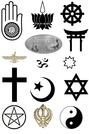
Religion is a significant aspect of human cultures everywhere. In these lessons, we explore questions such as: What are the main elements of religion? Why is believing in a higher power important to human beings across cultures? How is religion related to our social orders? How is religion related to the politics of today's world?This resource is comprised of 7 lessons based on online modules, plus a final presentation assignment. Each lesson includes a discussion or written assignment. This class was originally taught by Huma Mohibullah at Renton Technical College.
This contemplative practice inquires into the complex web of interdependencies linking global …
This contemplative practice inquires into the complex web of interdependencies linking global climate change, the War on Terror, Afghan poppy production, opiate addiction, and food security through the lens of systems theory. The exercise challenges students to consider these linkages not only conceptually but also somatically and emotionally.
(Note: this resource was added to OER Commons as part of a batch upload of over 2,200 records. If you notice an issue with the quality of the metadata, please let us know by using the 'report' button and we will flag it for consideration.)
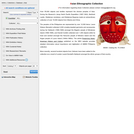
This online database of our African Ethnographic collection includes artifacts that were …
This online database of our African Ethnographic collection includes artifacts that were found throughout the continent of Africa, from The Gambia to Madagascar, from Algeria to South Africa. The database allows you to see all artifacts for a country by clicking on a map or list of country names, search by object type, culture, and keyword find out what items are currently on display, and learn about recently acquired artifacts. There are two ways to search the collection as a picture-only gallery, or as a catalog that describes each artifact's provenance (country, locale, culture), materials, dimensions, and year of acquisition.
These educational videos provide an invaluable resource on Ancient Nubia for Middle …
These educational videos provide an invaluable resource on Ancient Nubia for Middle and High School Ancient World History and Geography teachers and students. The video content aligns with Geography, Economics, Civics, and Historical Thinking Social Studies standards across the nation. Key concepts and inquiry skills from each content area weave seamlessly throughout the videos and associated lesson plans. This unit overview document links to developed resources on the Archeology in the Community site.
This online article explains the meticulous care and tracking that goes into …
This online article explains the meticulous care and tracking that goes into storing the 530,000 items in the museum's anthropology collection. Along with discussing the inherent differences between the items in each of the collection's three subdivisions (archaeology, ethnology, and biological anthropology), the article covers the nature of collections, preserving anthropology collections and computerizing collections management
This online article introduces students to the Objects Conservation Laboratory run by …
This online article introduces students to the Objects Conservation Laboratory run by the museum's Anthropology Division. It discusses the main activities of the lab's conservators what that process involves.
This course introduces students to some of the major social theories and …
This course introduces students to some of the major social theories and debates that inspire and inform anthropological analysis. Over the course of the semester, we will investigate a range of theoretical propositions concerning such topics as agency, structure, subjectivity, history, social change, power, culture, and the politics of representation. Ultimately, all theories can be read as statements about human beings and the worlds they create and inhabit. We will approach each theoretical perspective or proposition on three levels: (1) in terms of its analytical or explanatory power for understanding human behavior and the social world; (2) in the context of the social and historical circumstances in which they were produced; and (3) as contributions to ongoing dialogues and debate.
The purpose of this course is the study of human communication across …
The purpose of this course is the study of human communication across the life span from a temporal-spatial approach. Specifically, the course examines human communication from an evolutionary and adaptive perspective and explores the fundamental question, in what way does culture shape communication and communication shape culture?
Contains syllabus, ten lessons, and two fieldwork exercises for a ten-week course.
This is a collection of mini lectures created by anthropologists and those …
This is a collection of mini lectures created by anthropologists and those in conversation with anthropology as supplimental material to assist college and university instructors who were made to shift their courses online because of COVID19.For more information, see here.To contribute, please create an OER author account and send your name and OER registered email to AnthropologyTeaching@gmail.com.
ANTH 150 World Archaeology Introduction to archaeology and cultural change from the …
ANTH 150 World Archaeology Introduction to archaeology and cultural change from the earliest times to the advent of state-level societies.
Course Description: • When did we become fully modern humans? • When (and why) did we stop being hunter-gatherers? • When did inequality emerge? • Why did some people decide to start living in cities? • What led to the development of complex state-level societies? These are important questions about what it means to be human that archaeologists address. In this course, we’ll consider these topics while providing an introduction to archaeology and the study of world prehistory. The course provides an overview of human prehistory from modern humans up to the development of literate civilizations. The approach will be problem oriented and comparative. We will consider ancient cultures from around the world in order to foster an appreciation for human cultural diversity. Explaining why cultural developments occurred is often hotly debated among archaeologists, and different perspectives will be explored critically throughout this course.
This course applies the tools of anthropology to examine biology in the …
This course applies the tools of anthropology to examine biology in the age of genomics, biotechnological enterprise, biodiversity conservation, pharmaceutical bioprospecting, and synthetic biology. It examines such social concerns such as bioterrorism, genetic modification, and cloning. It offers an anthropological inquiry into how the substances and explanations of biology — ecological, organismic, cellular, molecular, genetic, informatic — are changing. The course also examines such artifacts as cell lines, biodiversity databases, and artificial life models, and using primary sources in biology, social studies of the life sciences, and literary and cinematic materials, asks how we might answer Erwin Schrödinger's 1944 question, "What Is Life?", today.
This course examines the ways humans experience sound and how perceptions and …
This course examines the ways humans experience sound and how perceptions and technologies of sound emerge from cultural, economic, and historical worlds. It considers how the sound/noise/music boundaries have been imagined, created, and modeled across sociocultural and historical contexts. Students will learn how environmental, linguistic, and musical sounds are construed cross-culturally as well as the rise of telephony, architectural acoustics, sound recording, multi-channel and spatial mix performance, and the globalized travel of these technologies. Questions of sound ownership, property, authorship, remix, and copyright in the digital age are also addressed.
This class has been reorganized to focus primarily on the War in …
This class has been reorganized to focus primarily on the War in Iraq. As in previous years, the class still examines war in cross-cultural perspective, asking whether war is intrinsic to human nature, what causes war, how particular cultural experiences of war differ, and how war has affected American culture.
This course examines traditional performances of the Arabic-speaking populations of the Middle …
This course examines traditional performances of the Arabic-speaking populations of the Middle East and North Africa. Starting with the history of the ways in which the West has discovered, translated and written about the Orient, we will consider how power and politics play roles in the production of culture, narrative and performance. This approach assumes that performance, verbal art, and oral literature lend themselves to spontaneous adaptation and to oblique expression of ideas and opinions whose utterance would otherwise be censorable or disruptive. In particular we will be concerned with the way traditional performance practices are affected by and respond to the consequences of modernization. Topics include oral epic performance, sacred narrative, Koranic chant performance, the folktale, solo performance, cultural production and resistance.
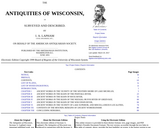
The Antiquities of Wisconsin, Increase A. Lapham's most important published work, includes …
The Antiquities of Wisconsin, Increase A. Lapham's most important published work, includes 92 pages of text, illustrated with 61 wood engravings, and 55 lithographed plates and was the result of his research into the Indian effigy mounds found on Wisconsin's Landscape.
El libro presenta una exploración profunda de la relación entre la alimentación …
El libro presenta una exploración profunda de la relación entre la alimentación y la evolución humana. Inicia descifrando los cambios dietéticos de los primeros homínidos y cómo estos cambios influenciaron su desarrollo físico y cognitivo, desde la dentición hasta el aumento del tamaño cerebral. Luego analiza la influencia cultural y sociopolítica en la dieta de antiguas civilizaciones como Egipto, Roma y China. Se destaca la alimentación en culturas precolombinas, resaltando la diversidad agrícola, sus prácticas sostenibles y la conexión cósmica con la tierra. Aborda también, la Revolución Industrial y cómo transformó los patrones alimentarios, llevando a problemas de salud en la modernidad. También se discute la "revolución verde" y las tecnologías para mejorar la producción alimentaria. Y finalmente se explica sobre la sostenibilidad en los sistemas alimentarios y las innovaciones para el futuro, como la carne de laboratorio y la nutrición basada en insectos. El libro concluye reconociendo la nutrición como una ciencia multidisciplinaria, que busca garantizar la salud y calidad de vida. Esta obra es el resultado de un esfuerzo colectivo de académicos que buscan entender la alimentación humana desde sus orígenes hasta el presente.
This online database of our Asian Ethnographic collection includes artifacts that were …
This online database of our Asian Ethnographic collection includes artifacts that were found throughout the continent of Asia, from Russia to Indonesia, from Turkey to Japan. The database allows you to see all artifacts for a country by clicking on a map or list of country names, search by object type, culture, and keyword, find out what items are currently on display and learn about recently acquired artifacts. There are two ways to search the collection as a picture-only gallery, or as a catalog that describes each artifact's provenance (country, locale, culture), materials, dimensions, and year of acquisition.
No restrictions on your remixing, redistributing, or making derivative works. Give credit to the author, as required.
Your remixing, redistributing, or making derivatives works comes with some restrictions, including how it is shared.
Your redistributing comes with some restrictions. Do not remix or make derivative works.
Most restrictive license type. Prohibits most uses, sharing, and any changes.
Copyrighted materials, available under Fair Use and the TEACH Act for US-based educators, or other custom arrangements. Go to the resource provider to see their individual restrictions.