In this activity, students construct their own rocket-powered boat called an "aqua-thruster." …
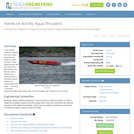
In this activity, students construct their own rocket-powered boat called an "aqua-thruster." These aqua-thrusters will be made from a film canister and will use carbon dioxide gas produced from a chemical reaction between an antacid tablet and water to propel it. Students observe the effect that surface area of this simulated solid rocket fuel has on thrust.
Students design and build paper rockets around film canisters, which serve as …
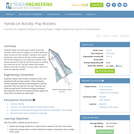
Students design and build paper rockets around film canisters, which serve as engines. An antacid tablet and water are put into each canister, reacting to form carbon dioxide gas, and acting as the pop rocket's propellant. With the lid snapped on, the continuous creation of gas causes pressure to build up until the lid pops off, sending the rocket into the air. The pop rockets demonstrate Newton's third law of motion: for every action, there is an equal and opposite reaction.
No restrictions on your remixing, redistributing, or making derivative works. Give credit to the author, as required.
Your remixing, redistributing, or making derivatives works comes with some restrictions, including how it is shared.
Your redistributing comes with some restrictions. Do not remix or make derivative works.
Most restrictive license type. Prohibits most uses, sharing, and any changes.
Copyrighted materials, available under Fair Use and the TEACH Act for US-based educators, or other custom arrangements. Go to the resource provider to see their individual restrictions.