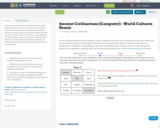
In the computer-based Ancient Civilizations activity, students create their own civilization and …
In the computer-based Ancient Civilizations activity, students create their own civilization and see how it fares over the years based on choices they make for location, animals, plants and materials. Students trade resources between their civilizations, repeatedly go to war with unnamed enemies, and learn some fun facts about real-world ancient civilizations along the way. This activity was inspired by Guns, Germs and Steel by Jared Diamond.
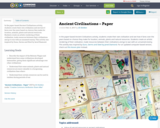
In the paper-based Ancient Civilizations activity, students create their own civilization and …
In the paper-based Ancient Civilizations activity, students create their own civilization and see how it fares over the years based on choices they make for location, animals, plants and natural resources. Students create an artistic rendering of their civilization, trade resources between their civilizations and go to war with an unnamed enemy. This activity was inspired by Guns, Germs and Steel by Jared Diamond.
In this problem-based learning module, students will use their knowledge of the ancient …
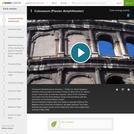
In this problem-based learning module, students will use their knowledge of the ancient Roman Empire and will work to analyze critical theories historians agree contributed to the fall of Rome. Students will then work to compare the problems faced by the Romans with problems citizens of the United States still largely face today. Through this investigation, students should recognize how modern technology, government agencies, laws and resources help to solve societal problems that could have once destroyed an empire. With this new understanding, students should work to present a solution to a major problem that plagued the Roman Empire during the years leading up to its collapse.
In this problem-based learning module, students will use their knowledge of the ancient …
In this problem-based learning module, students will use their knowledge of the ancient Roman Empire and will work to analyze critical theories historians agree contributed to the fall of Rome. Students will then work to compare the problems faced by the Romans with problems citizens of the United States still largely face today. Through this investigation, students should recognize how modern technology, government agencies, laws and resources help to solve societal problems that could have once destroyed an empire. With this new understanding, students should work to present a solution to a major problem that plagued the Roman Empire during the years leading up to its collapse.Remix Resource uses key South Carolina standards for 6th Grade Social Studies and Language ArtsOriginal Resource uses key Ohio standards for 7th Grade Social Studies and Language ArtsAuthor: Blended Learning Teacher Practice Network Date Added: 07/23/2018License: Creative Commons Attribution-NonCommercial 4.0 Language: English Media Format: Audio, Downloadable docs, Graphics/Photos, Text/HTML
The 12th grade learning experience consists of 7 mostly month-long units aligned …
The 12th grade learning experience consists of 7 mostly month-long units aligned to the Common Core State Standards, with available course material for teachers and students easily accessible online. Over the course of the year there is a steady progression in text complexity levels, sophistication of writing tasks, speaking and listening activities, and increased opportunities for independent and collaborative work. Rubrics and student models accompany many writing assignments.Throughout the 12th grade year, in addition to the Common Read texts that the whole class reads together, students each select an Independent Reading book and engage with peers in group Book Talks. Language study is embedded in every 12th grade unit as students use annotation to closely review aspects of each text. Teacher resources provide additional materials to support each unit.
In our lives, we are constantly telling stories to ourselves and to …
In our lives, we are constantly telling stories to ourselves and to others in an attempt to both understand our experiences and present our best selves to others. But how do we tell a story about ourselves that is both true and positive? How do we hold ourselves up in the best possible light, while still being honest about our struggles and our flaws? Students will explore ways of interpreting and portraying personal experiences. They'll read Chinua Achebe's novel Things Fall Apart , analyzing the text through the eyes of one character. They'll get to know that character's flaws and strengths, and they'll tell part of the story from that character's perspective, doing their best to tell an honest tale that presents their character's best side. Then they'll explore their own stories, crafting a personal narrative about an important moment of learning in his or her life.
ACCOMPLISHMENTS
Students read and analyze Chinua Achebe’s Things Fall Apart , viewing the events and conflicts of the novel through the eyes of one of the central characters. Students write a two-part narrative project: one narrative told through their character’s perspective and one personal narrative about an incident in their own life.
GUIDING QUESTIONS
These questions are a guide to stimulate thinking, discussion, and writing on the themes and ideas in the unit. For complete and thoughtful answers and for meaningful discussions, students must use evidence based on careful reading of the texts.
How do our conflicts shape and show our character? How can we tell a story about ourselves that’s both honest and positive? How do definitions of justice change depending on the culture you live in? What are ways individuals can react to a changing world? To a community that doesn’t accept us?
BENCHMARK ASSESSMENT: Cold Read
During this unit, on a day of your choosing, we recommend you administer a Cold Read to assess students’ reading comprehension. For this assessment, students read a text they have never seen before and then respond to multiple-choice and constructed-response questions. The assessment is not included in this course materials.
Mythology is a powerful vehicle for teaching students about symbols and the …
Mythology is a powerful vehicle for teaching students about symbols and the ways people have sought to explain their relationships to nature and to each other. Teachers can use these lessons and works of art to introduce or examine the role of myths in explaining human customs, mysteries about nature, or the reasons why things exist in the world. Lessons include: Pandora's Box; Apollo Pursuing Daphne; Diana and Endymion; The Fall of Phaeton; and The Corinthian Maid.
This resource is an introduction to William Shakespeare's tragic play, "The Tragedy …
This resource is an introduction to William Shakespeare's tragic play, "The Tragedy of Julius Caesar", through the study of universal themes using multiple-perspective investigations of betrayal scenarios.
History 116, the first part of the introductory surveys of Western Civilization. …
History 116, the first part of the introductory surveys of Western Civilization. This course covers the period from early civilized man to the early Middle Ages of Europe, with emphasis on Greece, Rome, Egypt and other Mediterranean peoples.
No restrictions on your remixing, redistributing, or making derivative works. Give credit to the author, as required.
Your remixing, redistributing, or making derivatives works comes with some restrictions, including how it is shared.
Your redistributing comes with some restrictions. Do not remix or make derivative works.
Most restrictive license type. Prohibits most uses, sharing, and any changes.
Copyrighted materials, available under Fair Use and the TEACH Act for US-based educators, or other custom arrangements. Go to the resource provider to see their individual restrictions.