This lesson follows the NGSS standards for reviewing analog and digital waves. …
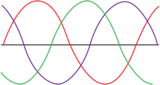
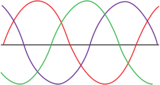
This lesson follows the NGSS standards for reviewing analog and digital waves. Students will be able to review the differences and similarities of analog and digital waves. Students will also be able to review how signals sent as analog or digital waves are used.
This lesson follows the NGSS standards for reviewing analog and digital waves. …
This lesson follows the NGSS standards for reviewing analog and digital waves. Students will be able to review the differences and similarities of analog and digital waves. Students will also be able to review how signals sent as analog or digital waves are used.
For all intents and purposes, this show is the fourth edition of …
For all intents and purposes, this show is the fourth edition of the textbook Computer Organization and Design Fundamentals by David Tarnoff. Since the first edition came out in 2005, the PDFs have been made free for download to anyone interested in computer organization. With the trend toward audio and video instructional material, it was time for an update.
The presentation of the material in this series will be similar to that of the original textbook. In the first third, we will discuss the mathematical foundation and design tools that address the digital nature of computers. This will include an introduction to the differences between the physical world and the digital world, how those differences affect the way the computer represents and manipulates data, and the use and design of digital logic and logic gates. In the second third, the fundamentals of the digital logic and design will be used to design common circuits such as binary adders, describe checksums and cyclic redundancy checks, network addressing, storage devices, and state machines. The final third will examine the top-level view of the computer. This will include a discussion of the memory hierarchy and its components, the components of a CPU, and maybe even a discussion of assembly language along with some examples.
This course introduces students to both passive and active electronic components (op-amps, …
This course introduces students to both passive and active electronic components (op-amps, 555 timers, TTL digital circuits). Basic analog and digital circuits and theory of operation are covered. The labs allow the students to master the use of electronic instruments and construct and/or solder several circuits. The labs also reinforce the concepts discussed in class with a hands-on approach and allow the students to gain significant experience with electrical instruments such as function generators, digital multimeters, oscilloscopes, logic analyzers and power supplies. In the last lab, the students build an electronic circuit that they can keep. The course is geared to freshmen and others who want an introduction to electronics circuits. This course is offered during the Independent Activities Period (IAP), which is a special 4-week term at MIT that runs from the first week of January until the end of the month.
Students learn various topics associated with the circle through studying a clock. …
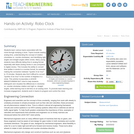
Students learn various topics associated with the circle through studying a clock. Topics include reading analog time, understanding the concept of rotation (clockwise vs. counter-clockwise), and identifying right angles and straight angles within circles. Many young students have difficulty telling time in analog format, especially with fewer analog clocks in use (compared to digital clocks). This includes the ability to convert time written in words to a number format, for example, making the connection between "quarter of an hour" to 15 minutes. Students also find it difficult to convert "quarter of an hour" to the number of degrees in a circle. This activity incorporates a LEGO® MINDSTORMS® NXT robot to help students distinguish and visualize the differences in clockwise vs. counter-clockwise rotation and right vs. straight angles, while learning how to tell time on an analog clock. To promote team learning and increase engagement, students work in teams to program and control the robot.
No restrictions on your remixing, redistributing, or making derivative works. Give credit to the author, as required.
Your remixing, redistributing, or making derivatives works comes with some restrictions, including how it is shared.
Your redistributing comes with some restrictions. Do not remix or make derivative works.
Most restrictive license type. Prohibits most uses, sharing, and any changes.
Copyrighted materials, available under Fair Use and the TEACH Act for US-based educators, or other custom arrangements. Go to the resource provider to see their individual restrictions.