Students extend their knowledge of the skeletal system to biomedical engineering design, …
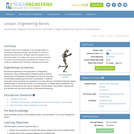
Students extend their knowledge of the skeletal system to biomedical engineering design, specifically the concept of artificial limbs. Students relate the skeleton as a structural system, focusing on the leg as structural necessity. They learn about the design considerations involved in the creation of artificial limbs, including materials and sensors.
Students are introduced to prosthetics history, purpose and benefits, main components, main …
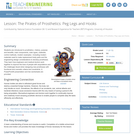
Students are introduced to prosthetics history, purpose and benefits, main components, main types, materials, control methods, modern examples including modern materials used to make replacement body parts and the engineering design considerations to develop prostheses. They learn how engineers and medical doctors work together to improve the lives of people with amputations and the challenges faced when designing new prostheses with functional and cosmetic criteria and constraints. A PowerPoint(TM) presentation and two worksheets are provided.
Student teams investigate biomedical engineering and the technology of prosthetics. Students create …
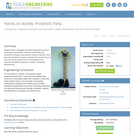
Student teams investigate biomedical engineering and the technology of prosthetics. Students create a model prosthetic lower leg using various materials. Each team demonstrate its prosthesis' strength and consider its pros and cons, giving insight into the characteristics and materials biomedical engineers consider in designing artificial limbs.
D-Lab World Prosthetics is a collaboration between the Massachusetts Institute of Technology …
D-Lab World Prosthetics is a collaboration between the Massachusetts Institute of Technology and the Jaipur Foot Organization to improve the design, manufacture, and distribution of rehabilitation devices in the developing world. The course welcomes individuals interested in physical rehabilitation to work on multidisciplinary teams of students with bioengineering, mechanical engineering, material science, and medical or pre-medical backgrounds. Students will learn about the basics of human walking, different types of gait disabilities, as well as the technologies that seek to address those disabilities. Patient perspectives and current research areas are presented. Lecture topics focus on lower-limb disabilities, including polio and above-knee and below-knee amputation, and will cover both developed and developing world techniques for overcoming these disabilities. Students form teams to design and prototype low-cost orthotic and prosthetic devices, and present their work at the end of the course.
Students experience the engineering design process as they design and construct lower-leg …
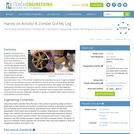
Students experience the engineering design process as they design and construct lower-leg prostheses in response to a hypothetical zombie apocalypse scenario. Like the well-known Apollo 13 story during which engineers were challenged to fix the crippled spacecraft with limited supplies in order to save astronauts' lives, in this activity, students act as engineers during an imaginary disaster in which a group member's leg was amputated in order to survive a zombie attack. Building on what they learned and researched in the associated lesson, they design and fabricate a replacement prosthetic limb using given specific starting material and limited additional supplies, similar to how engineers design for individuals while working within constraints. A more-advanced scenario challenges students to design a prosthesis that is able to provide a more-specific movement function.
No restrictions on your remixing, redistributing, or making derivative works. Give credit to the author, as required.
Your remixing, redistributing, or making derivatives works comes with some restrictions, including how it is shared.
Your redistributing comes with some restrictions. Do not remix or make derivative works.
Most restrictive license type. Prohibits most uses, sharing, and any changes.
Copyrighted materials, available under Fair Use and the TEACH Act for US-based educators, or other custom arrangements. Go to the resource provider to see their individual restrictions.