The lesson begins with a demonstration introducing students to the force between …
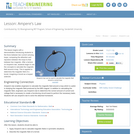
The lesson begins with a demonstration introducing students to the force between two current carrying loops, comparing the attraction and repulsion between the loops to that between two magnets. After formal lecture on Ampere's law, students begin to use the concepts to calculate the magnetic field around a loop. This is applied to determine the magnetic field of a toroid, imagining a toroid as a looped solenoid.
This freshman-level course is the second semester of introductory physics. The focus …
This freshman-level course is the second semester of introductory physics. The focus is on electricity and magnetism. The subject is taught using the TEAL (Technology Enabled Active Learning) format which utilizes small group interaction and current technology. The TEAL/Studio Project at MIT is a new approach to physics education designed to help students develop much better intuition about, and conceptual models of, physical phenomena. Acknowledgements The TEAL project is supported by The Alex and Brit d'Arbeloff Fund for Excellence in MIT Education, MIT iCampus, the Davis Educational Foundation, the National Science Foundation, the Class of 1960 Endowment for Innovation in Education, the Class of 1951 Fund for Excellence in Education, the Class of 1955 Fund for Excellence in Teaching, and the Helena Foundation. Many people have contributed to the development of the course materials. (PDF)
This course is a graduate level subject on electromagnetic theory with particular …
This course is a graduate level subject on electromagnetic theory with particular emphasis on basics and applications to Nuclear Science and Engineering. The basic topics covered include electrostatics, magnetostatics, and electromagnetic radiation. The applications include transmission lines, waveguides, antennas, scattering, shielding, charged particle collisions, Bremsstrahlung radiation, and Cerenkov radiation. Acknowledgments Professor Freidberg would like to acknowledge the immense contributions made to this course by its previous instructors, Ian Hutchinson and Ron Parker.
In this introduction to light energy, students learn about reflection and refraction …
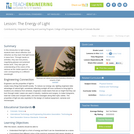
In this introduction to light energy, students learn about reflection and refraction as they learn that light travels in wave form. Through hands-on activities, they see how prisms, magnifying glasses and polarized lenses work. They also gain an understanding of the colors of the rainbow as the visible spectrum, each color corresponding to a different wavelength.
Students are given an engineering challenge: A nearby hospital has just installed …
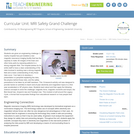
Students are given an engineering challenge: A nearby hospital has just installed a new magnetic resonance imaging facility that has the capacity to make 3D images of the brain and other body parts by exposing patients to a strong magnetic field. The hospital wishes for its entire staff to have a clear understanding of the risks involved in working near a strong magnetic field and a basic understanding of why those risks occur. Your task is to develop a presentation or pamphlet explaining the risks, the physics behind those risks, and the safety precautions to be taken by all staff members. This 10-lesson/4-activity unit was designed to provide hands-on activities to teach end-of-year electricity and magnetism topics to a first-year accelerated or AP physics class. Students learn about and then apply the following science concepts to solve the challenge: magnetic force, magnetic moments and torque, the Biot-Savart law, Ampere's law and Faraday's law. This module is built around the Legacy Cycle, a format that incorporates findings from educational research on how people best learn.
This course is an introduction to electromagnetism and electrostatics. Topics include: electric …
This course is an introduction to electromagnetism and electrostatics. Topics include: electric charge, Coulomb's law, electric structure of matter, conductors and dielectrics, concepts of electrostatic field and potential, electrostatic energy, electric currents, magnetic fields, Ampere's law, magnetic materials, time-varying fields, Faraday's law of induction, basic electric circuits, electromagnetic waves, and Maxwell's equations. The course has an experimental focus, and includes several experiments that are intended to illustrate the concepts being studied. Acknowledgements Prof. Roland wishes to acknowledge that the structure and content of this course owe much to the contributions of Prof. Ambrogio Fasoli.
Course 8.022 is one of several second-term freshman physics courses offered at …
Course 8.022 is one of several second-term freshman physics courses offered at MIT. It is geared towards students who are looking for a thorough and challenging introduction to electricity and magnetism. Topics covered include: Electric and magnetic field and potential; introduction to special relativity; Maxwell's equations, in both differential and integral form; and properties of dielectrics and magnetic materials. In addition to the theoretical subject matter, several experiments in electricity and magnetism are performed by the students in the laboratory. Acknowledgments Prof. Sciolla would like to acknowledge the contributions of MIT Professors Scott Hughes and Peter Fisher to the development of this course. She would also like to acknowledge that these course materials include contributions from past instructors, textbooks, and other members of the MIT Physics Department affiliated with course 8.022. Since the following works have evolved over a period of many years, no single source can be attributed.
This freshman-level course is the second semester of introductory physics. The focus …
This freshman-level course is the second semester of introductory physics. The focus is on electricity and magnetism. The subject is taught using the TEAL (Technology Enabled Active Learning) format which utilizes small group interaction and current technology. The TEAL/Studio Project at MIT is a new approach to physics education designed to help students develop much better intuition about, and conceptual models of, physical phenomena. Staff List Visualizations: Prof. John Belcher Instructors: Dr. Peter Dourmashkin Prof. Bruce Knuteson Prof. Gunther Roland Prof. Bolek Wyslouch Dr. Brian Wecht Prof. Eric Katsavounidis Prof. Robert Simcoe Prof. Joseph Formaggio Course Co-Administrators: Dr. Peter Dourmashkin Prof. Robert Redwine Technical Instructors: Andy Neely Matthew Strafuss Course Material: Dr. Peter Dourmashkin Prof. Eric Hudson Dr. Sen-Ben Liao Acknowledgements The TEAL project is supported by The Alex and Brit d'Arbeloff Fund for Excellence in MIT Education, MIT iCampus, the Davis Educational Foundation, the National Science Foundation, the Class of 1960 Endowment for Innovation in Education, the Class of 1951 Fund for Excellence in Education, the Class of 1955 Fund for Excellence in Teaching, and the Helena Foundation. Many people have contributed to the development of the course materials. (PDF)
Electricity and magnetism dominate much of the world around us – from …
Electricity and magnetism dominate much of the world around us – from the most fundamental processes in nature to cutting-edge electronic devices. Electric and magnetic fields arise from charged particles. Charged particles also feel forces in electric and magnetic fields. Maxwell’s equations, in addition to describing this behavior, also describe electromagnetic radiation. The three-course series comprises: 8.02.1x: Electrostatics 8.02.2x: Magnetic Fields and Forces 8.02.3x: Maxwell’s Equations This course was organized as a three-part series on MITx by MIT’s Department of Physics and is now archived on the Open Learning Library, which is free to use. You have the option to sign up and enroll in each module if you want to track your progress, or you can view and use all the materials without enrolling.
No restrictions on your remixing, redistributing, or making derivative works. Give credit to the author, as required.
Your remixing, redistributing, or making derivatives works comes with some restrictions, including how it is shared.
Your redistributing comes with some restrictions. Do not remix or make derivative works.
Most restrictive license type. Prohibits most uses, sharing, and any changes.
Copyrighted materials, available under Fair Use and the TEACH Act for US-based educators, or other custom arrangements. Go to the resource provider to see their individual restrictions.