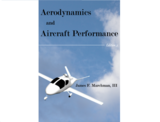
This course extends fluid mechanic concepts from Unified Engineering to the aerodynamic performance of wings and bodies in sub/supersonic regimes. It generally has four components: subsonic potential flows, including source/vortex panel methods; viscous flows, including laminar and turbulent boundary layers; aerodynamics of airfoils and wings, including thin airfoil theory, lifting line theory, and panel method/interacting boundary layer methods; and supersonic and hypersonic airfoil theory. Course material varies each year depending upon the focus of the design problem.
This course extends fluid mechanic concepts from Unified Engineering to the aerodynamic performance of wings and bodies in sub/supersonic regimes. 16.100 generally has four components: subsonic potential flows, including source/vortex panel methods; viscous flows, including laminar and turbulent boundary layers; aerodynamics of airfoils and wings, including thin airfoil theory, lifting line theory, and panel method/interacting boundary layer methods; and supersonic and hypersonic airfoil theory. Course material varies each year depending upon the focus of the design problem.
How does an airplane stay aloft when upside down? This media-rich essay from the NOVA Web site offers an explanation based on Newton's third law of motion. Grades 6-12.
Boundary layers as rational approximations to the solutions of exact equations of fluid motion. Physical parameters influencing laminar and turbulent aerodynamic flows and transition. Effects of compressibility, heat conduction, and frame rotation. Influence of boundary layers on outer potential flow and associated stall and drag mechanisms. Numerical solution techniques and exercises. The major focus of 16.13 is on boundary layers, and boundary layer theory subject to various flow assumptions, such as compressibility, turbulence, dimensionality, and heat transfer. Parameters influencing aerodynamic flows and transition and influence of boundary layers on outer potential flow are presented, along with associated stall and drag mechanisms. Numerical solution techniques and exercises are included.
This lesson teaches the engineering method for testing wherein one variable is changed while the others are held constant. Students compare the performance of a single paper airplane design while changing the shape, size and position of flaps on the airplane. Students also learn about control surfaces on the tail and wings of an airplane.
Subject:
Mathematics and Statistics, Science and Technology
The purpose of this activity is to use a scientific method to determine the effect of control surfaces on a paper glider. The students will construct a paper airplane/glider and test its performance to determine the base characteristics of the plane. They will then change one of the control surfaces and compare the results to their base glider in order to determine the cause and effect relationship of the control surfaces.
Subject:
Mathematics and Statistics, Science and Technology
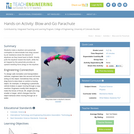
Students make a skydiver and parachute contraption to demonstrate how drag caused by air resistance slows the descent of skydivers as they travel back to Earth. Gravity pulls the skydiver toward the Earth, while the air trapped by the parachute provides an upward resisting force (drag) on the skydiver.
Subject:
Mathematics and Statistics, Science and Technology
The purpose of this activity is to demonstrate some of the different parts of an airplane through the construction of a paper airplane. Students will build several different kinds of paper airplanes in order to figure out what makes an airplane fly and what can be changed to influence the flying characteristics of an airplane.
Subject:
Mathematics and Statistics, Science and Technology
Students learn about weight and drag forces by making paper helicopters and measuring how adding more weight affects the time it takes for the helicopters to fall to the ground.
Subject:
Mathematics and Statistics, Science and Technology
On the topic of energy related to motion, this summary lesson is intended to tie together the concepts introduced in the previous four lessons and show how the concepts are interconnected in everyday applications. A hands-on activity demonstrates this idea and reinforces students' math skills in calculating energy, momentum and frictional forces.
Subject:
Mathematics and Statistics, Science and Technology
This lesson introduces students to the art of designing an airplane through paper airplane constructions. The goal is that students will learn important aircraft design considerations and how engineers must iterate their designs to achieve success. Students first follow several basic paper airplane models, after which they will then design their own paper airplane. They will also learn how engineers make models to test ideas and designs.
Subject:
Mathematics and Statistics, Science and Technology
The airplanes unit begins with a lesson on how airplanes create lift, which involves a discussion of air pressure and how wings use Bernoulli's Principle to change air pressure. Following the lessons on lift, students explore the other three forces acting on airplanes thrust, weight and drag. Following these lessons, students learn how airplanes are controlled and use paper airplanes to demonstrate these principles. The final lessons addresses societal and technological impacts airplanes have had on our world. Students learn about different kinds of airplanes and then design and build their own balsa wood airplanes based on what they have learned.
Subject:
Mathematics and Statistics, Science and Technology
Students begin to explore the idea of a force. To further their understanding of drag, gravity and weight, they conduct activities that model the behavior of parachutes and helicopters. An associated literacy activity engages the class to recreate the Wright brothers' first flight in the style of the "You Are There" television series.
Subject:
Mathematics and Statistics, Science and Technology
Students learn about friction and drag two different forces that convert energy of motion to heat. Both forces can act on a moving object and decrease its velocity. Students learn examples of friction and drag, and suggest ways to reduce the impact of these forces. The equation that governs common frictional forces is introduced, and during a hands-on activity, students experimentally measure a coefficient of friction.
Subject:
Mathematics and Statistics, Science and Technology
No restrictions on your remixing, redistributing, or making derivative works.
Give credit to the author, as required.
Your remixing, redistributing, or making derivatives works comes with some
restrictions, including how it is shared.
Your redistributing comes with some restrictions. Do not remix or make
derivative works.
Copyrighted materials, available under Fair Use and the TEACH Act for US-based
educators, or other custom arrangements. Go to the resource provider to see
their individual restrictions.