The Educator & Staff Professional Learning Plan is one component of the …
The Educator & Staff Professional Learning Plan is one component of the K-12 Voices for Open OER - DEIA Action Planning Guide. This plan, and the entire guide, is intended as a strategic planning tool for district leaders wishing to promote the already pedagogically and financially compelling practice of creating or adapting open educational resources (OER) to help achieve district goals in serving all students through diversity, equity, inclusion, or accessibility (DEIA) lens. The guide provides step-by-step planning tools, including examples, templates, and resources to help district leaders articulate and establish action plans for what we refer to as "OER-DEIA." The entire guide is an open educational resource itself, free and openly licensed for reuse, remixing, and resharing.
This guide is the fourth and final guide in the series and …
This guide is the fourth and final guide in the series and focuses on evaluating the processes and outcomes in the strategic plan. Evaluation is central to strategic planning as it allows you to review what is and isn’t working on the school improvement journey. There are 2 types of evaluation you should consider: Process evaluation examines whether practices have been applied in the way they were planned. Outcome evaluation examines whether practices are having the desired effect on student learning. Process and outcome evaluation both play key roles at different stages of a strategic plan’s life cycle.
This guide recommends practical steps for evaluating processes for improving practices, as well as the effect of these practices on student learning. We recommend reading this guide after you have read the third guide in this series, Selecting Practices to Deliver Improvement.
On April 18, 2023, #GoOpen held a public webinar titled, "Integrating OER into …
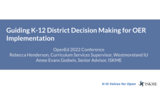
On April 18, 2023, #GoOpen held a public webinar titled, "Integrating OER into Instructional Initiatives." The session featured Rebecca Henderson, Curriculum Services Supervisor, Westmoreland Intermediate Unit, PA; Tracy Rains, Virtual Learning Specialist, Appalachia Intermediate Unit 8, PA; and, Kelly Hammond, OER and Open Pedagogy Adjunct, CUNY School of Professional Studies; and facilitator, Amee Evans Godwin of ISKME and the #GoOpen National Network.
This guide is intended as a strategic planning tool for district leaders …
This guide is intended as a strategic planning tool for district leaders wishing to promote the already pedagogically and financially compelling practice of creating or adapting open educational resources (OER) to help achieve district goals in serving all students through diversity, equity, inclusion, or accessibility (DEIA) lens. The guide provides step-by-step planning tools, including examples, templates, and resources to help district leaders articulate and establish action plans for what we refer to as "OER-DEIA." The entire guide is an open educational resource itself, free and openly licensed for reuse, remixing, and resharing.
The links within this resource are designed to provide educators with background …
The links within this resource are designed to provide educators with background context regarding the development of the K-12 Voices for Open OER-DEIA Action Plan for K-12 District Implementation. Presented as a poster session at the 2022 OpenEd Conference, the slides explain the purpose of the Guide, as well as the development process.This guide is intendend as a strategic planning tool for district leaders wishing to promote the already pedagogically and financially compelling practice of creating or adapting open educational resources (OER) to help achieve district goals in serving all students through diversity, equity, inclusion, or accessibility (DEIA) lens. The guide provides step-by-step planning tools, including examples, templates, and resources to help district leaders articulate and establish action plans for what we refer to as "OER-DEIA." The entire guide is an open educational resource itself, free and openly licensed for reuse, remixing, and resharing.
Strategic planning is an iterative process that requires a purposeful investment of …
Strategic planning is an iterative process that requires a purposeful investment of time. These guides are designed for flexible use alongside system supports, providing a starting point rather than a complete outline of everything schools must do. They are designed to help school leaders with strategic planning directly related to learning. School leaders may also choose to include aspects of school improvement that enable learning (for example, student wellbeing) using a similar approach. Some guidance may not apply in all contexts and may look different in schools of different sizes. Reasonable adjustments should be made to fit school context where necessary. This guide is the first in a series of 4 and focuses on setting goals and targets for student learning. In the context of this guide, a 'goal’ represents an aim for improvement in a learning area. A ‘target’ enables you to monitor progress towards this goal by measuring changes in the learning area over a specified time period (for example, by the end of the school term or year). This guide recommends practical steps for setting goals and targets for student learning. After reading this guide, we recommend you read Prioritising Approaches to Achieve Each Goal.
A revision of Supporting Beginning Special Educators: Tips for Educational Leaders, this …
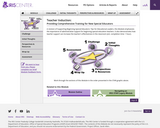
A revision of Supporting Beginning Special Educators: Tips for Educational Leaders, this Module emphasizes the importance of administrative support for beginning special education teachers. It also demonstrates how teacher support can increase the teacher's effectiveness in the classroom (est. completion time: 1 hour).
This template is part of the K-12 Voices for Open OER-DEIA Action …
This template is part of the K-12 Voices for Open OER-DEIA Action Plan for K-12 District Implementation. The template, and the entire guide, is intendend as a strategic planning tool for district leaders wishing to promote the already pedagogically and financially compelling practice of creating or adapting open educational resources (OER) to help achieve district goals in serving all students through diversity, equity, inclusion, or accessibility (DEIA) lens. The guide provides step-by-step planning tools, including examples, templates, and resources to help district leaders articulate and establish action plans for what we refer to as "OER-DEIA." The entire guide is an open educational resource itself, free and openly licensed for reuse, remixing, and resharing.
This template is part of the K-12 Voices for Open OER-DEIA Action …
This template is part of the K-12 Voices for Open OER-DEIA Action Plan for K-12 District Implementation. The template, and the entire guide, is intendend as a strategic planning tool for district leaders wishing to promote the already pedagogically and financially compelling practice of creating or adapting open educational resources (OER) to help achieve district goals in serving all students through diversity, equity, inclusion, or accessibility (DEIA) lens. The guide provides step-by-step planning tools, including examples, templates, and resources to help district leaders articulate and establish action plans for what we refer to as "OER-DEIA." The entire guide is an open educational resource itself, free and openly licensed for reuse, remixing, and resharing.
This template is part of the K-12 Voices for Open OER-DEIA Action …
This template is part of the K-12 Voices for Open OER-DEIA Action Plan for K-12 District Implementation. The template, and the entire guide, is intendend as a strategic planning tool for district leaders wishing to promote the already pedagogically and financially compelling practice of creating or adapting open educational resources (OER) to help achieve district goals in serving all students through diversity, equity, inclusion, or accessibility (DEIA) lens. The guide provides step-by-step planning tools, including examples, templates, and resources to help district leaders articulate and establish action plans for what we refer to as "OER-DEIA." The entire guide is an open educational resource itself, free and openly licensed for reuse, remixing, and resharing.
This course discusses management methods of relevance to public transportation systems. Topics …
This course discusses management methods of relevance to public transportation systems. Topics include strategic planning management, labor relations, maintenance planning and administration, financing, marketing and fare policy, and management information and decision support systems. The course shows how these general management tasks are dealt with in the transit industry and presents alternative strategies. It also identifies alternative arrangements for service provision, including different ways of involving the private sector in public transportation.
This class surveys the current concepts, theories, and issues in strategic management …
This class surveys the current concepts, theories, and issues in strategic management of transportation organizations. It provides transportation logistics and engineering systems students with an overview of the operating context, leadership challenges, strategies, and management tools that are used in today's public and private transportation organizations. The following concepts, tools, and issues are presented in both public and private sector cases: alternative models of decision-making, strategic planning (e.g., use of SWOT analysis and scenario development), stakeholder valuation and analysis, government-based regulation and cooperation within the transportation enterprise, disaster communications, systems safety, change management, and the impact of globalization.
Through a combination of lectures, cases, and class discussions this subject examines …
Through a combination of lectures, cases, and class discussions this subject examines the economic and political conflict between transportation and the environment. It investigates the role of government regulation, green business and transportation policy as facilitators of economic development and environmental sustainability. It analyzes a variety of international policy problems including government-business relations; the role of interest groups, non-governmental organizations, and the public and media in the regulation of the automobile; sustainable development; global warming; the politics of risk and siting of transport facilities; environmental justice; equity; and transportation and public health in the urban metropolis. It provides students with an opportunity to apply transportation and planning methods to developing policy alternatives in the context of environmental politics.
Kelly Hammond, Open Educational Resources (OER) and Instructional Technology Adjust at CUNY …
Kelly Hammond, Open Educational Resources (OER) and Instructional Technology Adjust at CUNY School of Professional Studies, talks about the importance of developing a strategic introduction to the OER-DEIA Action Plan for K-12 District Implementation that provides users with critical information that gives them a solid foundation when beginning their OER-DEIA journey. As she developed this section of the guide she reflected on her own OER journey and asked herself the guiding question, "What would I have needed to know in order to get there faster and more comfortably?"
No restrictions on your remixing, redistributing, or making derivative works. Give credit to the author, as required.
Your remixing, redistributing, or making derivatives works comes with some restrictions, including how it is shared.
Your redistributing comes with some restrictions. Do not remix or make derivative works.
Most restrictive license type. Prohibits most uses, sharing, and any changes.
Copyrighted materials, available under Fair Use and the TEACH Act for US-based educators, or other custom arrangements. Go to the resource provider to see their individual restrictions.