Acceleration (a) is the change in velocity (Δv) over the change in …
Acceleration (a) is the change in velocity (Δv) over the change in time (Δt), represented by the equation a = Δv/Δt. This allows you to measure how fast velocity changes in meters per second squared (m/s^2). Acceleration is also a vector quantity, so it includes both magnitude and direction. Created by Sal Khan.
Using students' step length to understand the relationship between distance, speed and …
Using students' step length to understand the relationship between distance, speed and acceleration. Includes graphing of data and interpretation of graphs.
Students construct rockets from balloons propelled along a guide string. They use …
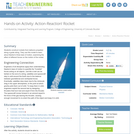
Students construct rockets from balloons propelled along a guide string. They use this model to learn about Newton's three laws of motion, examining the effect of different forces on the motion of the rocket.
Students prepare for the associated activity in which they investigate acceleration by …
Students prepare for the associated activity in which they investigate acceleration by collecting acceleration vs. time data using the accelerometer of a sliding Android device. Based on the experimental set-up for the activity, students form hypotheses about the acceleration of the device. Students will investigate how the force on the device changes according to Newton's Second Law. Different types of acceleration, including average, instantaneous and constant acceleration, are introduced. Acceleration and force is described mathematically and in terms of processes and applications.
In the first of two sequential lessons, students create mobile apps that …
In the first of two sequential lessons, students create mobile apps that collect data from an Android device's accelerometer and then store that data to a database. This lesson provides practice with MIT's App Inventor software and culminates with students writing their own apps for measuring acceleration. In the second lesson, students are given an app for an Android device, which measures acceleration. They investigate acceleration by collecting acceleration vs. time data using the accelerometer of a sliding Android device. Then they use the data to create velocity vs. time graphs and approximate the maximum velocity of the device.
Students investigate the motion of a simple pendulum through direct observation and …
Students investigate the motion of a simple pendulum through direct observation and data collection using Android® devices. First, student groups create pendulums that hang from the classroom ceiling, using Android smartphones or tablets as the bobs, taking advantage of their built-in accelerometers. With the Android devices loaded with the (provided) AccelDataCapture app, groups explore the periodic motion of the pendulums, changing variables (amplitude, mass, length) to see what happens, by visual observation and via the app-generated graphs. Then teams conduct formal experiments to alter one variable while keeping all other parameters constant, performing numerous trials, identifying independent/dependent variables, collecting data and using the simple pendulum equation. Through these experiments, students investigate how pendulums move and the changing forces they experience, better understanding the relationship between a pendulum's motion and its amplitude, length and mass. They analyze the data, either on paper or by importing into a spreadsheet application. As an extension, students may also develop their own algorithms in a provided App Inventor framework in order to automatically note the time of each period.
How do we find out whether the forces acting on an object …
How do we find out whether the forces acting on an object are balanced or unbalanced? Learn in this video from the "Forces and Motion" chapter of the Virtual School GCSE / K12 Physics.
Are you a passionate teacher who would like to reach tens of thousands of learners? Get in touch: vsteam@fusion-universal.com Find out more: http://www.thevirtualschool.com Follow us: http://www.youtube.com/virtualschooluk Friend us: http://www.facebook.com/virtualschooluk
Teach the world.
This video is distributed under a Creative Commons License: Attribution-NonCommercial-NoDerivs CC BY-NC-ND
Demonstrate the Bernoulli Principle using simple materials on a small or large …
Demonstrate the Bernoulli Principle using simple materials on a small or large scale. This resource includes two activities that allow learners to experience the Bernoulli Principle, in which an object is suspended in air by blowing down on it. Use this activity to explain how atomizers work and why windows are sometimes sucked out of their frames as two trains rush past each other.
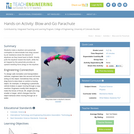
Students make a skydiver and parachute contraption to demonstrate how drag caused …
Students make a skydiver and parachute contraption to demonstrate how drag caused by air resistance slows the descent of skydivers as they travel back to Earth. Gravity pulls the skydiver toward the Earth, while the air trapped by the parachute provides an upward resisting force (drag) on the skydiver.
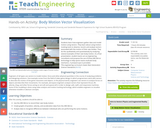
Students learn how engineers gather data and model motion using vectors. They …
Students learn how engineers gather data and model motion using vectors. They learn about using motion-tracking tools to observe, record, and analyze vectors associated with the motion of their own bodies. They do this qualitatively and quantitatively by analyzing several examples of their own body motion. As a final presentation, student teams act as engineering consultants and propose the use of (free) ARK Mirror technology to help sports teams evaluate body mechanics. A pre/post quiz is provided.
Students design and build devices to protect and accurately deliver dropped eggs. …
Students design and build devices to protect and accurately deliver dropped eggs. The devices and their contents represent care packages that must be safely delivered to people in a disaster area with no road access. Similar to engineering design teams, students design their devices using a number of requirements and constraints such as limited supplies and time. The activity emphasizes the change from potential energy to kinetic energy of the devices and their contents and the energy transfer that occurs on impact. Students enjoy this competitive challenge as they attain a deeper understanding of mechanical energy concepts.
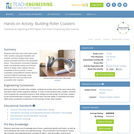
Bridges come in a wide variety of sizes, shapes, and lengths and …
Bridges come in a wide variety of sizes, shapes, and lengths and are found all over the world. It is important that bridges are strong so they are safe to cross. Design and build a your own model bridge. Test your bridge for strength using a force sensor that measures how hard you pull on your bridge. By observing a graph of the force, determine the amount of force needed to make your bridge collapse.
Students build their own small-scale model roller coasters using pipe insulation and …
Students build their own small-scale model roller coasters using pipe insulation and marbles, and then analyze them using physics principles learned in the associated lesson. They examine conversions between kinetic and potential energy and frictional effects to design roller coasters that are completely driven by gravity. A class competition using different marbles types to represent different passenger loads determines the most innovative and successful roller coasters.
A bungee jump involves jumping from a tall structure while connected to …
A bungee jump involves jumping from a tall structure while connected to a large elastic cord. Design a bungee jump that is "safe" for a hard-boiled egg. Create a safety egg harness and connect it to a rubber band, which is your the "bungee cord." Finally, attach your bungee cord to a force sensor to measures the forces that push or pull your egg.
A zip line is a way to glide from one point to another while hanging from a cable. Design and create a zip line that is safe for a hard-boiled egg. After designing a safety egg harness, connect the harness to fishing line or wire connected between two chairs of different heights using a paper clip. Learn to improve your zip line based on data. Attach a motion sensor at the bottom of your zip line and display a graph to show how smooth a ride your egg had!
Students apply their knowledge of linear regression and design to solve a …
Students apply their knowledge of linear regression and design to solve a real-world challenge to create a better packing solution for shipping cell phones. They use different materials, such as cardboard, fabric, plastic, and rubber bands to create new “composite material” packaging containers. Teams each create four prototypes made of the same materials and constructed in the same way, with the only difference being their weights, so each one is fabricated with a different amount of material. They test the three heavier prototype packages by dropping them from different heights to see how well they protect a piece of glass inside (similar in size to iPhone 6). Then students use linear regression to predict from what height they can drop the fourth/final prototype of known mass without the “phone” breaking. Success is not breaking the glass but not underestimating the height by too much either, which means using math to accurately predict the optimum drop height.
No restrictions on your remixing, redistributing, or making derivative works. Give credit to the author, as required.
Your remixing, redistributing, or making derivatives works comes with some restrictions, including how it is shared.
Your redistributing comes with some restrictions. Do not remix or make derivative works.
Most restrictive license type. Prohibits most uses, sharing, and any changes.
Copyrighted materials, available under Fair Use and the TEACH Act for US-based educators, or other custom arrangements. Go to the resource provider to see their individual restrictions.